
The accepted wisdom that home advantage is a pillar of football betting is collapsing under the weight of data, not because of one single factor, but due to a systemic erosion of competitive asymmetries.
- The introduction of VAR has measurably neutralized the subconscious bias referees once showed towards home crowds.
- Standardization of pitches and professionalization of travel have created predictable, sterile environments that strip home teams of their unique “fortress” factors.
Recommendation: Analysts and bettors must shift from assuming a generic home advantage to identifying the specific, rare contexts where true, unmitigated atmospheric pressure still exists.
For decades, it has been an article of faith for football fans, analysts, and especially bettors: the home team has a significant, bankable advantage. This belief is built on a foundation of seemingly obvious truths—the roar of the crowd, the subtle bias of a pressured referee, the comfort of familiar turf, and the fatigue of the travelling opposition. This assumption has shaped betting lines and pundit predictions since the sport’s inception. Yet, a closer look at long-term data reveals an undeniable and accelerating trend: the fortress is crumbling. Home advantage is not what it used to be.
The common explanations often point to a single culprit, most frequently the Video Assistant Referee (VAR). Others cite more professional travel arrangements or the homogenization of tactics. While these elements play a role, they are merely symptoms of a much deeper phenomenon. The true story of the decline is one of a systemic erosion of asymmetries. Modern football, in its relentless pursuit of fairness, consistency, and commercial appeal, has systematically standardized the very imperfections and variables that once gave the home side its edge.
This analysis will move beyond surface-level observations to dissect the interconnected factors neutralizing this once-critical variable. We will explore how technology has sanitized officiating, how uniform regulations have turned unique grounds into predictable environments, and how the psychological dynamics of crowd pressure are more complex than the simple “12th man” narrative suggests. The goal is not just to state that home advantage is declining, but to provide a data-driven framework for understanding why, enabling bettors and analysts to adapt their models to a new reality.
To understand this shift, this article breaks down the core components that have contributed to the decline of host dominance. We will examine the data behind each factor, from officiating technology to the psychology of stadium atmosphere, to build a complete picture for the modern football analyst.
Summary: The Key Factors Neutralizing Football’s Home-Field Edge
- Why VAR Has Reduced the Influence of the Home Crowd on Decisions?
- How Uniform Pitch Regulations Have Removed the “Fortress” Factor?
- Intimidation or Jet Lag: Which Factor Actually Impacts the Away Team?
- The Psychological Error of Assuming Three Points at Home
- How Conceding in the First 10 Minutes Turns the Home Crowd Toxic?
- How to Measure Crowd Noise to Quantify the “12th Man” Effect?
- How the “VAR Delay” Impacts the Psychological Momentum of a Goal?
- What Makes the Copa Libertadores Atmosphere More Intense Than European Tournaments?
Why VAR Has Reduced the Influence of the Home Crowd on Decisions?
The most cited agent in the decline of home advantage is the Video Assistant Referee (VAR), and for good reason. However, its impact goes deeper than simply correcting clear and obvious errors. VAR’s primary function in this context is the neutralization of subconscious referee bias. For over a century, referees were subjected to immense, real-time atmospheric pressure from tens of thousands of home supporters. This environment created a well-documented, albeit often unintentional, bias in marginal decisions—50/50 tackles, penalty shouts, and added time. The roar of the home crowd served as a powerful, persuasive force.
VAR removes the immediacy of this pressure. A decision is no longer just made in the heat of the moment, influenced by the deafening appeal of the home end. It is reviewed in a sterile, remote room, insulated from the stadium’s emotional climate. The official can re-watch an incident from multiple angles in slow motion, transforming a decision from an emotional reaction into a clinical analysis. This procedural shift systematically strips the home crowd of one of its most potent, unwritten weapons. The data supports this shift away from home-favored outcomes.
Crucially, this technological intervention directly addresses one of the core historical asymmetries. While both teams played on the same pitch, only one had the crowd’s influence working in its favor on officials. According to recent findings, this has had a tangible effect on scoring patterns. A compelling piece of research published in 2025 demonstrates that VAR significantly boosts the number of goals scored by away teams, while not negatively affecting the home team’s ability to score. This suggests VAR isn’t penalizing home teams, but rather leveling the playing field by removing a pre-existing bias that hindered visitors.
How Uniform Pitch Regulations Have Removed the “Fortress” Factor?
Long before VAR, a home team’s “fortress” was built on more than just fans; it was built on turf. Historically, clubs could manipulate their pitch dimensions to suit their playing style. A team built on fast wingers might opt for a wider pitch, while a team focused on a compact, defensive game could play on a narrower surface. Visiting teams were forced to adapt to unfamiliar dimensions, often within a single training session. This created a distinct tactical asymmetry, a unique home-field variable that could disrupt an opponent’s rhythm and game plan. This era of bespoke pitches is largely over.
Governing bodies like FIFA and UEFA have pushed for rigorous standardization. The drive for broadcast-quality surfaces and consistent playing conditions for major tournaments has led to the widespread adoption of specific dimensions. Today, 105 x 68 meters has become the de facto standard for most top-tier professional clubs, creating predictable environments across an entire league or continent. Pitches are now almost universally pristine, often reinforced with hybrid turf technology, removing the bobbles, bad patches, and peculiar cambers that once made a ground unique and treacherous for visitors.
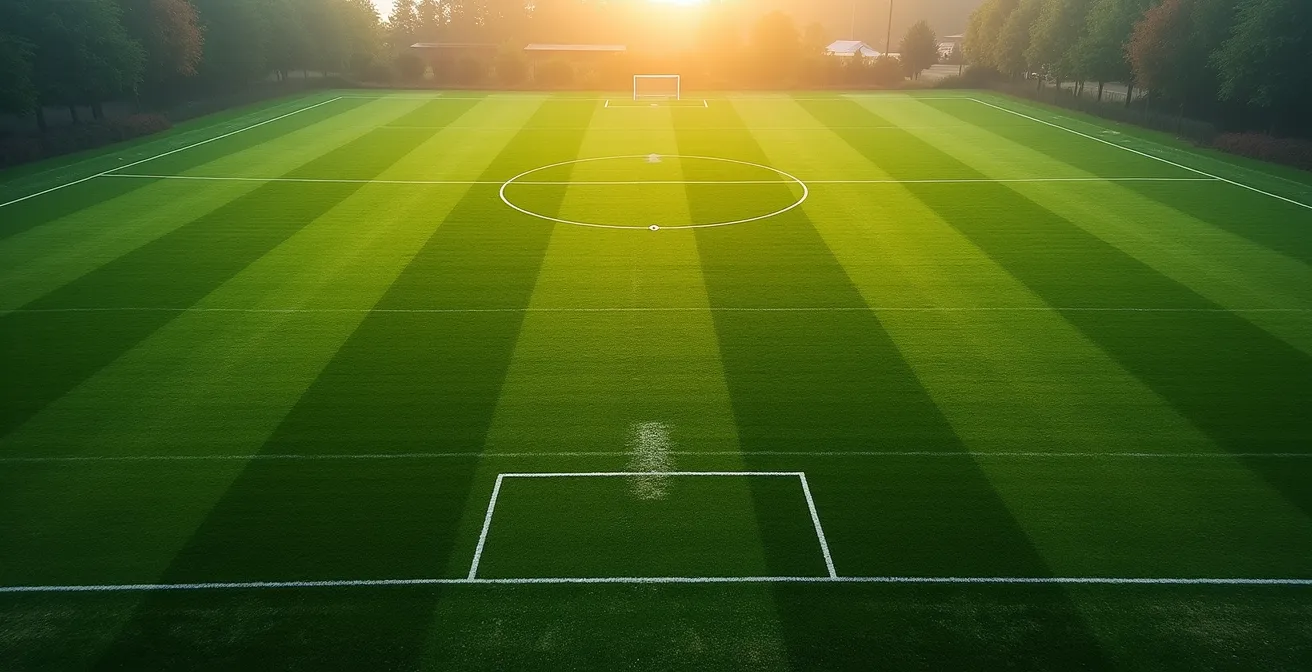
This standardization has created a homogenized playing experience. An away team arriving at a modern stadium knows almost exactly what to expect from the playing surface. The tactical puzzle of adapting to a quirky pitch has been solved before they even arrive. While minor variations still exist, they are exceptions rather than the rule, and the significant tactical advantage they once conferred has been almost completely eroded, contributing to the flattening of home advantage.
The table below highlights how, despite the trend toward uniformity, some notable outliers remain, reminding analysts that stadium-specific factors can still play a minor role.
| Stadium | Dimensions (meters) | Tactical Impact |
|---|---|---|
| Wembley Stadium | 105 x 68 | FIFA standard – balanced play |
| NYCFC Yankee Stadium | 100.5 x 64 | Minimum allowed – favors compact defending |
| Most Premier League | 105 x 67-70 | Slight width variations for tactical preferences |
Intimidation or Jet Lag: Which Factor Actually Impacts the Away Team?
Disentangling the “away team disadvantage” has always been a challenge for analysts. Is a team’s poor performance due to the intimidating atmosphere of the home crowd, or is it simply the physical toll of travel? For years, the two were intertwined and difficult to measure independently. The COVID-19 pandemic, however, provided a unique and powerful natural experiment. When matches were played in empty stadiums, the “crowd intimidation” factor was completely removed, leaving only the effects of travel.
The results were telling. Extensive pandemic research from 4,356 European matches revealed a 7% increase in away team wins during these “ghost games.” This strongly suggests that the home crowd is indeed a significant component of home advantage. Removing the fans directly translated into better results for visiting teams. The data shows that the atmospheric pressure, the subconscious influence on players and officials, and the psychological boost for the home side are not just anecdotal; they are a measurable force. When that force is absent, the competitive balance shifts demonstrably.
However, this does not mean travel is an irrelevant factor. Even with the crowd effect isolated, away teams still won less than 50% of the time, indicating that other disadvantages persist. As the Discover Magazine Research Team notes, “Travel factors such as the physical effects of flying and time zone changes were found to be contributors to the home field advantage”. The modern era has mitigated this with charter flights, dedicated nutritionists, and sports science, but the fundamental disruption of routine and the physical strain of travel—especially across time zones—remains a persistent, albeit smaller, asymmetry. The evidence suggests that while crowd intimidation is the larger slice of the pie, travel fatigue is still a real and quantifiable handicap for the visiting side.
The Psychological Error of Assuming Three Points at Home
For bettors and analysts, one of the most significant factors in the modern game is not on the pitch, but in the mind. The very concept of “home advantage” has become a powerful cognitive bias. Because home wins have been historically common, we tend to overweight their probability in the present, a classic example of the availability heuristic. We expect the home team to win because, for a century, they usually did. This ingrained expectation can cloud objective analysis of current, data-driven realities.
The statistical decline is not a recent blip; it is a profound, long-term trend. The raw numbers are stark and undeniable. An analysis of English top-flight football shows that historical data reveals a dramatic decline in home win percentage, falling from a dominant 64.6% in the 1895-98 period to just 41% in 2015-16. This is not a minor fluctuation; it’s a fundamental shift in the competitive landscape of the sport. Before the recent acceleration caused by VAR, the advantage had already been eroding for decades due to the factors of professionalism, travel, and pitch standardization.
The danger for an analyst is to continue operating on an outdated premise. Assuming a home win is the most likely outcome is now a statistical error in many top European leagues, where the combined probability of a draw or an away win is often greater than 50%. The market, influenced by public betting patterns, can sometimes be slow to adjust to this new reality, creating potential value for the skeptical analyst who trusts the data over the myth. The psychological weight of a “home banker” is a relic of a bygone era, and clinging to it means ignoring a century of statistical evolution.
How Conceding in the First 10 Minutes Turns the Home Crowd Toxic?
The “12th man” is often portrayed as an unwavering source of support, but this is a romanticized oversimplification. A home crowd is a volatile entity, and its psychological impact can flip from a powerful asset to a crushing liability in an instant. The most common trigger for this reversal is an early away goal. When the home team concedes in the opening minutes, the atmosphere of optimistic support can rapidly curdle into one of anxiety, frustration, and audible discontent.
This phenomenon is known as the “toxic crowd” effect. Instead of lifting their team, the groans, whistles, and jeers create a high-pressure environment of negative reinforcement. Every misplaced pass is met with a sigh, every defensive error with outrage. Players, feeling the weight of expectation from their own fans, can become hesitant and risk-averse. The psychological burden of needing to “win back” the crowd is added to the tactical challenge of getting back into the game. For the visiting team, this is an ideal scenario: the opponent is not only a goal down but is also fighting a psychological battle on a second front against its own supporters.

This pressure doesn’t just affect players; it can also have a paradoxical effect on officiating. While a supportive crowd can bias a referee in favor of the home team, a hostile one can create an uncomfortable, adversarial environment. As noted in the Psychology of Sport and Exercise Journal, “Referees gave significantly more fouls and yellow cards against away sides, but team dominance diluted this effect”. When the home team is not dominant and the crowd is restless, this subconscious favor can evaporate as the official contends with a generally negative atmosphere. The “12th man” can quickly become an anchor, dragging the home team down.
How to Measure Crowd Noise to Quantify the “12th Man” Effect?
For a data-driven analyst, the concept of the “12th Man” is too vague. To move from anecdote to actionable insight, one must quantify its effect. Measuring crowd influence is a complex task, but it’s not impossible. It involves correlating acoustic data with in-game events to determine if and when atmospheric pressure translates into a tangible on-field advantage. The goal is to isolate moments where crowd noise peaks and observe the immediate impact on player performance and, crucially, referee decisions.
This is not a purely academic exercise. Advanced sports analytics firms and research groups already use sophisticated methods to model this effect. For example, a key finding from an analysis of 5,244 Premier League matches found that while a home-bias exists, individual referees vary significantly in home bias susceptibility. This implies that the “12th Man” effect is not universal; its impact depends on the specific psychology of the official in charge. Quantifying crowd noise in relation to a specific referee’s historical decisions can therefore provide a significant analytical edge.
So, how can an analyst or organization begin to measure this? It requires a multi-faceted approach that goes beyond simply placing a decibel meter in a stadium. A systematic process is needed to collect the right data and, more importantly, ask the right questions of it. The following checklist outlines a practical framework for turning abstract crowd noise into quantifiable data points for predictive modeling.
Action Plan: Quantifying the ’12th Man’ Effect
- Track Decibel Levels: Install and monitor stadium sound meters to record decibel levels, especially at key moments like penalty appeals, fouls, and goals.
- Correlate Acoustic Spikes: Align acoustic data with the match timeline, correlating significant noise spikes with referee decisions made within a 30-second window.
- Analyze Frequency Patterns: Use spectral analysis to differentiate between the low-frequency roar of supportive chants and the high-frequency whistles of a hostile crowd.
- Cross-Reference with In-Game Data: Compare crowd density and noise data with the distribution of fouls and yellow cards for both home and away teams.
- Compare Across Attendance Levels: Analyze home advantage metrics (like xG difference or goals scored) in matches with varying attendance figures (e.g., full vs. half-full stadiums) to isolate the impact of crowd density.
How the “VAR Delay” Impacts the Psychological Momentum of a Goal?
A goal is the ultimate explosion of psychological momentum in football. It triggers an immediate release of elation for the scoring team and deflation for the conceding team. This emotional swing often translates into a tangible period of on-field dominance. The “VAR delay,” however, fundamentally disrupts this process. The spontaneous celebration is put on hold, replaced by a period of anxious waiting that can last several minutes. This interruption acts as a psychological “cooling off” period, potentially neutralizing the momentum shift a goal would normally create.
During a VAR check, both teams are reset. The scoring team’s adrenaline rush subsides, and the conceding team is given a crucial window to regroup mentally and tactically. The manager can issue new instructions, and players can catch their breath. If the goal is eventually confirmed, the celebration is often more one of relief than pure, unadulterated joy. If it’s disallowed, the emotional pendulum swings violently back, giving the defending team a massive psychological boost. The data does show VAR changes player behavior, with Turkish Super League data from 1,838 matches showing that fouls decreased by 56% for home teams and 69% for away teams post-VAR, indicating a more cautious style of play overall.
However, as a skeptical analyst, it’s crucial to question how much this “momentum break” actually impacts the final result. While the psychological experience is undeniably altered, the statistical evidence on its effect on home advantage is mixed. In a comprehensive study, Abbate, Cross et al. concluded that “VAR had negligible effects on home field advantage and various crucial match statistics despite decreased total offsides and yellow cards”. This suggests that while the VAR delay feels significant and alters the flow of the game, its ultimate impact on whether the home team wins or loses may be overstated. The disruption of momentum is real, but its translation into a tangible disadvantage for the home side remains statistically debatable.
Key Takeaways
- The decline in home advantage is not caused by a single factor, but by a systemic erosion of historical asymmetries in officiating, pitch conditions, and travel.
- VAR’s primary impact is neutralizing the subconscious bias of referees, leveling a playing field that was historically tilted towards the home team’s crowd pressure.
- Standardization of pitches has created predictable, uniform environments, removing the unique tactical challenges that once defined a “fortress” stadium.
What Makes the Copa Libertadores Atmosphere More Intense Than European Tournaments?
While home advantage is in a measurable decline across Europe’s top leagues, it remains a potent and often decisive factor in other parts of the footballing world. Nowhere is this more evident than in South America’s premier club competition, the Copa Libertadores. The atmosphere in these matches serves as a powerful case study in what European football has lost: a raw, unmitigated, and often chaotic home-field edge driven by a different culture of support.
The intensity of a Libertadores match is a form of sensory assault that has been largely sanitized out of the modern European game. As a Copa Libertadores atmosphere analysis reveals, the environment is defined by elements that would be unthinkable in the Premier League or Champions League: a constant barrage of noise from drums and trumpets, coordinated bouncing that makes stadiums physically shake, and the widespread use of flares, pyrotechnics, and smoke bombs that create a visually intimidating and chaotic setting. This is not the managed, corporate-friendly support of Europe; it is a relentless, passionate, and overtly hostile environment for any visiting team.

This environment re-establishes the asymmetries that Europe has engineered away. Travel is more arduous, with vast distances and challenging logistics. The officiating, while improving, is still more susceptible to the overwhelming local pressure. The crowds are not just spectators; they are active participants in a psychological war. This contrast proves the central thesis: home advantage thrives on variables, imperfections, and intense, localized pressure. The Copa Libertadores is a living museum of the very factors that have been systematically scrubbed from the top tier of European football, showing what home advantage looks like when it is not diluted by standardization.
For bettors and analysts, the lesson is clear. The blanket assumption of home advantage is an outdated model. The path to a modern, data-driven strategy involves a more granular analysis: identifying the specific leagues, teams, and even referees where the old asymmetries persist. The value is no longer in backing the home team by default, but in pinpointing the rare environments where the fortress, against all odds, still stands.