
In summary:
- Effective transfer from futsal to soccer isn’t about specific ‘moves’ but mastering the underlying ‘grammar’ of movement and decision-making.
- Developing superior spatial awareness through constant scanning is more critical than complex footwork. Your eyes, not your feet, initiate a successful dribble.
- Training must evolve from sterile cone drills to ‘controlled chaos’ to bridge the gap between technical skill and in-game instinct.
- A perfect first touch is directional, using the right surface of the foot to instantly set up your next action, killing pressure before it starts.
For any winger or midfielder, the nightmare is the same: receiving the ball under pressure, surrounded by opponents, and feeling space evaporate. The common advice is to “look to futsal,” a game celebrated for producing technically gifted players who thrive in phone-booth-sized areas. This often leads to players endlessly practicing sole rolls and drag-backs, hoping to import a little bit of Brazilian magic onto the grass pitch. But this approach misses the point entirely.
The truth is, the world’s most creative players aren’t just running a playbook of futsal ‘tricks’. They have internalized something far deeper. They have mastered the very grammar of movement—the non-verbal language of feints, body shape, and spatial manipulation that the small-sided game hardwires into your brain. The secret isn’t in the moves themselves, but in the perceptual cues and split-second decisions that dictate *why* and *when* a move is executed.
This guide isn’t another list of futsal skills. Instead, we will deconstruct the core principles that make futsal a technical superpower. We will explore how to develop the instinctual decision-making, visual awareness, and movement sequencing that allow you to not just survive in tight spaces, but to dominate them. It’s time to stop copying the vocabulary and start learning the language.
To navigate this deep dive into the real mechanics of close control, this article is structured to build your understanding layer by layer. The following summary outlines the key concepts we will cover, from specific techniques to the cognitive skills that power them.
Summary: From Futsal Principles to 11-a-Side Dominance
- Why Drag-Backs Are More Effective Than Instep Turns in Crowded Boxes?
- How to Master the Iniesta Shuffle to Bypass Defenders in 1v1 Duels?
- Cone Drills or 1v1 Chaos: Which Develops Better Dribbling Instincts?
- The Visual Error That Turns a Good Dribble into a Turnover
- How to Chain Three Skill Moves Together to Unbalance an Elite Defender?
- How to Improve Distribution Accuracy When Under High Pressing?
- How to Perfect the First Touch to Set Up the Next Action Instantly?
- How to Improve Passing Accuracy in the Final Third Against Low Blocks?
Why Drag-Backs Are More Effective Than Instep Turns in Crowded Boxes?
In a packed penalty area, space is a currency and time is a luxury. The choice between a drag-back and an instep turn might seem like a minor stylistic preference, but it reveals a fundamental misunderstanding of spatial dynamics. An instep turn requires a full body rotation, a large movement that telegraphs your intention and momentarily takes your eyes off your surroundings. It’s a move for open space. The drag-back, by contrast, is a masterpiece of efficiency born from futsal. It’s a minimalist action with maximal impact.
Its effectiveness lies in manipulating the defender’s momentum. By using the sole of your foot to pull the ball back, you keep your body between the opponent and the ball, creating a natural shield. More importantly, this subtle action forces the onrushing defender to decelerate and change direction, creating a half-second of imbalance. That half-second is the window you exploit. The decision is not about the technique itself, but about the context. Futsal teaches that in high-density areas, the best move isn’t the most spectacular, but the one that most efficiently disrupts the opponent’s balance. Indeed, research confirms that dribbling decisions in futsal are heavily influenced by interpersonal distance, which dictates success. The drag-back is the ultimate tool for controlling that distance.
How to Master the Iniesta Shuffle to Bypass Defenders in 1v1 Duels?
Andrés Iniesta’s signature move, “La Croqueta,” is often seen as a moment of pure genius, but like all elite techniques, it’s built on a foundation of repeatable biomechanics and sharp perceptual triggers. It’s not magic; it’s a specific solution to a common problem: a defender squared up and waiting for you to commit. The shuffle works by presenting a false target. You appear to be moving the ball one way with the inside of your foot, only to deftly transfer it to your other foot in one fluid motion, bypassing the defender’s static posture.
The key to mastering it lies in a progressive training protocol that builds from mechanics to game-like application. First, you must automate the movement itself until it’s second nature. Then, you focus on the trigger: the defender’s body language. The shuffle is most effective when a defender is flat-footed or has their hips slightly open to one side. Your move exploits that commitment. As you can see in the technique breakdown below, the critical moment is the transfer, where the ball travels the shortest possible distance between your feet.

To truly integrate this skill, you must practice it within a larger sequence. A simple but effective progression is:
- Phase 1: Motor Pattern Automation. Practice the shuffle statically, then through cones in a zigzag pattern to master the fluid transfer of the ball between feet.
- Phase 2: Reading the Defender. In a 1v1 drill, focus solely on the defender’s posture. If their hips are open, execute the shuffle into the space they’ve given you. If they are square, use a different move.
- Phase 3: Game Sequence Integration. Practice a three-part chain: receive the ball, execute the shuffle to beat a passive defender, and immediately follow with a one-touch pass or shot on goal. This links the move to a productive outcome.
Cone Drills or 1v1 Chaos: Which Develops Better Dribbling Instincts?
The traditional training ground is dominated by cone drills. Weave in, weave out, perform a move at the last cone, and repeat. While these drills are essential for mastering the pure motor skills of a technique—the “action”—they fail to develop the most crucial element of elite dribbling: perception. A player can have perfect technique around cones but freeze in a game because cones don’t move, they don’t react, and they don’t try to tackle you. This is where futsal’s training philosophy offers a superior model: controlled chaos.
Game-like instinct, or “perception-action coupling,” is forged only when a player must constantly perceive, decide, and act in response to a live, unpredictable opponent. Unstructured 1v1s or small-sided games create this chaos, but can be overwhelming for a player still learning a new skill. The optimal approach is a hybrid model that progressively introduces pressure and unpredictability. You start with the sterile cone drill to build the muscle memory, then move to a 1v1 with a passive defender, and finally progress to a fully competitive scenario.
This structured progression bridges the gap between clean technique and messy, effective game application. As this comparative analysis from Futsal Guide shows, each training method has a distinct purpose, and the key is to blend them intelligently.
| Training Method | Primary Focus | Best For | Limitations |
|---|---|---|---|
| Cone Drills | Motor skill automation | Technique refinement in stress-free environment | Only trains ‘action’, not perception |
| 1v1 Chaos | Perception-action coupling | Decision-making under pressure | Can overwhelm beginners |
| Hybrid (Controlled Chaos) | Progressive skill transfer | Bridging technique to game application | Requires careful progression planning |
The Visual Error That Turns a Good Dribble into a Turnover
The single most common mistake that separates amateur dribblers from elite technicians has nothing to do with their feet. It’s a visual error: they are staring at the ball. When your focus is locked on the ball, you are effectively playing blind. You cannot see the defender’s movements, the positioning of your teammates, or the pockets of space opening and closing around you. A great dribble is orchestrated not by footwork, but by information gathered through constant, active scanning of the environment.
Futsal, with its relentless pressure and tight confines, forces players to develop superior peripheral vision and rapid scanning habits. Players learn to get their “head on a swivel,” taking mental snapshots of the pitch in the split-second before and during receiving the ball. This is a concept reinforced by the FIFA Training Centre, which states that scanning before receiving the ball is crucial for decision-making. As they put it:
Scanning before receiving the ball helps players to understand how much time they will have on the ball and in which direction they can move.
– FIFA Training Centre, Control Under Pressure – Futsal Training Guide
This practice of looking away from the ball while maintaining control is what allows a player to seem like they have all the time in the world. They aren’t reacting to pressure; they are anticipating it. They know their escape route before the defender even commits.
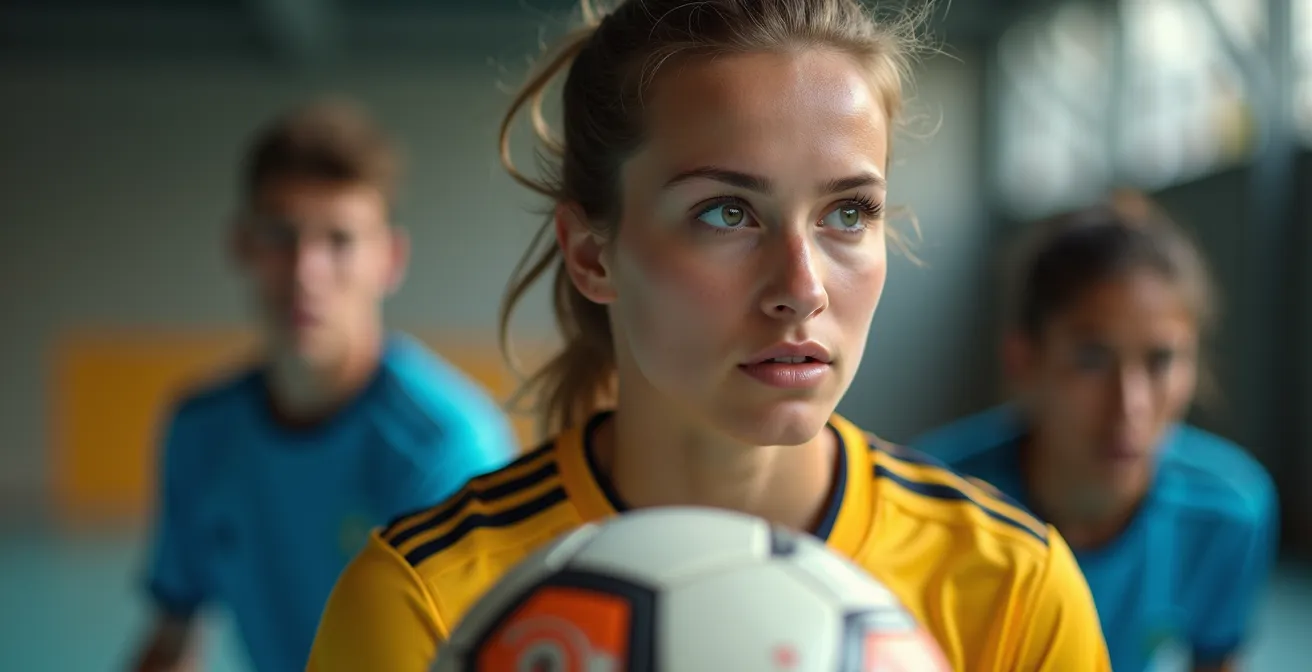
Training this skill involves consciously forcing yourself to look up. Practice dribbling while calling out the colors of cones placed around you, or the numbers on teammates’ bibs. At first, you will lose the ball constantly. But over time, your brain will adapt, building a stronger connection between what your eyes see and what your feet feel, a process that is critical for maintaining postural control and balance when vision is directed elsewhere.
How to Chain Three Skill Moves Together to Unbalance an Elite Defender?
Watching an elite dribbler is like listening to a fluent speaker. Their movements aren’t a series of isolated ‘words’ (moves) but are strung together into coherent ‘sentences’ that tell a story and manipulate the defender. This is the “grammar of dribbling.” A single step-over is easy to defend. But a slow drag-in, followed by an explosive step-over, capped with a hesitation and acceleration? That’s a sentence that can unbalance even the best defenders. Futsal excels at teaching this grammar because the tight spaces force players to link moves together to create space where none exists.
A successful sequence isn’t random; it follows a logical structure: the Setup, the Exploitation, and the Exit. This framework transforms a collection of tricks into a strategic weapon. You’re no longer just ‘doing a move’; you’re executing a three-part plan to create and then attack space.
- Move 1 (The Setup): This is a subtle, probing action designed to force a reaction. A slow sole drag or a slight body feint baits the defender into committing their weight.
- Move 2 (The Exploitation): This is your primary move, executed explosively at the moment the defender is off-balance. A step-over, a Croqueta, or a body swerve capitalizes on their reaction to the setup.
- Move 3 (The Exit): This is a simple acceleration or change of pace into the space you’ve just created. The biggest mistake players make is admiring their work after Move 2; the exit is what makes the sequence count.
Action Plan: Auditing Your Dribbling Grammar
- Points of Contact: List every 1v1 scenario in your game where you currently lose the ball or feel hesitant (e.g., receiving on the sideline, facing a defender in the box).
- Collecte: Inventory your current “go-to” moves. Are they isolated tricks (a step-over) or part of a sequence? Be honest about what you use instinctively.
- Cohérence: Confront your moves with the “Setup, Exploit, Exit” grammar. Does your first move actually provoke a reaction? Does your second move capitalize on it? Do you have a clear exit?
- Mémorabilité/Émotion: Review footage of your game. Identify moments where you used a generic, predictable move versus one that was creative and effective. What was the difference in the defender’s reaction?
- Plan d’intégration: Pick one scenario from your list and design a three-move sequence for it. Dedicate a training session to practicing this specific “sentence” in a controlled chaos drill.
How to Improve Distribution Accuracy When Under High Pressing?
High-pressing systems are designed to create panic. They shrink the pitch, cut off passing lanes, and force rushed, inaccurate passes. Futsal provides the ultimate blueprint for breaking a press because its entire existence is based on playing through pressure. The key isn’t a single technique but a pre-emptive cognitive process: creating a mental map of your options before you even receive the ball. By the time the ball arrives at your feet, you shouldn’t be deciding what to do; you should be executing one of several pre-planned options.
This “pre-reception mental mapping” is a rapid, four-part thought process that happens in the two seconds the ball is traveling toward you:
- Perform a 180-degree scan: Check over both shoulders to identify the location of opponents and teammates.
- Identify Plan A: Your primary, safest passing option. This is often a simple pass to a nearby teammate’s feet.
- Identify Plan B: An alternative, more aggressive pass. This might be a driven pass that breaks one of the pressing lines.
- Identify Escape Route C: Your emergency exit if Plans A and B are cut off. This could be a dribble into space, a pass back to the goalkeeper, or a chipped pass over the press.
The final decision is executed at the last possible moment, based on the presser’s final movement. This forces them to commit first, allowing you to exploit their momentum. Futsal teams drill these patterns relentlessly, often using a pivot player to act as a release valve against two-man presses, as detailed in the FIFA futsal coaching manual. This systematic approach turns a chaotic situation into a predictable problem with clear solutions.
Key Takeaways
- True technical transfer from futsal is about mastering decision-making grammar, not just individual moves.
- Your eyes are your most important tool; what you see before you receive the ball dictates the success of your action.
- Effective training must bridge sterile drills and game-day pressure through “controlled chaos” to build real instinct.
How to Perfect the First Touch to Set Up the Next Action Instantly?
The first touch is the most important skill in soccer. It’s the foundation upon which every subsequent action is built. A poor first touch invites pressure, kills momentum, and shrinks your options. A perfect first touch, however, is a weapon. It’s not just about stopping the ball; it’s about using the reception to move the ball into a more advantageous position, instantly setting up your next pass, dribble, or shot. This concept of a directional or “orientated” first touch is a cornerstone of futsal.
As the FIFA Training Centre explains, the goal is clear: “By taking an orientated first touch, players can move or pass in the direction they wish to go.” This simple idea is transformative. Instead of a two-step process (stop, then move), it becomes one fluid action (receive-and-move). The choice of which surface of the foot to use is a strategic decision based entirely on your intended next action, a decision that must be made before the ball arrives.
The selection of the foot surface is a crucial part of this decision-making process, as each offers a unique advantage. This guide breaks down the choice based on your intent.
| Surface Used | Intended Next Action | Advantage |
|---|---|---|
| Sole of foot | Close control in tight space | Maximum ball control, shield from defender |
| Inside foot | Accurate short pass | Precision and predictability |
| Outside foot | Quick change of direction | Deception and speed |
| Back foot (with turn) | Face opponent’s goal | Instant attacking position |
Using the sole of the foot, a futsal hallmark, is perfect for killing the ball’s momentum and shielding it in extremely tight spaces. Using the outside of the foot, however, allows for a deceptive change of direction. Mastering each is essential to having a complete toolkit. The perfect first touch is a conscious choice, not a passive reaction.
How to Improve Passing Accuracy in the Final Third Against Low Blocks?
Facing a low block defense can feel like trying to pass a ball through a forest. The defense is compact, passing lanes are non-existent, and any forced pass results in a turnover and a potential counter-attack. To break down these stubborn defensive shells, you need more than just hope; you need the precision, speed, and disguise of a futsal-style pass. The “laser pass”—a hard, low, driven ball with minimal back-lift—is the tool for this job. It’s designed to travel through congested areas quickly and accurately, catching defenders before they can shift their feet.
Executing this pass requires specific technique. Unlike a standard push pass, the ankle must be locked with the toe pointed down, and contact is made through the center of the ball. The follow-through is low and directed at the target, ensuring the ball stays on the ground. But the technique is only half the battle. Its effectiveness comes from combining it with pre-agreed movements from teammates. In futsal, where space is at a premium, players don’t pass to where a teammate is; they pass to where they are going to be. This creates the illusion of “no-look” passes, but it’s really just a result of relentless drilling on movement patterns. Furthermore, one-touch or two-touch passing in small grids enhances decision-making speed, a methodology proven to sharpen a player’s ability to find targets under pressure.
The steps to executing the perfect laser pass are as follows:
- Position the ball slightly ahead of your standing foot for an optimal striking angle.
- Keep your ankle locked and toe pointed down to ensure a hard, low trajectory.
- Strike cleanly through the horizontal midline of the ball with the inside of your foot.
- Follow through low and directly towards your target to keep the ball from rising.
- Practice this technique with teammates who are making pre-planned runs into small pockets of space.
Ultimately, transforming your close control is a journey from mimicry to true understanding. Stop focusing on what moves to make and start focusing on why and when to make them. Take one principle from this guide—be it scanning, the orientated first touch, or thinking in three-move sequences—and make it the single focus of your next training session. That is how real, lasting improvement is built.