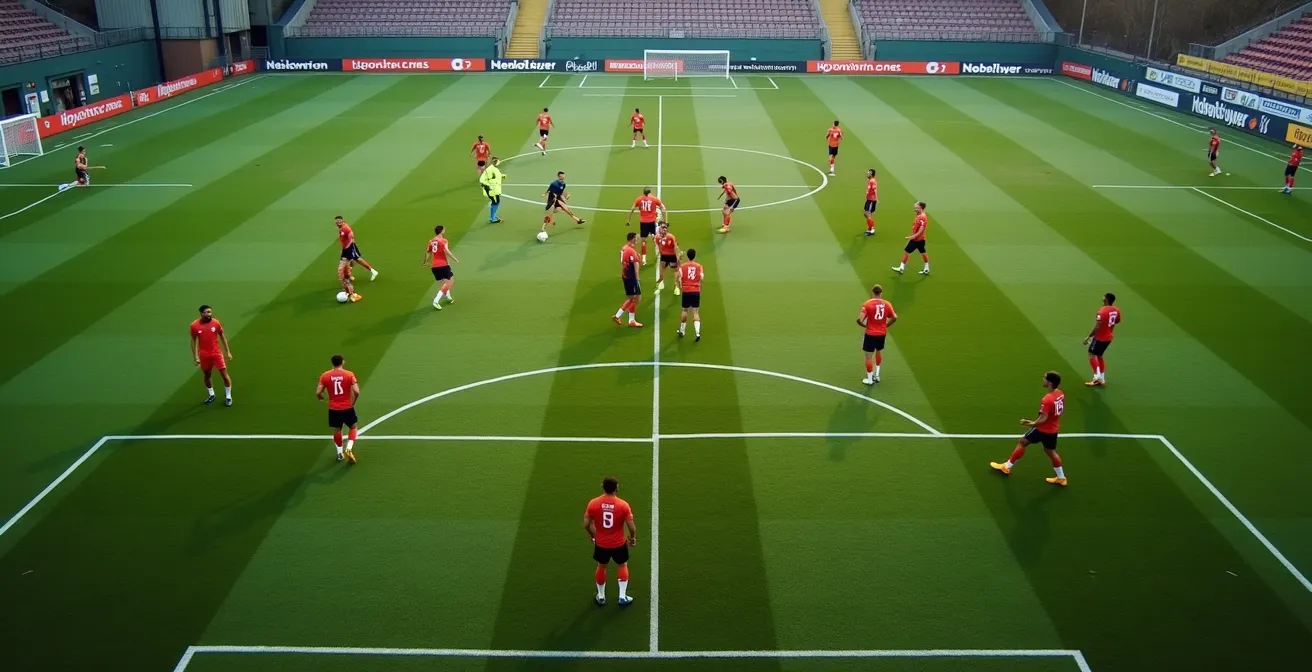
The key to breaking a 4-4-2 isn’t finding existing space—it’s actively manipulating the opponent’s defensive geometry to create it by design.
- Effective movement forces defenders into impossible choices, distorting their rigid shape.
- Operating in the half-space and receiving on the half-turn are the foundational skills for exploiting the structural weaknesses of a flat midfield four.
Recommendation: Shift your focus from simply occupying gaps to systematically pulling the defensive block apart through coordinated movements and intelligent positioning.
For any attacking midfielder or coach, the sight of a well-drilled 4-4-2 can be daunting. Its two flat, compact banks of four create a defensive wall that appears impenetrable, suffocating creativity and forcing play into predictable wide areas. The common advice is to “get between the lines” or “find pockets of space,” but this advice is passive. It assumes space is a pre-existing void waiting to be discovered. This approach often leads to players becoming isolated, hidden in an opponent’s cover shadow, or receiving the ball under immediate pressure with their back to goal.
The conventional wisdom tells you to scan, move, and hope a gap appears. But what if the true art of breaking down a 4-4-2 lies not in finding space, but in manufacturing it? The fundamental flaw of a rigid structure is its predictability. If you understand its geometry, you can learn to distort it. This guide reframes the challenge: instead of searching for pockets, you will learn to create them. It’s about applying specific pressures and movements that force defenders into decision-making dilemmas, pulling their disciplined shape apart thread by thread.
We will deconstruct the essential techniques and tactical concepts required to dismantle this formation. From the individual brilliance of the half-turn to the collective strategy of overloading half-spaces, you will gain a framework for turning the 4-4-2’s strength—its rigid structure—into its greatest weakness. This is not about luck; it’s about geometric design.
This tactical deep dive will equip you with a new lens to view the pitch, breaking down the principles of spatial manipulation into actionable steps. Explore the detailed sections below to master each component of this offensive strategy.
Summary: Unlocking the Geometry of the 4-4-2
- Why Receiving on the Half-Turn Is Key to Exploiting Small Pockets?
- How to Drag a Defensive Midfielder Out of Position to Create a Hole?
- Inside Channel or Overlap: Which Zone Maximizes Assist Potential?
- The Positioning Error of Hiding Behind the Cover Shadow of an Opponent
- When to Accelerate into the Box to Meet a Cross Unmarked?
- Why Operating in the Half-Space Confuses Opposition Markers?
- Why the “Free 8” Role Is the Hardest Position to Mark?
- How to Dismantle a 5-4-1 Low Block Without Getting Counter-Attacked?
Why Receiving on the Half-Turn Is Key to Exploiting Small Pockets?
Before any tactical system can function, the individual player must possess the technical tools to operate under pressure. In the tight confines between the lines, the half-turn is the master key. Receiving the ball flat, with your back to the opponent’s goal, is a tactical death sentence. It invites pressure, erases all forward passing options, and forces you to play backward, resetting the attack and wasting the valuable position you fought to gain. The half-turn transforms this defensive posture into an offensive launchpad.
By positioning your body at a 45-degree angle to the passer, you achieve three critical objectives simultaneously. First, you can see both the ball and a significant portion of the pitch in front of you. Second, you are prepared to take your first touch forward, into the newly created space, immediately putting defenders on their back foot. Third, it signals attacking intent, forcing the defense to react rather than act. Players who master this technique, like the legendary Andrés Iniesta and Luka Modrić, don’t just receive the ball; they use the act of reception itself as a weapon to transition their team from defense to attack in a single, fluid motion.
This body orientation allows a player to control the ball with their back foot, instantly creating separation from a nearby marker and opening up the entire field. It is the physical manifestation of thinking one step ahead—the foundational skill for any player who wishes to thrive in the most congested and valuable areas of the pitch.
Your Action Plan: The Half-Turn Execution Checklist
- Body Position: Approach the ball with an open body shape, not square-on, to see the passer, the goal, and defenders.
- Scanning: Check your shoulder before the pass arrives to map out the space you intend to attack and the location of the nearest opponent.
- Footwork: Aim to receive the ball with your back foot—the one furthest from the direction of the pass—to naturally turn and accelerate away from pressure.
- First Touch: Ensure your first touch is positive and directional, moving the ball into the space you want to exploit, not stopping it dead.
- Awareness: Understand that your receiving foot dictates your next move; a simple touch can eliminate a defender and advance your team’s buildup, as coaching analysis emphasizes is crucial for progression.
How to Drag a Defensive Midfielder Out of Position to Create a Hole?
A disciplined 4-4-2 relies on its central midfielders maintaining a compact shape to protect the most dangerous area of the pitch. Their primary instruction is to deny central penetration. Therefore, waiting for a gap to appear between them is often a futile exercise. The key is to force one of them to make a choice that compromises their team’s structure. This is where you begin to actively manipulate the defensive geometry.
The goal is to create a “decision-making dilemma” for a central midfielder. By making a sharp, diagonal movement away from the center—either into a wider area or dropping deep—you ask them a difficult question: “Do you follow me and abandon your central post, or do you let me receive the ball uncontested?” If they follow you, a vertical channel or “hole” opens up in the center for a teammate (like a striker dropping deep or another midfielder making a late run) to exploit. If they hold their position, you or a teammate can receive the ball in a less-pressured zone, with time to turn and face the play.
This tactic is especially effective because, as tactical analysis reveals, the gap between the two central midfielders in a 4-4-2 is naturally the narrowest as they prioritize protecting the direct path to goal. Any movement that forces them to widen that gap, even for a second, creates a window of opportunity. Coordinated movements, where one player’s run is purely a decoy to create space for another, are the hallmark of a sophisticated attacking unit. You are no longer just an attacker; you are a spatial architect.
Inside Channel or Overlap: Which Zone Maximizes Assist Potential?
Once you’ve successfully disrupted the midfield line, the next question is where to direct the attack for maximum impact. The two most potent zones to exploit are the “inside channel” (the space between a centre-back and a full-back) and the space created by an “overlap” (a run made by a wide player around the outside). The choice between these two is not random; it is a tactical decision based on the opposition’s defensive setup and your team’s positioning.
Attacking the inside channel is devastating against narrow defensive blocks. When defenders are compact, a sharp run into this channel can get you behind the defense with a direct line to goal or an easy cut-back opportunity. This requires precise timing and a pass that splits the defense. On the other hand, the overlap is most effective against a wider defensive line. When a winger or inside forward pins their full-back, it creates space for an overlapping full-back or wing-back to run into, creating a 2-v-1 situation on the flank and opening up crossing opportunities.
A third, more complex option is the “underlap,” where a player runs inside the teammate with the ball. This movement is particularly effective at creating confusion against rigid man-marking or zonal systems like the 4-4-2, as it disrupts the defenders’ assignment of who should track which runner. The optimal choice depends on a quick reading of the defensive geometry at that moment.
This table, based on principles outlined in analysis of modern attacking formations, breaks down the tactical advantages of each zone.
| Zone | Tactical Advantage | Best Scenario |
|---|---|---|
| Inside Channel | Inside forwards can run into channels between center-backs and full-backs to create gaps out wide. | Against narrow defensive blocks |
| Overlap | Wing-backs create space by getting behind full-backs, allowing inside forwards to exploit gaps. | Against wide defensive setups |
| Underlap | Creates confusion for defenders on marking assignments. | Against rigid 4-4-2 structures |
The Positioning Error of Hiding Behind the Cover Shadow of an Opponent
One of the most common and fatal mistakes an attacking player can make is to drift into an opponent’s “cover shadow.” This is the cone-shaped area behind a defender where they effectively block the passing lane from the ball carrier. While you might feel like you are in “space” because no one is marking you tightly, you have rendered yourself invisible and useless to your teammate on the ball. You have become a ghost in the machine, occupying a position without being a viable passing option.
To be effective between the lines, you must constantly adjust your position with small, sharp movements to stay out of these shadows. This is a game of angles. A slight step to the left or right can open up the passing lane and make you available again. It requires constant spatial awareness and a mental connection with the ball carrier. Hiding is passive; the goal is to be actively available. You must always present a clear line of sight for the pass.
Elite teams have turned escaping cover shadows into an art form. This requires not only individual intelligence but also collective understanding. Coordinated movements, where teammates make decoy runs to pull defenders and enlarge the passing lanes to the player between the lines, are crucial. As a case in point, consider the tactical patterns developed by Roberto De Zerbi at Brighton. His teams mastered the art of baiting the press and breaking lines through intricate passing sequences.
Brighton under Roberto De Zerbi became particularly effective at breaking lines when the Italian took charge in autumn 2022. Their pattern involved slow accurate build-up from deep to lure opposition players, before quick one-touch passing to play out of the press.

This image illustrates the concept: being in the light means being a viable option, while being in the shadow means being tactically irrelevant. Your objective is to always play in the light, forcing defenders to constantly readjust and creating instability in their structure.
When to Accelerate into the Box to Meet a Cross Unmarked?
Creating space between the lines is only part of the equation. The final, decisive action is often a run into the penalty area to convert an opportunity. The key to arriving unmarked is timing and deception. Making your run too early allows a defender to track you easily. The most effective runs are late, explosive, and originate from a defender’s blind spot.
As the play develops in a wide area and a cross becomes imminent, the attacker’s instinct is often to dash toward the goal. A more sophisticated approach is to delay your run. Hold your position at the edge of the box, slightly behind the defensive line. This “hiding in plain sight” makes defenders focus on the ball and the more immediate threats. As the crosser prepares to deliver the ball, you make a sudden, sharp acceleration into a pre-identified space—often the area between the two centre-backs or between the far-side centre-back and full-back.
Modern formations with three advanced midfielders are designed to facilitate these late runs, creating overloads and making it incredibly difficult for a traditional back four to defend. This was a hallmark of Antonio Conte’s 2016-17 title-winning Chelsea side. Their 3-4-2-1 system was built to create these exact scenarios. The wing-backs would provide the width, and if they couldn’t receive the ball, they would deliver crosses for a target man like Diego Costa, whose presence would occupy the centre-backs. This created the perfect conditions for inside forwards like Eden Hazard or Pedro to exploit the chaos with perfectly timed late runs into the box, arriving unmarked to devastating effect.
Why Operating in the Half-Space Confuses Opposition Markers?
If the area “between the lines” is the general target zone, the “half-space” is the surgical strike point. The pitch is conceptually divided into five vertical corridors: the two wide channels, the central channel, and two “half-spaces” in between. Operating in the half-space is the ultimate tool for creating defensive disorganization within a 4-4-2.
The reason is simple: it blurs lines of responsibility. When you occupy the half-space, you pose a question to both the opponent’s wide midfielder and their nearest centre-back. Is it the wide midfielder’s job to track you inside, leaving space on the flank? Or is it the centre-back’s job to step out, leaving a gap in the heart of the defense? This moment of hesitation is all an attacker needs. The half-space is a zone of tactical ambiguity, and ambiguity creates opportunities.

From this position, a player on the half-turn has a panoramic view of the pitch and multiple attacking options: a through-ball to a striker, a diagonal pass to the opposite flank, a combination with the full-back, or a shot on goal. It is the most threatening position on the field for a creative player. Elite teams, such as Erik ten Hag’s Ajax and Pep Guardiola’s Manchester City, have built their entire attacking philosophies around getting players to receive the ball in these zones. It is the key to unlocking their progression into the final third, as it systematically dismantles the opposition’s defensive shape by creating numerical and qualitative superiority in the most dangerous areas.
Why the “Free 8” Role Is the Hardest Position to Mark?
The “Free 8” is the ultimate expression of spatial intelligence, the embodiment of every principle discussed so far. Unlike a traditional central midfielder (CM) who operates in a defined zone or a Number 10 who primarily moves vertically, the Free 8 is a hybrid player with a license to roam. This role is designed specifically to be a ghost in the opponent’s system, a player who is impossible to assign a single marker to.
The Free 8 drifts fluidly between the half-spaces, drops deep to collect the ball, and makes late, penetrative runs into the box. They are a permanent problem for a rigid 4-4-2. The opposing central midfielders cannot track them without completely abandoning their team’s shape, and the defenders cannot step up to mark them without leaving gaps behind. The Free 8 thrives on this confusion, exploiting the momentary indecision of their opponents. This role requires immense tactical intelligence, technical security, and a relentless engine.
A prime example of this concept in action was seen in Pep Guardiola’s Manchester City during the 2020/21 season. With a double pivot of Rodri and İlkay Gündoğan, City often attacked without a traditional striker. This structure allowed Gündoğan to evolve into a Free 8, pushing forward from his deeper position to make devastating, untracked runs through the inside channels. His movement from deep was almost impossible for defenders to pick up, resulting in a career-best goal-scoring season and demonstrating the immense power of this elusive role.
The table below highlights the fundamental differences that make the Free 8 so difficult to contain.
| Role | Movement Pattern | Defensive Challenge |
|---|---|---|
| Free 8 | Operates between defensive and midfield lines with freedom to roam | Cannot be tracked by a single defender |
| Traditional CM | Fixed central positioning | Easier to mark with a zonal system |
| Number 10 | Primarily vertical movement | Can be contained by a defensive midfielder |
Key Takeaways
- The 4-4-2’s rigidity is its biggest weakness; manipulate its geometry instead of just looking for space.
- The half-turn is the essential individual skill, turning reception into an attacking move.
- Operating in the half-space creates decisional chaos for defenders, blurring their marking responsibilities.
How to Dismantle a 5-4-1 Low Block Without Getting Counter-Attacked?
The principles of breaking down a 4-4-2 can be adapted and intensified to tackle an even more compact challenge: the 5-4-1 low block. Here, the space between the lines is even more compressed, and the extra centre-back provides additional security. A brute-force approach is futile and leaves you dangerously exposed to counter-attacks. The key is patience, circulation, and structural security.
Against a low block, the attacking team must maintain a shape that is both offensively potent and defensively stable. A formation like the 4-3-2-1, or “Christmas Tree,” is perfectly suited for this task. The narrow positioning of the two attacking midfielders behind the striker naturally allows them to operate in the half-spaces, overloading the center and creating the same decision-making dilemmas for the opposition’s midfield four. The three central midfielders behind them provide a secure base, allowing for rapid ball circulation to switch the point of attack while also being perfectly positioned to snuff out counter-attacks.
The legendary AC Milan side of the mid-2000s, under Carlo Ancelotti, provides the ultimate blueprint. Ancelotti built his team around Andrea Pirlo as the deep-lying pivot in a 4-3-2-1. Ahead of him, players like Kaká and Seedorf operated as the two attacking midfielders, tormenting defenses from the half-spaces. Crucially, the hard-working midfielders Gennaro Gattuso and Massimo Ambrosini flanked Pirlo, providing a defensive shield that allowed the creative players to flourish without fear. This structure allowed Milan to dominate possession, patiently probe for openings, and remain secure against transitions, as highlighted in analyses of their Champions League-winning campaigns.
Breaking down a low block is a test of tactical intelligence and collective patience. It requires you to draw the opponent out with quick ball movement, exploit the half-spaces with creative players, and, most importantly, have a structure that prevents the counter-attack before it even begins. It’s the ultimate application of geometric control.
Now that you understand the geometric principles to distort and dismantle defensive structures, the next logical step is to implement these concepts into your training drills and tactical preparations. Begin by focusing on mastering the half-turn and building your team’s awareness of the half-space.