
Breaking down a low block isn’t about brute force; it’s about mastering the invisible arts of space, time, and perception to make the defense question its own structure.
- Exploit half-spaces not just for positioning, but to create cognitive dissonance and communication breakdowns in the defensive line.
- Develop perceptual superiority through constant scanning to see the game three steps ahead, making decisions before the ball ever arrives.
- Use calculated shifts in tempo—the “Slow, Slow, QUICK” principle—to induce decisional fatigue in defenders, creating gaps that speed alone cannot.
Recommendation: The single biggest improvement you can make is to perfect the ‘scan-decide-execute’ sequence before receiving the ball. This is the foundation of a playmaker’s vision.
The scene is achingly familiar for any creative midfielder: you receive the ball, lift your head, and see a wall. Two banks of four, compact, disciplined, and seemingly impenetrable. The collective groan from the crowd is audible. The common advice echoes in your mind: “be patient,” “switch the play,” “get it wide.” While these are components of the puzzle, they are merely the surface-level actions. They are the notes, not the music. The real art of dismantling a low-block defense isn’t a physical battle; it’s a psychological war, a game of chess played on grass where the prize is a single, fatal gap in the opponent’s concentration.
True playmakers, the maestros of the midfield, understand this. They don’t just see the players; they see the spaces between them, the “invisible threads” connecting teammates, and the flickering moments of doubt in a defender’s eyes. They operate on a different plane of perception. Instead of trying to force a way through the defensive wall, they manipulate it, stretch it, and confuse it until it crumbles under the weight of its own indecision. This isn’t about running faster or shooting harder; it’s about thinking quicker and seeing more.
This guide moves beyond the platitudes. We will deconstruct the mental and tactical framework of an elite playmaker facing a low block. We will explore the specific zones that cause maximum confusion, the visual scanning techniques that grant ‘perceptual superiority’, the subtle art of tempo manipulation, and the precise timing of the final, killer pass. It’s time to learn how to conduct the orchestra, not just play an instrument.
To navigate the complex art of unlocking a compact defense, this guide is structured to build your understanding layer by layer, from foundational spatial awareness to the final execution. The following sections will provide a complete roadmap for any aspiring midfield maestro.
Summary: The Maestro’s Mind: Unlocking Low-Block Defenses
- Why Operating in the Half-Space confuses Opposition Markers?
- How to Improve Scanning Frequency to See Passes Before Receiving the Ball?
- Regista or Trequartista: Which Playmaker Role Unlocks Defenses Better?
- The Dribbling Mistake That Kills Momentum in the Final Third
- When to Release the Final Pass to Beat the Offside Trap?
- When to Release the Ball to Ensure the Striker Is Onside?
- How to Move the Ball Faster to Tire the Defending Block?
- How to Improve Passing Accuracy in the Final Third Against Low Blocks?
Why Operating in the Half-Space confuses Opposition Markers?
The half-space, that vertical channel between the opposition’s wide and central players, is not just a patch of grass; it is a zone of pure defensive ambiguity. When a playmaker drifts into this area, it triggers a moment of cognitive dissonance for the defending team. Whose responsibility is it? The center-back is reluctant to be dragged out of position, the full-back is wary of leaving the winger, and the central midfielder is caught in between. This hesitation, this brief breakdown in communication, is the playmaker’s gold.
By receiving the ball here, you are no longer a simple problem for one defender. You become a complex question posed to the entire defensive unit. From the half-space, the entire pitch opens up. You can play a diagonal pass to the opposite flank, slip a through ball between the center-back and full-back, or combine with an overlapping player. This multi-threat potential forces defenders into making a choice, and against a good playmaker, any choice they make is likely the wrong one. Your presence alone destabilizes their structure without you even needing to play a complex pass.
To effectively exploit this zone, your positioning must be deliberate. You are not just running into space; you are occupying a tactical nexus. The key is to become a constant, unsolvable problem, forcing the defense to react to you and, in doing so, create the very spaces you intend to exploit. Mastering this positioning is the first step in orchestrating chaos in an otherwise organized block.
- Position yourself between the opposition’s center-back and full-back to create a communication breakdown.
- Receive the ball on the half-turn to maintain vision of the entire pitch while shielding from markers.
- Use disguised passes – face the touchline then reverse pass back inside to exploit the half-space vertically.
- Create width with wingers or overlapping fullbacks to stretch the defense and open half-space channels.
- Time your movement to arrive in the half-space as teammates shape to pass, maximizing time and space.
How to Improve Scanning Frequency to See Passes Before Receiving the Ball?
The single greatest differentiator for an elite playmaker is not what they do with the ball, but what they do before it arrives. This is the realm of perceptual superiority, and its foundation is the relentless, almost subconscious act of scanning. Scanning—a quick check of the shoulders to absorb the positions of teammates, opponents, and space—is the act of gathering data. A high-frequency scanner is not just playing football; they are processing a live, three-dimensional map of the pitch in real-time, allowing them to see passes that others don’t even know exist.
This isn’t just a theory; it’s backed by data. Analysis of elite players reveals a clear correlation between scanning frequency and midfield effectiveness. For instance, research from English Premier League analysis shows that central midfielders scan most frequently, and this heightened awareness directly contributes to more successful forward passes and better decision-making under pressure. It’s the difference between reacting to the game and dictating it.

As the image above illustrates, the technique is about decoupling your head from the ball. Your eyes should be constantly updating your mental map of the pitch. The final look before receiving should be to confirm the ball’s position, but the preceding seconds are for information gathering. This habit allows you to decide your next action—whether to turn, shield, or play a one-touch pass—long before the defender can react.
Xavi’s Scanning Mastery
Arsène Wenger’s commissioned study of European football revealed that Xavi Hernández had the highest scanning rate among all players analyzed, checking his surroundings 6-8 times in the 10 seconds before receiving the ball. This exceptional awareness allowed him to consistently make line-breaking passes and maintain Barcelona’s possession-based dominance. He wasn’t just passing a ball; he was executing a decision he had made seconds earlier based on superior information.
Regista or Trequartista: Which Playmaker Role Unlocks Defenses Better?
The term “playmaker” is not monolithic. Against a low block, the specific type of playmaker deployed can drastically alter the method of attack. The two classic Italian archetypes, the Regista and the Trequartista, represent two fundamentally different philosophies of unlocking a defense. The choice between them is not about which is “better,” but which tactical key fits the specific lock presented by the opposition.
The Regista is the deep-lying conductor. Operating in front of the defense, their primary weapon is tempo control and surgical, line-breaking passes from deep. They are the architects of the attack, seeing the entire picture and patiently probing for a weakness. Against a compact low block, the Regista’s value lies in their ability to stretch the opposition vertically. By drawing defenders out to press them, they create space behind for others to exploit. They are the masters of the “pass before the pass,” orchestrating moves from 40 yards out.
Conversely, the Trequartista is the advanced locksmith, operating in the tight spaces between the opposition’s midfield and defense. They thrive in chaos and congestion, using quick feet, clever turns, and subtle touches to find pockets of space where none seem to exist. Their job is not to build the attack, but to provide its decisive, finishing touch. Against a low block, a Trequartista lives in and around the half-spaces, aiming to receive the ball in dangerous areas to either shoot or play the final killer pass.
This table breaks down the core differences in their approach to dismantling a low block, with data drawn from tactical analysis of playmaker roles.
| Aspect | Regista | Trequartista |
|---|---|---|
| Position | Deep-lying (in front of defense) | Advanced (between midfield and attack) |
| Primary Phase | Build-up phase | Final third phase |
| Key Strength vs Low Block | Tempo control and line-breaking passes from deep | Finding pockets in tight spaces near the box |
| Space Created | Vertical stretching by playing from deep | Horizontal manipulation in congested areas |
| Modern Examples | Jorginho, Kovacic, Gravenberch | Fewer pure examples – role often merged with false 9 |
| Defensive Contribution | Intercepts and reads the game | Minimal defensive responsibility |
Ultimately, the two roles are not mutually exclusive but can exist in a symbiotic relationship. As one expert from The Football Notebook notes:
The Regista’s patient circulation and line-breaking passes from deep are what create the space and moments for the Trequartista to be decisive
– Tactical Analysis Expert, The Football Notebook
The Dribbling Mistake That Kills Momentum in the Final Third
In the congested final third against a low block, space is a precious commodity. The instinct for a creative player can be to try and dribble their way out of trouble, to produce a moment of individual magic. However, this is often the single biggest mistake a playmaker can make. The cardinal sin is the aimless dribble: taking multiple touches with your head down, dribbling into traffic, and hoping for a gap to appear. This doesn’t break down the defense; it helps it. You become a static, predictable target, allowing the defensive block to reset, close passing lanes, and ultimately dispossess you, killing your team’s attacking momentum in an instant.
The maestro understands that against a low block, the ball must move faster than the players. Quick, incisive passing is what disorganizes a set defense, not slow, meandering dribbles. A dribble should be a tool used with surgical precision, not a blunt instrument. It should be a “provocation dribble” designed to draw a specific defender out of line to create a passing lane for a teammate, and it must be followed by an immediate release of the ball.
The goal is to eliminate indecision. By the time you receive the ball, your prior scanning should have already informed you whether the correct action is to pass or dribble. Hesitation and a “wait-and-see” approach with the ball at your feet is fatal.
The Wisdom of Top Teams: Quick Circulation over Dribbling
As analysis of Liverpool and Manchester City matches shows, successful penetration of low blocks correlates with minimal individual dribbling in congested central areas. Instead, their success is built on quick one-touch passing sequences and rapid positional rotations that create disorganization and find gaps. Dribbling is most often reserved for 1v1 situations in wide areas where space exists to isolate a single defender, not in the crowded heart of the defense.
- Identify your ‘release trigger’ – when a teammate accelerates into space or a defender commits to a tackle, that’s your cue to pass.
- Avoid dribbling into a ‘passing shadow’ where your body position blocks the most dangerous passing lane.
- Use ‘provocation dribbles’ with purpose – draw a defender out of position then immediately release.
- Never hesitate with the ball at your feet – if no pass is on, shield and wait rather than taking aimless touches.
- Scan before receiving to plan whether you’ll dribble or pass, avoiding indecision in the moment.
When to Release the Final Pass to Beat the Offside Trap?
The offside trap is a defensive gamble, a coordinated attempt to shrink the pitch and catch attackers in no-man’s-land. For the playmaker, it is a puzzle that requires immaculate timing and a deep, almost telepathic understanding with the runner. Releasing the final pass too early results in the striker being caught; too late, and the defensive line has time to drop, closing the very space you aimed to exploit. Beating the trap is an art form, a delicate dance performed on the edge of legality.
The first key is to read the posture and momentum of the defensive line. A high line, with defenders facing you and poised to spring forward, is a clear invitation. Your body language becomes a crucial trigger. Opening your hips as if to play the pass is often the signal for the defense to step up. This is the moment of deception. You are not passing yet; you are baiting the trap. The actual pass must be released the microsecond the last defender begins their upward movement, played into the space they are vacating.
Another critical cue is the “moment of imbalance” in a defender. As they pivot their hips to turn and run with your striker, there is a split second where they are neither moving forward nor backward effectively. This is the sweet spot. Your pass should be played as their weight shifts, ensuring they cannot recover their position in time. It requires you to look through the runner and focus on the hips and shoulders of that last defender. This is the essence of playing with “invisible threads”—your pass is not aimed at your striker’s current position, but at the future position where they will be once the defender’s movement is accounted for.
When to Release the Ball to Ensure the Striker Is Onside?
While beating the offside trap involves reading the defense, ensuring your striker is onside is more about reading your own teammate. It’s a partnership built on shared cues and absolute trust. The playmaker’s responsibility is to interpret the striker’s movement and release the ball at the precise moment their run becomes unstoppable. The most effective strikers do not simply run in a straight line; they use clever, disguised movements to gain an advantage.
The single most important movement to look for is the “bent” or “curved” run. A striker who runs along the defensive line before curving their run in behind is a playmaker’s dream. This type of run gives you, the passer, a much larger margin for error. You are no longer trying to thread a needle into a tiny window of time. Instead, you are passing into the path of the curve. The pass should be released just as the striker begins to arc their run away from the last defender, aimed for the space they will enter in one or two strides.
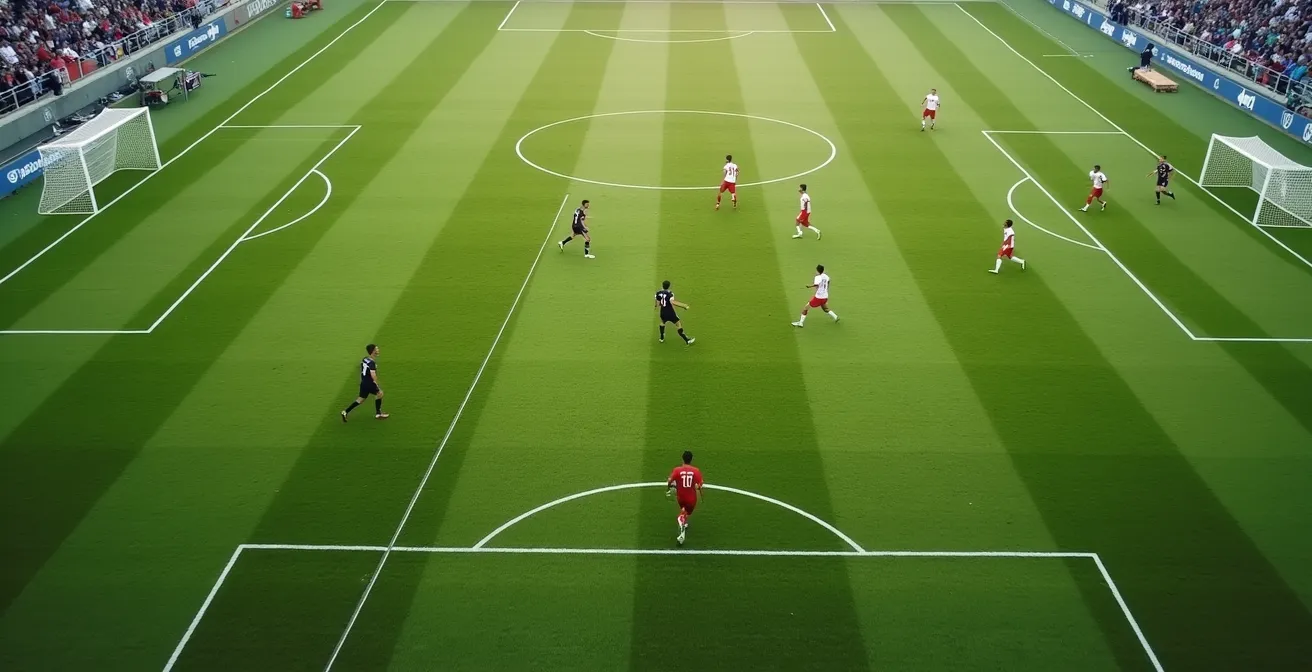
This synchronization is often established through a non-verbal “passer-runner agreement.” This can be a subtle glance, the striker pointing to the space, or, most commonly, the playmaker’s body shape. When you open your body to pass, that is the striker’s signal to accelerate. You must then wait for the final trigger: the moment the striker’s shoulders turn fully away from you, indicating their absolute commitment to the run behind the defense. That is your cue to release the ball. It’s a delicate sequence of reading your teammate’s intention and executing with precision.
Your Action Plan: Timing the Killer Pass
- Look for the striker’s ‘bent run’ along the defensive line – pass into the curve’s path for more forgiving timing.
- Establish the ‘passer-runner agreement’ – your body opening is their signal to accelerate.
- Wait for the ‘second movement’ – let the striker check toward you first, then spin behind for the pass.
- Release when the striker’s shoulders turn away from you – this indicates their commitment to the run.
- Use your peripheral vision to monitor the defensive line’s position while focusing on the striker’s movement.
How to Move the Ball Faster to Tire the Defending Block?
A low block defense is designed for physical efficiency. It minimizes the space defenders have to cover, allowing them to conserve energy. Therefore, the playmaker’s goal is not just to move the ball, but to move it in a way that maximizes the defenders’ mental and physical workload. The key is to create “decisional fatigue.” Every time the ball is switched quickly from one side to the other, the entire defensive block must shift, communicate, and re-establish their shape. Doing this repeatedly is more exhausting than any physical sprint.
This is where tempo becomes a weapon. It’s not about playing at 100 miles per hour constantly. It’s about lulling the defense with a period of slow, patient possession (“Slow, Slow…”) and then, suddenly, injecting a sequence of one or two-touch passes to move the ball from one flank to the other in seconds (“…QUICK!”). This sudden change in rhythm is what catches defenders off guard. They are mentally conditioned to the slower pace, and the rapid acceleration forces rushed decisions, poor positioning, and, eventually, creates the gaps you are looking for.
Maintaining a high passing speed and forcing quick decisions on the opposition is a proven tactic. For instance, tactical analysis of pressing teams like Ajax has shown how forcing a high number of passes per defensive action (PPDA) can lead to opposition errors. While this is a defensive metric, the principle is the same for an attacking team: making the opposition react at a speed they are uncomfortable with leads to breakdowns. Your passing isn’t just about finding a teammate; it’s about forcing a defender to think, move, and adjust, over and over, until they can no longer keep up.
- Apply the ‘Slow, Slow, QUICK’ principle – lull defenders with patient possession then inject sudden one-touch combinations.
- Use ‘Up-Back-Through’ patterns to force defenders to step, drop, and turn in quick succession.
- Pass to the receiver’s ‘back foot’ (furthest from the defender) enabling one-motion turns forward.
- Create ‘decisional fatigue’ by constantly switching play and forcing defenders to shift laterally.
- Maintain distances of 10-15 yards between players to enable quick, flat passes that defenders can’t intercept.
Key takeaways
- The half-space is a cognitive trap for defenders, not just a physical location. Your presence there forces choices that break their structure.
- Elite playmakers gather information before receiving the ball; scanning is their most important skill, providing the perceptual superiority to see the future of the play.
- Quick ball circulation and calculated shifts in tempo create “decisional fatigue” in a low block, which is far more effective at creating space than aimless individual dribbling.
How to Improve Passing Accuracy in the Final Third Against Low Blocks?
After all the scanning, movement, and tempo manipulation, it all comes down to the final action: the pass. In the hyper-congested final third, passing accuracy is not just about technique; it’s about decision-making under extreme pressure. Every pass carries a weight of risk and reward. The master playmaker has an internal framework to evaluate this instantly, categorizing each potential pass as either for ‘possession’ (a safe, high-percentage pass to retain the ball, >95% success) or ‘penetration’ (a risky, line-breaking pass with a lower success rate but high potential reward, ~40% success). The genius lies in knowing when to be safe and when to gamble.
One of the most powerful tools to increase passing accuracy in tight spaces is the ‘disguised pass’. This involves using your eyes and body shape to deceive the defense. By looking one way, you shift the entire defensive block’s attention and balance, creating a sliver of space in the opposite direction. The ability to look at the winger but slide a pass into the striker’s feet without changing your body shape is a high-level skill that can bypass an entire line of defense. It’s another form of creating cognitive dissonance, making defenders react to a lie while you execute the truth.
Furthermore, your pass weight becomes a form of communication. A firm pass to feet tells the receiver to set it back for a third-man run. A softer pass played into space invites them to turn and attack. You can even impart different types of spin on the ball as a ‘message’—backspin on a pass to feet makes it sit up for easy control, while topspin on a through ball makes it accelerate away from a chasing defender. This is the final layer of detail, transforming a simple pass into a precise instruction.
- Master the ‘disguised pass’ – look one way to shift the block’s attention before passing elsewhere.
- Use pass weight as communication – hard passes mean ‘set it back’, soft passes mean ‘turn and run’.
- Apply the Risk vs. Reward framework: categorize each pass as ‘possession’ (95% success) or ‘penetration’ (40% success).
- Receive on the half-turn in half-spaces to maintain multiple passing angles.
- Create ‘message passing’ – use backspin for control passes, topspin for penetrating passes.
The journey from a promising midfielder to a true maestro is a long one, but it is paved with intelligent decisions, not just athletic feats. Begin implementing these principles today. Focus on one aspect in your next training session or match—perhaps operating exclusively in the half-space, or making a conscious effort to scan twice as often. This is how you transform tactical knowledge into instinct and become the creative force that dictates the game.