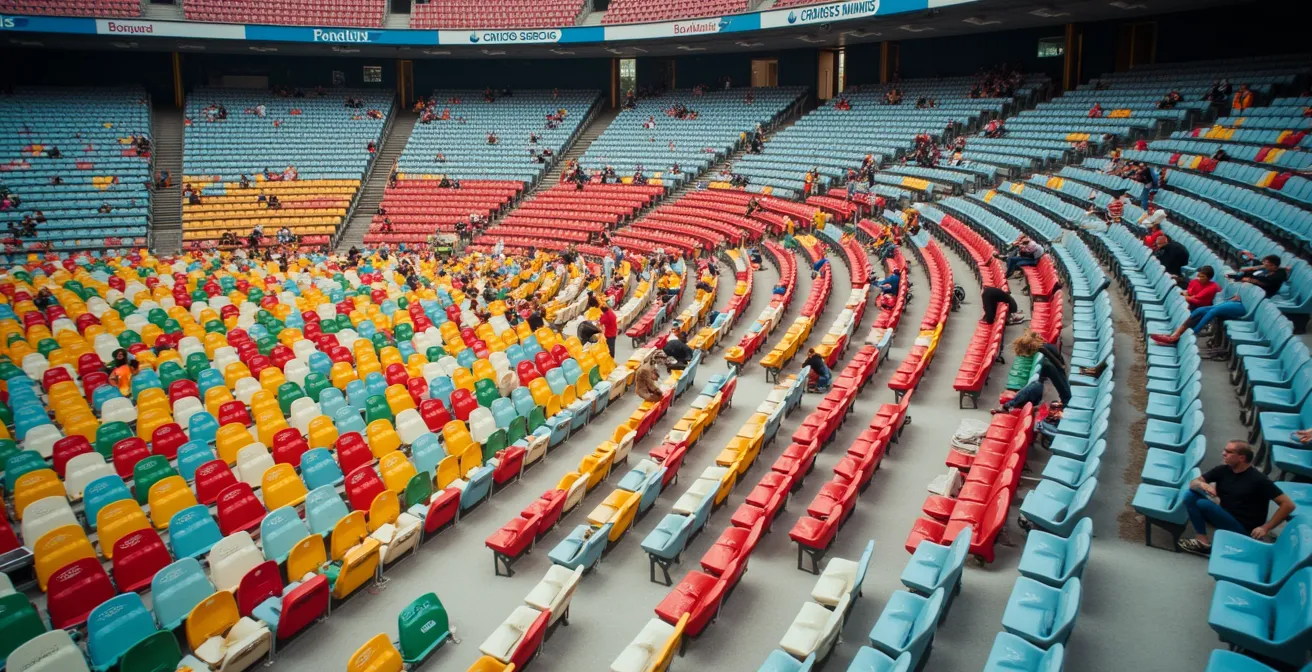
Executing a flawless tifo isn’t about passion; it’s a cold, calculated exercise in logistical precision and risk management.
- Material science dictates not only the visual vibrancy but also fire safety and weather resistance, which are critical liabilities.
- Pixel-perfect execution relies on digital seat mapping, translating an artistic vision into thousands of individual, actionable data points.
- A centralized command structure, led by a capo, is the only method to achieve the synchronized execution necessary for a coherent display.
Recommendation: Master the granular details of planning, material sourcing, and human infrastructure before you ever commit to a design.
The moment a stadium-wide tifo is revealed is pure magic. A wave of color, a colossal image, a defiant message materializes from the hands of thousands, unified in a single, breathtaking instant. For the fans in the stands and the millions watching at home, it’s a powerful symbol of loyalty and artistic expression. But for the small, dedicated team of coordinators behind the scenes, this moment of spectacle is the end of a brutal campaign. It’s the culmination of months of meticulous planning, resource management, and problem-solving that more closely resembles a military operation than an art project.
Most discussions about tifos focus on the final image—the design, the message, the sheer scale. They celebrate the passion. But passion doesn’t get 10,000 colored cards onto the correct seats. Passion doesn’t account for wind shear on a 500-meter banner or ensure the materials are fire-retardant. The real art, the secret discipline that separates a legendary display from a chaotic failure, lies in mastering the logistical warfare. It’s about understanding material science, human infrastructure, and the unwritten rules of large-scale choreographic discipline.
This is not a gallery of pretty pictures. This is a field manual. We will dissect the operational pillars that underpin every successful tifo, from the foundational science of visual design to the complex ballet of human coordination. We’ll explore the critical decisions around materials, the unforgiving reality of weather, and the safety regulations that govern your ambition. This is the blueprint for turning artistic vision into overwhelming reality.
To truly grasp the scale of this undertaking, it’s essential to break down the complex machinery of tifo creation into its core components. The following sections will guide you through each critical stage of the process, from initial concept to final, flawless execution.
Summary: The Logistics Behind Creating a Full Stadium Mosaic Tifo?
- Why High Contrast Colors Work Better Than Detailed Images on Card Displays?
- How to Map a Stadium Section to Assign Cards to Seats?
- Plastic Sheets or Painted Cloth: Which Tifo Material Is More Fire Safe?
- The Planning Error That Ruins Painted Banners on Rainy Matchdays
- How to Signal 10,000 People to Raise Their Cards Simultaneously?
- Steep Stands or Shallow Bowls: Which Design Keeps the Noise In?
- Why Playing at High Altitude in La Paz Is the Ultimate Test for Visiting Teams?
- Safe Standing and Pyrotechnics: How to Balance Atmosphere with Safety Regulations?
Why High Contrast Colors Work Better Than Detailed Images on Card Displays?
From the coordinator’s perch, a stadium section isn’t a crowd; it’s a low-resolution screen. The fundamental principle of tifo design is accepting this limitation. An intricate portrait or a detailed landscape that looks stunning on a computer monitor will dissolve into a meaningless blur from 100 meters away. The human eye, at that distance, cannot resolve fine details. It perceives blocks of color and strong, defined shapes. This is why high-contrast color schemes—think bold yellows against deep blues, or stark whites on black—are the lifeblood of an effective card display.
The goal is immediate legibility. A simple, powerful symbol or a short, bold word will have infinitely more impact than a complex drawing. The design must be “readable” in a split second by everyone, from the opposite stand to the broadcast cameras. Some of the most memorable tifos, often involving over 20,000 fans creating visual mosaics, rely on no more than two or three dominant colors. The genius of these displays isn’t in the artistic complexity of the source image, but in the disciplined reduction of that image to its most powerful, high-contrast essence.
Take the legendary “Yellow Wall” at Borussia Dortmund’s Westfalenstadion. As a case study, its success isn’t just about the passion of the fans. It’s a masterclass in visual impact. The club’s core colors, black and yellow, provide a naturally high-contrast palette. The supporter groups, BVB’s famed ultras, have perfected the art of using these simple colors to create memorable mosaics that tell a story or send a message with breathtaking clarity. Their creative and memorable displays prove that in the world of stadium-scale art, simplicity and contrast are the ultimate forms of sophistication.
How to Map a Stadium Section to Assign Cards to Seats?
The translation of a digital design into a physical reality across thousands of seats is the single most critical logistical task. This is where artistic vision meets brutal, painstaking grunt work. There is no room for error. The process begins with obtaining official stadium seating charts, which serve as the foundational map. However, these plans must be ground-truthed; a coordinator must physically verify seat counts, as theoretical plans often differ from the reality of a stand that has seen years of modifications.
Once you have an accurate seat count and layout, you create a digital grid system. Each seat becomes a pixel with a specific coordinate. This digital map is where the design is overlaid, assigning a color to every single seat. It’s a meticulous process of data entry that must meticulously account for every obstacle that breaks the grid: stairways, camera platforms, entry and exit tunnels, and disabled access areas. These “dead zones” must be mapped as negative space within the design. Failing to do so will result in distorted lines and incomprehensible shapes on matchday.
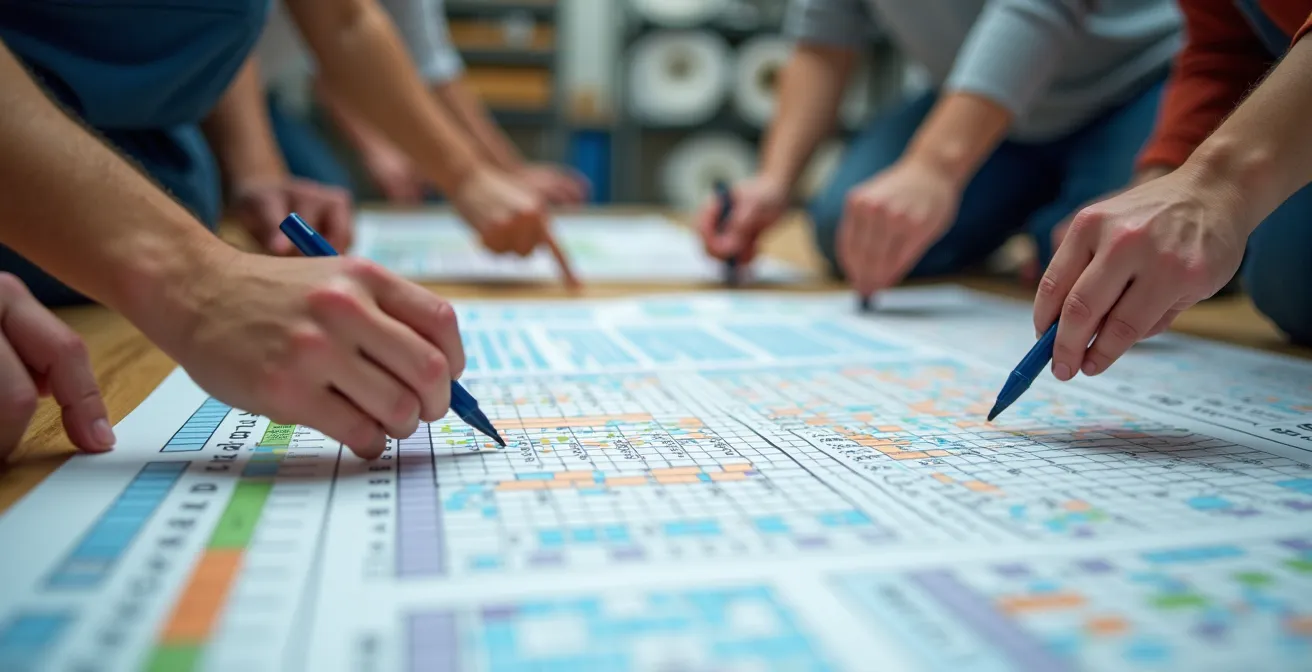
As the image above illustrates, this mapping phase is a collaborative effort, often involving a core team working for hours over large-scale prints. Each section is color-coded, and packets of cards are prepared based on this master plan. The final stage is distribution, where a trusted team of volunteers places the correct card pack on every single seat according to the map. A single misplaced stack of cards can break the entire image. This is not a task for the general public; it requires a disciplined human infrastructure of volunteers who understand the importance of precision.
Plastic Sheets or Painted Cloth: Which Tifo Material Is More Fire Safe?
The choice of material for a tifo is a complex calculation of cost, weight, weather performance, and, most critically, safety. In modern stadiums, fire safety is a non-negotiable starting point. A massive banner or thousands of plastic cards represent a significant fuel load, and stadium authorities and local fire marshals will demand certification. This is where professional-grade materials offer a distinct advantage over DIY solutions. As an example of the seriousness of this investment, Frankfurt fans spent 50,000 euros on tifo materials for a single European campaign, a significant portion of which was dedicated to ensuring compliance and safety.
While painted bedsheets are the historical root of tifo culture, they carry inherent risks. Unless treated with a fire retardant, cotton cloth is highly flammable. Furthermore, it becomes incredibly heavy when wet, posing a different kind of safety risk. Modern, purpose-made materials like knitted polyester or airmesh fabric are the industry standard for a reason: they come with fire retardant certifications (like B1 classification in Europe) and offer superior performance. The following table breaks down the key differences, based on data from material suppliers.
| Material | Fire Safety | Weather Performance | Cost per m² |
|---|---|---|---|
| Knitted Polyester | Fire retardant certified | Vibrant, strong, ideal for detailed prints | Medium |
| Polyester Airmesh | Fire retardant certified | 54% air permeable, perfect for windier stadiums | Higher |
| Painted Cloth | Depends on treatment | Heavy when wet | Lower |
As the comparison shows, materials like Polyester Airmesh offer benefits beyond just fire safety, providing permeability that is essential for massive banners in windy stadiums, preventing the “sail effect” that can make a banner uncontrollable. The choice is a strategic one: while the initial cost of certified materials is higher, it buys you safety, compliance, and operational reliability—three things no coordinator can afford to compromise on.
The Planning Error That Ruins Painted Banners on Rainy Matchdays
There is no sight more heartbreaking for a tifo crew than watching months of work on a magnificent painted banner get ruined by an unexpected downpour. The most common and devastating planning error is underestimating the impact of weather. A large cloth banner, especially one made from untreated cotton, acts like a giant sponge. When it gets wet, two catastrophic things happen: the paint runs, turning your masterpiece into a muddy mess, and the banner’s weight can increase tenfold, making it dangerously heavy and almost impossible for volunteers to control. This is a classic failure point that separates experienced crews from novices.
The solution is not to hope for clear skies, but to plan for the worst-case scenario. This means making smart choices from the very beginning. Using waterproof or water-repellent cloth is the first line of defense. These materials prevent moisture absorption, ensuring the banner remains lightweight and the paint stays intact. Furthermore, the construction of the banner itself can be a form of contingency. Large tifos are rarely one single piece; they are often printed or painted in sections and then stitched together. Designing with weather in mind means you can plan these sections to be quickly detached if conditions worsen, preventing a total loss.
A robust weather strategy is not a single plan, but a series of layered contingencies. It’s a mindset that anticipates failure and builds in responses at every stage of the process, from material selection to deployment day tactics. Having a clear, pre-agreed plan ensures that the team can react decisively under pressure, rather than panicking as the rain begins to fall.
Your Pre-Match Weather Contingency Checklist
- Material Choice: Confirm that you are using water-repellent treated fabrics that won’t absorb significant moisture.
- Sectional Design: Ensure your banner is designed in sections that can be managed or even detached if conditions deteriorate rapidly.
- Failure Points: Designate and reinforce specific points on the banner meant to handle high stress, and identify weaker “failure points” that would tear in a controlled way to prevent a catastrophic collapse.
- Volunteer Briefing: Brief the deployment team on the weather plan, including wind-speed limits and the exact signals for a controlled retraction or takedown.
- Post-Match Logistics: Pre-arrange for a large, dry indoor space for immediate drying and storage of wet materials to prevent mold and damage.
How to Signal 10,000 People to Raise Their Cards Simultaneously?
Achieving perfect synchronization across a massive, noisy, and distracted crowd is perhaps the most impressive feat of tifo coordination. It is a problem of mass communication under extreme conditions. The solution is not shouting; it is a rigid, hierarchical command structure. At the apex of this structure is the Capo. This individual, often positioned centrally on a platform or railing, is the conductor of the entire orchestra. They are the single point of truth for the timing of the display.
The Capo’s signal, however, cannot be seen by everyone. This is where the next layer of the human infrastructure comes in: the section leaders. Each block of the stand has its own designated leader, whose sole focus is to watch the Capo. When the Capo gives the signal—a flag drop, a flare, a hand gesture—the section leaders instantly replicate it for their specific area. This creates a cascade or relay system, where the command ripples out from the central point across the entire stand in a fraction of a second. This choreographic discipline is a hallmark of Ultras groups, who practice this coordinated support with drums and chants to build a unified atmosphere.
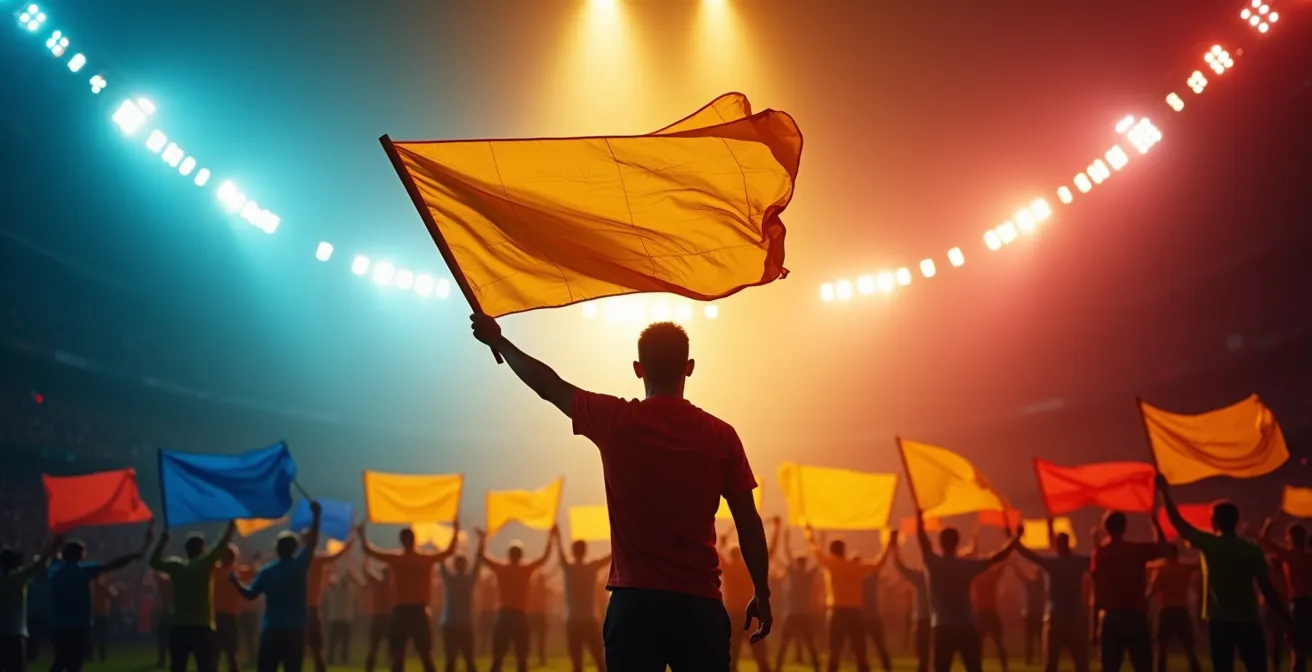
This system requires an immense volunteer effort. It’s not just about placing cards on seats; it’s about building and briefing a command chain. For a truly massive display, the numbers are staggering. As an example, Feyenoord fans once mobilized more than 200 people for a banner that took four weeks to complete. A significant portion of that team would have been dedicated to the matchday deployment and signaling hierarchy. The signal itself must be visual and unambiguous: a large, brightly colored flag is often more effective than pyrotechnics, which can be obscured by smoke.
Steep Stands or Shallow Bowls: Which Design Keeps the Noise In?
While stadium architecture is often discussed in terms of acoustics, its impact on the visual success of a tifo is just as profound. The geometry of the stands is, in effect, the canvas you are working on. The title’s question about noise is relevant because the very designs that trap sound—steep, continuous, and close to the pitch—also happen to create the most effective canvas for visual displays. A steeply raked stand presents a flatter, less distorted surface to the viewer opposite and to the cameras.
Shallow, bowl-shaped stadiums, common in modern multi-purpose venues, are a logistical nightmare for tifo coordinators. The gentle slope means that a card display can appear compressed and unreadable from many angles. The image becomes heavily distorted, especially for those viewing it from the sides. Coordination is also far more complex in a bowl, as sight lines between section leaders and the Capo can be obstructed by the very curvature of the stadium. It becomes difficult to maintain the rigid command structure needed for synchronized execution.
In contrast, a classic European-style stand, like Borussia Dortmund’s famous Südtribüne (South Tribune), is an ideal environment. With a capacity of almost 25,000 standing fans, its intimidatingly steep angle creates a near-vertical “wall” of supporters. This architecture is a primary reason why the tifos created there are legendary. The image is presented with maximum impact and minimal distortion. The sight lines are clear, allowing for flawless coordination. When selecting a location for a display within a stadium, an experienced coordinator will always choose the steepest stand available, as it provides the best possible canvas for their art.
Why Playing at High Altitude in La Paz Is the Ultimate Test for Visiting Teams?
The infamous challenge of playing football at the high altitude of La Paz, Bolivia, serves as a powerful metaphor for the hidden stresses of tifo logistics. On the surface, the task seems simple: place cards or unfurl a banner. But just as the thin air in La Paz saps the energy of elite athletes, the grueling reality of tifo preparation can exhaust even the most dedicated volunteer crew. This is logistics under extreme stress, and it’s a factor that must be planned for.
A typical tifo deployment isn’t a brief, ten-minute job. It requires a core team of volunteers arriving hours before kickoff to place every single element of the display on the seats. This is a physically demanding task involving thousands of repetitions of bending, lifting, and climbing stairs. When you factor in environmental stressors—be it the literal thin air of a high-altitude stadium, blistering heat, or freezing cold—the physical toll on your human infrastructure can become a critical failure point. A tired, exhausted crew is far more likely to make mistakes in the final, high-pressure moments before the display.
This is why material choice is again so critical. The materials must be not only visually effective and safe but also as lightweight and easy to handle as possible. Every extra gram is multiplied by thousands of units and hours of labor. Using light and durable materials like recyclable cloth or lightweight cardboard becomes a strategic choice to conserve the energy of the volunteer team. The ultimate test of a tifo plan is not just how it looks, but whether it can be executed by a human team working under real-world, often adverse, conditions. A good coordinator plans for the physical and environmental strain on their people just as carefully as they plan the design.
Key Takeaways
- Visual Impact: High-contrast, simple designs will always defeat complex, detailed images when viewed at stadium scale. Clarity trumps complexity.
- Material Science: Certified fire-retardant materials are a non-negotiable investment in safety and compliance, not an optional cost. Weather-resistance is your primary insurance policy against disaster.
- Command and Control: A clear, rehearsed command hierarchy (Capo -> section leaders -> fans) is the only reliable method to achieve the perfect synchronization that defines a legendary tifo.
Safe Standing and Pyrotechnics: How to Balance Atmosphere with Safety Regulations?
The ultimate expression of stadium atmosphere often involves a combination of elements: the visual spectacle of a tifo, the vocal power of safe standing sections, and the raw energy of pyrotechnics. For a tifo coordinator, orchestrating this is the final boss of logistical challenges. It requires balancing artistic ambition not just with logistics, but with stringent safety regulations. The goal is a choreographed sensory assault, where flags, banners, colored smoke, and flares are sequenced for maximum impact without endangering a single person.
The first rule is separation. Flammable tifo materials—even fire-retardant ones will burn if exposed to a direct, sustained heat source like a flare—must have designated safety zones between them and any pyrotechnic activity. This requires meticulous planning on the seating map, creating buffer zones and briefing both the tifo team and the pyro team on the precise boundaries. Coordinated atmosphere demands coordinated safety protocols. Some supporter groups will spend upwards of $10,000 for materials for a single display; risking that investment and the safety of fans for a poorly planned pyro launch is unacceptable.
This balancing act is where the true purpose of the ultra movement often shines. As academic research notes, tifos are more than just decoration; they can be a powerful form of expression.
Tifos have been instrumental in protest and activism, challenging commercialization and social injustices in football.
– Academic research, The Art of Tifo – Peter Lang Verlag
This higher purpose adds another layer of responsibility. Creating a safe environment is paramount because it ensures the message, whatever it may be, is delivered powerfully and without negative incident. It protects the group’s ability to continue its activism and artistic expression in the future. The balance is not a compromise; it is a discipline that enables ambition.
The next roar of the crowd celebrating your masterpiece begins not on matchday, but now, with a spreadsheet, a seating chart, and a ruthless commitment to logistical excellence. Begin your planning.