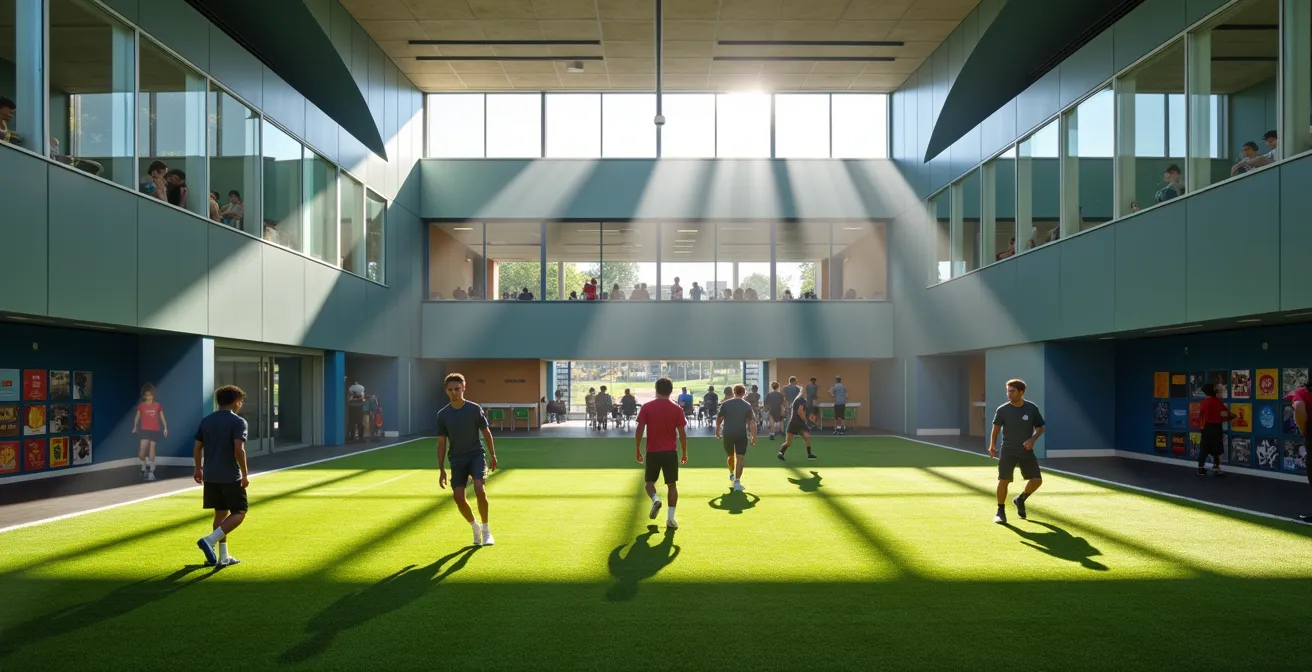
The greatest mistake an academy can make is treating a young athlete’s education and sport as a ‘balancing act’ they must solve alone.
- True development requires an architectural approach, managing biological age (bio-banding) over chronological age.
- Academic success is not an obstacle but a variable to be integrated through ‘academic periodization’.
Recommendation: Shift from developing ‘footballers’ to cultivating ‘people who play football’ by building a supportive, integrated ecosystem.
As academy directors and parents, we witness the immense pressure on our U16 athletes. They are expected to excel in the classroom, dominate on the pitch, and navigate the complexities of adolescence. The common advice offered—”manage your time better,” “work harder,” “get enough sleep”—is well-intentioned but fundamentally flawed. It places the entire burden of this complex equation on the shoulders of a 15-year-old, treating their development as a personal challenge of willpower and organization.
This approach is not just ineffective; it’s a dereliction of our duty of care. The constant tension between academic deadlines and training demands isn’t a problem for the player to solve, but an architectural failure of the system they are in. What if the conversation shifted from personal balance to institutional integration? What if we, as the architects of their environment, designed a system where school and sport are not competing priorities but interconnected components of a single, holistic development plan?
This is our core responsibility. It requires moving beyond generic advice and building a protective ecosystem grounded in science and empathy. It means we must actively manage the variables of physical maturation, academic stress, and technical growth. This guide provides the blueprint for that system, outlining the structural changes necessary to nurture not just elite athletes, but resilient, intelligent, and well-rounded young individuals.
In the following sections, we will explore the critical pillars of this architectural approach. From confronting the inherent biases in talent identification to designing intelligent training schedules, this framework offers a sustainable path for long-term player success both on and off the field.
Summary: The Academy’s Architect: Balancing Education and U16 Player Development
- Why Late Bloomers Are Often Cut from Academies Too Early?
- How to Design a Weekly Schedule That Includes School, Training, and Rest?
- Early Specialization or Multi-Sport Background: Which Reduces Injury Risk?
- The Development Error of Creating Players Who Cannot Function Outside Football
- When to Increase Training Load for a 15-Year-Old Without Causing Growth Injuries?
- Why Early Physical Development Can Mask a Lack of Technical Ability in U17s?
- How to Integrate Academy Players into the Starting XI Without Risking Stability?
- Why Youth Cups Are the Best Indicator of Future National Team Success?
Why Late Bloomers Are Often Cut from Academies Too Early?
One of the most significant and damaging biases in youth football is the “relative age effect.” We select players based on chronological age groups (U15, U16), yet we judge them on physical performance. This system inherently favors early maturers—those who are bigger, stronger, and faster simply because they hit their growth spurts sooner. The statistics are alarming; research from European academies shows that over 50% of youth academy players are born in the first three months of the selection year. These players are not necessarily more talented; they are just temporarily more physically developed.
This bias leads us to make critical errors, cutting late-maturing players who may possess superior technical skill, game intelligence, and long-term potential. We mistake physical precocity for talent and, in doing so, discard future gems. To counter this, our architectural responsibility is to implement systems that evaluate potential beyond current physicality. The most effective tool for this is bio-banding, where players are grouped based on biological age (e.g., percentage of adult height attained) rather than chronological age.
As a case study in its effectiveness, bio-banding provides distinct advantages for all players. Early maturers face greater physical and technical challenges by playing with peers of similar maturity, forcing them to rely on skill rather than size. Conversely, late maturers experience less physical intimidation, giving them the confidence and opportunity to showcase their technical and tactical abilities without being overpowered. This creates a more equitable and accurate development environment, protecting late bloomers and truly challenging early developers.
How to Design a Weekly Schedule That Includes School, Training, and Rest?
A U16 athlete’s life is a constant drain on energy. We cannot simply look at their calendar and block out time for “school” and “training.” We must think in terms of an energy budget. A chemistry exam on Tuesday can be as draining as a key match on Saturday. Our role as academy architects is to map this energy expenditure and build a schedule that provides for both high-drain activities and essential restoration.
A truly holistic schedule moves beyond basic time management. It requires a coordinated effort, including what we can call Academic Periodization. This involves proactive communication with schools to understand the academic calendar. During intense exam periods, for instance, training load should be adjusted. Intensity can be reduced, and the focus can shift to tactical video analysis or low-impact technical drills. Conversely, during lighter academic weeks, training intensity can be strategically increased.

Furthermore, rest must be defined and scheduled with the same seriousness as training. It is not merely “time off.” We must differentiate and mandate various forms of recovery. This includes:
- Passive Rest: Ensuring 8-10 hours of quality sleep per night, which is non-negotiable for adolescent growth and recovery.
- Active Recovery: Light mobility sessions, stretching, or swimming on days after intense matches to aid muscle repair.
- Mental Unplugging: Scheduled time for non-sport hobbies and social interaction, which is crucial for preventing mental burnout and fostering a healthy identity outside of football.
Creating recovery windows after “double-load” days—such as a major school test followed by an intense training session—is a critical part of this protective structure.
Early Specialization or Multi-Sport Background: Which Reduces Injury Risk?
There is a pervasive and dangerous trend in youth sports toward early specialization. Parents and coaches, driven by the fear of their child “falling behind,” push for year-round, single-sport focus from a very young age. In fact, recent studies indicate that approximately 30% of young athletes are highly specialized before the age of 12. While this may seem like the fastest path to elite status, it is often a direct path to overuse injuries, burnout, and stunted athletic development.
From a physiological standpoint, specializing early exposes a young, developing body to repetitive movement patterns. This constant strain on the same muscles, joints, and ligaments dramatically increases the risk of growth-related and overuse injuries, such as Osgood-Schlatter disease or stress fractures. A multi-sport background, by contrast, builds a more robust and resilient athlete. Engaging in different sports like basketball, swimming, or gymnastics develops a wider range of motor skills, improves neuromuscular coordination, and promotes more balanced muscular development.
An athlete who has played multiple sports develops a broader “movement vocabulary.” They have better balance, agility, and spatial awareness. This not only makes them a more creative and adaptable football player but also provides a protective buffer against injury. The varied physical demands prevent any one part of the body from being chronically overloaded. Psychologically, it also prevents the mental fatigue and identity foreclosure that often comes with single-sport obsession. Our academy structure should therefore actively encourage and even create opportunities for multi-sport participation in the younger age groups before specialization is gradually introduced.
The Development Error of Creating Players Who Cannot Function Outside Football
One of the most profound developmental errors an academy can make is to cultivate a singular identity in a young player. When we treat them only as “footballers,” we set them up for profound struggles later in life, whether their career is cut short by injury or ends naturally. As one development framework notes, youth athletes are full-time students and part-time athletes. Our primary responsibility is to nurture the whole person, not just the player. The goal must be to develop a “person who plays football.”
This means actively building a dual identity, where the athlete’s sense of self-worth is not exclusively tied to their performance on the pitch. Progressive academies understand this and are integrating mandatory life skills education into their curriculum. These are not optional add-ons; they are core components of the development program. This includes workshops on essential real-world competencies that football alone cannot teach.
Key areas of focus include:
- Financial Literacy: Teaching young players about budgeting, saving, and the basics of contracts long before they sign their first professional deal.
- Public Speaking and Media Training: Equipping them with the confidence and skills to communicate effectively, whether in a post-match interview or a team meeting.
- Digital Citizenship: Educating them on managing their social media presence responsibly and protecting their personal brand.
- Career Exploration: Exposing them to different professions and educational pathways, reinforcing that football is something they do, not the entirety of who they are.
By investing in these areas, we provide a safety net and a foundation for a successful life beyond the game. We are not distracting them from football; we are building more resilient, mature, and capable individuals who, in turn, often become better and more balanced players.
When to Increase Training Load for a 15-Year-Old Without Causing Growth Injuries?
Applying a uniform training load to a squad of 15-year-olds is one of the most hazardous practices in youth development. Chronological age is a poor indicator of physical readiness. During adolescence, the variance in biological maturation is immense; studies show adolescent squads can have up to a 23cm height and 18kg weight difference within the same age group. An early maturer might be physically robust and ready for increased load, while a late maturer is in the midst of a rapid growth spurt, making their bones, tendons, and ligaments highly vulnerable to injury.
Increasing training load—particularly activities involving high-impact acceleration and deceleration—during a player’s Peak Height Velocity (PHV) is a recipe for growth-related injuries like Sever’s disease or apophysitis. The key is individualized load management based on maturation monitoring, not a team-wide schedule. Academies must regularly track players’ growth (height and weight) to estimate their maturation status and identify when they are entering this vulnerable growth spurt window.

A benchmark for best practice comes from top European clubs. The Ajax Academy, for example, famously implemented a bio-banded training intervention. Players identified as entering their growth spurt were assigned to a modified conditioning program. This program strategically reduced high-impact activities and instead increased the emphasis on foundational elements that support healthy growth. The focus shifted to improving coordination, balance, core strength, and mobility. This approach not only protects the player from injury but also uses this crucial developmental period to build a stronger athletic foundation for when their body is ready to handle higher loads.
Why Early Physical Development Can Mask a Lack of Technical Ability in U17s?
At the U16 and U17 levels, the physically dominant player often shines. They win duels, cover ground quickly, and can appear to be the most effective player on the pitch. However, this early physical development can act as a mask, hiding significant deficiencies in technical ability and tactical understanding. An early maturer can often get away with a poor first touch or a slow decision because their speed and strength allow them to recover the situation. This creates a dangerous illusion of competence.
As these players progress to senior levels, their physical advantages diminish. Everyone is strong, and everyone is fast. At this point, the players who succeed are the ones with superior technique, vision, and decision-making speed—the very skills the early maturer was never forced to develop. This is why many “star” youth players fail to make the professional leap. In a striking confirmation of this, surprising research reveals that 100% of players who reached the top 5 European leagues from one studied academy were, in fact, late maturers. They had to survive and thrive using their technical and mental skills, building a foundation that served them when their bodies caught up.
Our evaluation methods must therefore be designed to “de-couple” physical attributes from technical and tactical assessment. We need to create environments where physical dominance is neutralized, forcing a player’s true footballing brain and feet to be revealed.
Action Plan: Unmasking True Technical Ability
- Assess in context: Implement constrained games in tight spaces to neutralize physical advantages and highlight touch and awareness.
- Isolate technique: Use one-touch passing drills and rondos to reveal the speed of technical understanding and execution under pressure.
- Mix the groups: Create small-sided games with mixed maturation groups (using bio-banding) to see how players adapt.
- Evaluate the mind: Focus assessments on the speed and quality of decision-making rather than just the physical execution of the action.
- Track progress separately: Document technical skill progression on a separate trajectory from physical metric improvements to get a true picture of development.
How to Integrate Academy Players into the Starting XI Without Risking Stability?
Promoting a promising U17 player into the first-team environment is a delicate process. Simply throwing them into the starting XI is a high-risk gamble that can shatter a young player’s confidence and disrupt team chemistry. A structured, phased integration protocol is essential to protect both the player and the team. The goal is to set the player up for success, not to test them in a sink-or-swim scenario.
An effective strategy used by professional clubs is the “Mentorship Pod.” This involves creating a support triangle around the young player. They are paired with a veteran senior player (often in a similar position) and a position-specific coach. This pod provides constant guidance, feedback, and psychological support. The senior player acts as an on-field mentor, helping them navigate the unwritten rules of the professional dressing room and the tactical demands of the first team, while the coach works on specific technical and tactical details in smaller sessions.
Alongside this mentorship, a phased minutes protocol is crucial. The player’s introduction to competitive matches should be gradual and planned. It is not about giving them a full 90-minute debut. Instead, the process progresses in stages with clear, achievable objectives for each one.
- Phase 1 (15-20 minutes): Introducing the player in the final stages of a game that is already under control, with the simple objective of maintaining tempo and executing basic defensive duties.
- Phase 2 (30-45 minutes): Bringing them on as a half-time substitute, giving them more time to influence the game with specific tactical instructions.
- Phase 3 (60+ minutes): Giving them their first start, ideally in a lower-stakes cup match or against a less formidable opponent, before eventually building them into a regular starter.
This methodical approach de-risks the transition, builds confidence incrementally, and ensures that when the player does earn a permanent spot, they are fully prepared for the demands.
Key Takeaways
- The Relative Age Effect is a primary source of bias in talent ID; implementing bio-banding is a necessary architectural countermeasure to protect late-maturing players.
- An athlete’s schedule must be managed through a holistic “energy budget” that integrates academic periodization, not just a simple time-based calendar.
- The ultimate goal is to develop a “dual identity” in athletes—a ‘person who plays football’—to ensure their long-term well-being and build resilience beyond the sport.
Why Youth Cups Are the Best Indicator of Future National Team Success?
The debate around the value of youth tournaments is often polarized. Some see them as meaningless trophies, while others view them as the ultimate predictor of future glory. The reality, as shown by historical data, is more nuanced. Winning a U17 or U20 World Cup is not a guaranteed ticket to senior success. However, consistent performance at these tournaments often correlates strongly with a nation’s future achievements, but only when the right lessons are learned.
The table below highlights this complexity. While nations like Spain and Germany translated consistent youth success into major senior trophies, others like Ghana and Nigeria, despite multiple youth titles, have not seen the same level of senior team achievement. This suggests the value is not in the victory itself, but in the process.
| Country | U17/U20 Success | Senior Team Achievement | Correlation |
|---|---|---|---|
| Spain | Multiple youth titles 2000-2010 | World Cup 2010, Euros 2008/2012 | Strong |
| Germany | Consistent youth success | World Cup 2014 | Strong |
| Ghana | U20 World Cup 2009 | Limited senior success | Weak |
| Nigeria | Multiple U17 titles | No major senior trophies | Weak |
So where does the true value lie? It’s not in the silverware, but in what these tournaments provide as a developmental tool. As noted in an analysis of their impact, their primary function is as an “Experience Accelerator.”
The true value is not the trophy itself, but the ‘Experience Accelerator’ effect—exposing young players to diverse playing styles, international travel, and media pressure.
– Sports Development Research, Analysis of Youth Tournament Impact
These tournaments are a unique crucible. They test players against different footballing cultures, force them to adapt to unfamiliar environments, and introduce them to the pressures of knockout football and media scrutiny. For a national federation, consistent qualification and competitive showings at youth cups are an indicator that their development pipeline is successfully producing players capable of handling the demands of international football. It’s a barometer of the system’s health. The trophy is a bonus; the experience is the prize.
Your responsibility as an academy director or parent extends far beyond the pitch. Begin implementing these architectural principles today to build not just better players, but more resilient, successful, and well-rounded young adults.