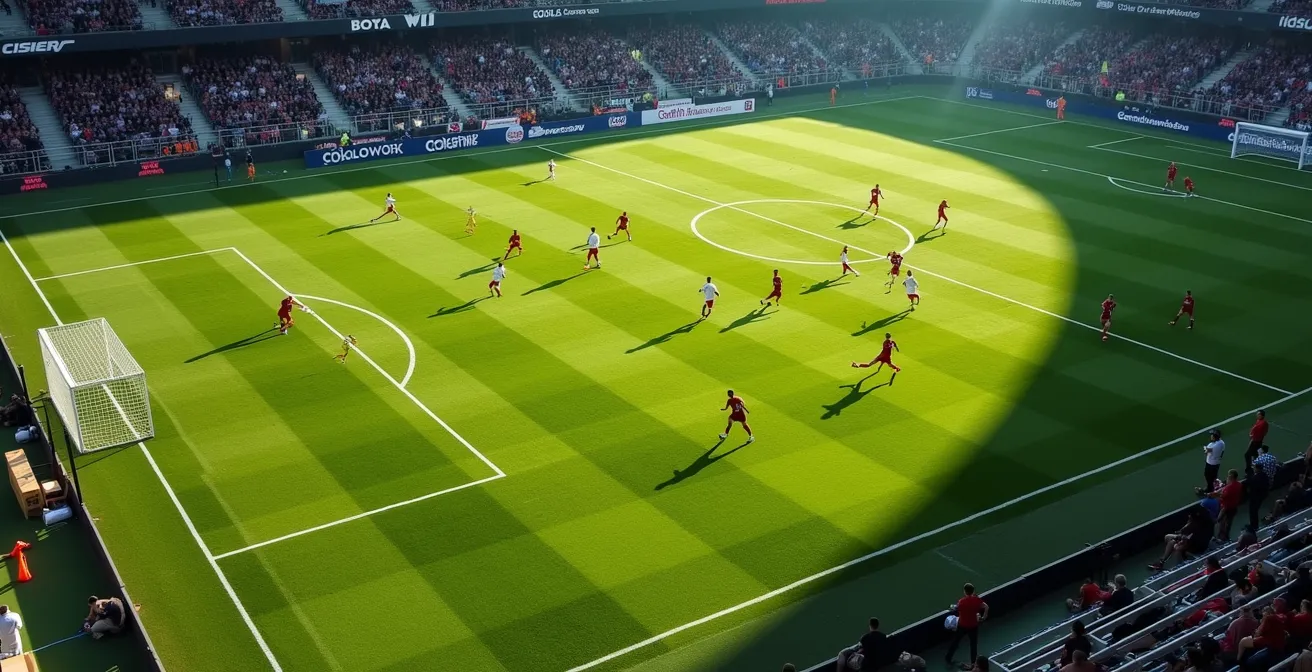
Your team’s attacking phase is its moment of greatest defensive weakness; effective rest defense treats this vulnerability not as an afterthought, but as the central organizing principle of possession.
- A structured rest defense is built on proactive risk assessment, identifying how an attack will fail before it happens.
- It prioritizes control over negative space and key defensive zones over simply marking players.
Recommendation: Shift your focus from reacting to turnovers to building a pre-emptive defensive structure that makes counter-attacks organizationally impossible for the opponent.
For any coach, the sight is sickening: a promising attack breaks down, and seconds later, the ball is in the back of your own net. The opposition celebrates a swift counter-attack, and you are left analyzing the point of failure. The common diagnosis focuses on the moment the ball was lost. We drill counter-pressing, we demand faster reactions, we preach the importance of transition. These are not incorrect, but they are reactive. They treat the symptom, not the disease.
The fundamental flaw often lies not in the reaction to the turnover, but in the structural organization—the ‘rest defense’—during the attacking phase itself. True defensive solidity is not about what you do when you lose the ball; it’s about the “defensive pre-mortem” you conduct while you have it. It is a pessimistic, architectural approach that anticipates failure to neutralize its consequences. This isn’t just about leaving players back; it’s a dynamic system of risk assessment, identifying vulnerability triggers in your own attacking patterns and positioning players to control the most dangerous counter-attacking spaces before they become a threat.
For those who prefer a more visual medium, the following video, though set in a gaming simulation, offers a simplified illustration of some core principles of defensive positioning and reaction. It can help visualize the spatial relationships and trigger-based movements discussed in this guide.
This guide provides a blueprint for constructing a robust rest defense. We will dissect the philosophies, key roles, common structural errors, and the disciplined reactions required to transform your team from one that is vulnerable on the break to one that is defensively prepared, even at its most expansive attacking moments.
Table of Contents: A Blueprint for Structuring Your Rest Defense
- Why Winning the Ball Back in 5 Seconds Is the Best Defense?
- How to Position the Midfield Pivot to Screen Counters Effectively?
- Structure or Chaos: Which Transition Defense Suits Slow Defenders?
- The Positioning Error That Leaves the Channels Wide Open for Wingers
- How to React Instantly to a Loss of Possession in the Final Third?
- Why Pressing High Is Worth the Risk of Leaving Space Behind?
- How to Regain Defensive Shape Within 5 Seconds of Losing Possession?
- Why Playing a High Defensive Line Is High Risk Without VAR Technology?
Why Winning the Ball Back in 5 Seconds Is the Best Defense?
The most aggressive form of rest defense is pre-emptive offense. The “5-second rule” is not merely a frantic scramble; it is a calculated, high-intensity system of “controlled chaos” designed to suffocate a counter-attack at its source. The principle is brutally simple: upon losing possession, the team commits to a collective and immediate press to recover the ball within five seconds. The logic is rooted in the opponent’s disorganization. In the instant they win the ball, their shape is geared towards defending, not attacking. This is the moment of maximum vulnerability for them, and maximum opportunity for you. The data supports this aggression; high turnovers are exceptionally potent attacking weapons. An analysis of Premier League pressing data reveals that 13.0% of shot-ending high turnovers result in a goal, a conversion rate that dwarfs most other forms of attack creation.
This approach was famously perfected by Pep Guardiola’s Barcelona. Their implementation of the 5-second rule allowed them to maintain relentless pressure and territorial dominance. Crucially, the rule included a failure protocol: if the ball was not won back within the five-second window, the press was abandoned, and the team would immediately retreat into its organized defensive block. This discipline prevents the “controlled chaos” from descending into actual chaos, which could leave the defense exposed.
Action Plan: The 5-Second Counter-Press Protocol
- Immediate Pressure: The player nearest to the ball carrier applies aggressive pressure instantly to prevent a forward pass or turn.
- Cut Passing Lanes: The second and third closest players move to intercept the most immediate and dangerous forward passing options, forcing the opponent backward or sideways.
- Horizontal Compaction: The entire midfield line squeezes towards the ball, eliminating central channels and shrinking the effective playing area.
- Vertical Compaction: The defensive line pushes up aggressively to compress the space between the lines, supporting the midfield press and creating offside risks for the opposition.
- Failure Protocol: If the ball is not recovered within 5 seconds, all players disengage from the press and sprint back into their pre-defined defensive shape and positions.
However, this strategy is not a universal solution. It demands exceptional fitness, tactical discipline, and a shared understanding of triggers among all players. Without these elements, it becomes a high-risk gamble that can be easily bypassed by composed opponents.
How to Position the Midfield Pivot to Screen Counters Effectively?
If the immediate counter-press is the first line of defense, the midfield pivot is the system’s structural anchor and primary insurance policy. This player’s role is not glamorous; it is a task of perpetual pessimism, constantly scanning and anticipating points of failure in his own team’s attack. An effective pivot operates in the “negative space”—the areas the opposition wants to exploit on the counter. Their positioning is not relative to the ball, but to the most dangerous potential threat. A common error is for the pivot to be drawn towards the ball during possession, leaving the central corridor in front of the defenders—the “golden zone”—unprotected.

The ideal positioning requires a constant mental checklist. The pivot must maintain a distance that allows them to support circulation but prioritizes their ability to intercept a direct ball to the opponent’s striker. Their body orientation is critical; an open stance, allowing them to see both the ball and the potential runners behind them, is non-negotiable. They must be the team’s foremost expert in risk assessment, understanding that an overlapping full-back or a risky through-ball attempt is a “vulnerability trigger” that requires them to adjust their position pre-emptively, often by dropping deeper or shifting laterally to cover the newly opened space. This proactive movement is the essence of effective screening.
Rest defence refers to the defensive structure a team maintains when they are attacking. It’s the ‘insurance policy’ that ensures a team can quickly respond to a loss of possession.
– The Football Analyst, Rest-Defence – Football Tactics Explained
Ultimately, the pivot is the brain of the rest defense. Their discipline and spatial awareness dictate whether a simple turnover becomes a minor inconvenience or a catastrophic defensive breakdown. They are the architect’s most important piece on the board.
Structure or Chaos: Which Transition Defense Suits Slow Defenders?
A coach’s philosophy on transition defense must be brutally honest about the physical attributes of their squad. Specifically, the pace of the central defenders dictates the viability of the chosen approach. There are two dominant philosophies: the “Structured” drop and the “Chaotic” counter-press. Choosing the wrong one is a recipe for disaster. For a team with slow defenders, embracing a chaotic, high-pressing counter-press is tactical suicide. If the initial wave of pressure is beaten, the space behind the defense becomes an undefendable chasm. The only logical choice is a structured retreat.
This approach prioritizes immediate, organized withdrawal into a compact defensive block upon losing possession. The primary goal is not to win the ball back high up the pitch, but to deny space behind the defense and force the opponent into a slower, more predictable build-up. While this cedes initiative and allows the opponent time on the ball, it protects your greatest vulnerability. It is a pessimistic but pragmatic strategy. Conversely, a team blessed with pacey defenders and high fitness levels can embrace the “controlled chaos” of a counter-press, knowing they have the recovery speed to handle balls played in behind. This high-risk, high-reward approach generates potent scoring opportunities, as recent Premier League data shows that shots from high turnovers have an average value of 0.11 Expected Goals (xG).
The following table, based on an analysis of tactical transitions, outlines the fundamental trade-offs a coach must consider.
| Approach | Key Characteristics | Best For | Risks |
|---|---|---|---|
| Structured (Drop & Compact) | Immediate retreat to defensive block, vertical compactness priority, space denial behind defense | Teams with slow center-backs, defensive-minded teams | Allows opponent time to organize attack |
| Chaotic (Counter-Press) | Aggressive immediate pressure, 5-second rule application, high defensive line | Teams with pacey defenders, high fitness levels | Vulnerable to balls over the top if press is beaten |
The decision is therefore not about which system is “better,” but which system exposes your team to the least amount of unacceptable risk. A defensive architect builds the structure to fit the materials available, not the other way around.
The Positioning Error That Leaves the Channels Wide Open for Wingers
One of the most common and devastating errors in rest defense is a failure to protect the channels, particularly on the weak side of the attack. It often stems from symmetrical attacking patterns where both full-backs push high simultaneously. When possession is lost, the space they vacate becomes a prime target for opposing wingers, forcing a center-back to be pulled wide and disrupting the entire defensive line. This creates a chain reaction of negative consequences, opening up the central areas the center-back has just vacated. A robust rest defense must be built on asymmetrical principles to pre-emptively close these gaps.
Case Study: Liverpool’s Asymmetrical Rest Defense Strategy
During the 2023-24 season, Liverpool often employed a highly effective asymmetrical structure. When one full-back, typically Trent Alexander-Arnold, moved high and inside to influence the attack, the opposite full-back, Andrew Robertson, would tuck in to form a temporary back three alongside the two center-backs. This created a stable 3-2 rest defense structure (three defenders, two deeper midfielders). This setup automatically protected the weak-side channel while still allowing for attacking freedom on the strong side. Upon losing the ball, the tucked-in full-back was already in an ideal defensive position to cover the dangerous half-space and prevent a simple switch of play from becoming a crisis.
This asymmetrical system requires clear triggers and communication. The players must understand that the advance of one full-back is the cue for the other to adopt a more conservative position. The goal is to ensure that the team never has fewer than three players in the deepest defensive line, providing a stable base to manage transitions. The defensive midfielder’s role becomes even more crucial in this system, as they must shift to screen the side of the pitch with the advanced full-back. Failing to maintain this balance is an open invitation for counter-attacks down the flanks.
How to React Instantly to a Loss of Possession in the Final Third?
Losing the ball in the opponent’s final third is a moment of extreme defensive peril. The team is at its most spread out, with many players committed ahead of the ball. The reaction in this zone cannot be hesitant; it must be an immediate, instinctive, and collective action. The primary objective is to prevent the opponent from playing a clean first pass forward. This is where the principles of counter-pressing are most vital. The players closest to the ball—the striker, wingers, attacking midfielders—become the first line of defense. Their job is not necessarily to win the ball back, but to apply immediate, suffocating pressure to force a mistake, a long clearance, or a backward pass.

This “swarm” buys the rest of the team precious seconds to recover their defensive shape. Every player must have a pre-programmed reaction. While the forwards press, the midfielders must sprint back towards their own goal, compacting the center of the pitch. Analysis using advanced metrics like Goal Probability Added (GPI) confirms the urgency; it reveals that the first 6 seconds after a turnover are the most critical in determining the outcome of the subsequent possession. Any delay in reaction exponentially increases the opponent’s chance of launching a successful counter. This immediate reaction must be drilled relentlessly in training until it is second nature. It’s about transforming a moment of attacking failure into a trigger for a disciplined, collective defensive action.
The mindset must shift from disappointment at losing the ball to an immediate focus on the next action: pressing, recovering, and restoring the team’s structural integrity. Hesitation is the counter-attacking team’s greatest ally.
Why Pressing High Is Worth the Risk of Leaving Space Behind?
From a pessimistic, structuralist viewpoint, a high press appears to be an act of recklessness. It involves committing players high up the pitch, willingly leaving vast spaces behind the defensive line for opponents to exploit. It seems to contradict the very principle of minimizing risk. However, this is a miscalculation of the nature of risk and reward in football. The risk is not eliminated by dropping deep; it is merely transformed. A deep block invites sustained pressure and gives a quality opponent time and space to unpick your defense. A high press, while risky, is a proactive form of defense that aims to prevent the attack from ever organizing.
The statistical argument is compelling. Data from the Premier League shows that top teams average around 2.5 shot-ending high turnovers per game. These are some of the most efficient goal-scoring opportunities in open play. By pressing high, a team is not just defending; it is creating high-quality chances. The “risk” of the space behind the defense is mitigated by the intensity and coordination of the press itself. A successful press doesn’t allow the opponent the time to find the pass into that space. It is a calculated gamble that territorial dominance and the creation of turnovers is a more effective defensive strategy than passive containment.
Case Study: RB Leipzig’s Aggressive Rest Defense at Corners
RB Leipzig frequently demonstrates an extreme interpretation of high-risk rest defense, particularly during their own attacking corners. They often push all outfield players into the opponent’s final third, stationing two players on the edge of the penalty area to immediately contest clearances. This keeps the opponent pinned in their own third and allows Leipzig to sustain pressure by recycling possession. The trade-off is immense: the defensive line is at the halfway line, making them highly vulnerable to a counter if the initial press is bypassed. They accept this risk in exchange for absolute territorial control.
Therefore, the question for the defensive architect is not whether the risk exists, but whether the team is sufficiently drilled, fit, and coordinated to manage it effectively. A well-executed high press is a formidable defensive weapon that seizes control of the game’s rhythm.
Key Takeaways
- Rest defense is not a passive state but an active, pre-emptive system of risk management during your own team’s attack.
- The physical profile of your defenders (especially pace) is the non-negotiable factor that must dictate your transition strategy (structure vs. chaos).
- Effective structures are often asymmetrical, ensuring that the advancement of one player is balanced by the conservative positioning of another to protect vulnerable channels.
How to Regain Defensive Shape Within 5 Seconds of Losing Possession?
When the initial counter-press fails or is not the chosen strategy, the next five seconds are critical for damage control. The team must transition from a state of attacking expansion to defensive compactness with maximum speed and coordination. This is not a chaotic scramble back to goal; it is a drilled recovery run to specific landmarks on the pitch. The goal is to “shrink the pitch” both vertically and horizontally, denying the opponent the space they need to build a quick attack. The first priority is always to protect the central “golden zone” in front of the penalty area. Wingers and full-backs must resist the urge to immediately track their direct opponent out wide and instead recover centrally first, before shuffling out once the central danger is contained.
The two most common rest defense structures that form the basis for this recovery are the 2-3 (two center-backs with a line of three midfielders ahead) and the 3-2 (three defenders with two screening midfielders). Each offers different advantages in the recovery phase. The 2-3 structure provides a stronger immediate screen in midfield, making it easier to slow the opponent’s central progression. The 3-2 structure, often formed by an inverted full-back, offers better coverage of the wide areas and is more robust against direct balls into the channels.
The following table outlines the trade-offs between these two fundamental structures, which serve as the foundation for a rapid recovery.
| Formation | First Line | Second Line | Advantages | Weaknesses |
|---|---|---|---|---|
| 2-3 Structure | 2 defenders deep | 3 midfielders screening | Better central protection, easier transition to 4-4-2 block | Vulnerable to wide counter-attacks |
| 3-2 Structure | 3 defenders deep | 2 midfielders screening | Better width coverage, stronger against direct balls | Less midfield presence for immediate counter-press |
Regardless of the base structure, the recovery is a collective sprint with a shared purpose. The pivot drops to the top of the ‘D’, the center-backs hold the 18-yard line, and the wide players tuck in. This rapid compaction forces the opponent to slow down, allowing your team to fully reset its defensive organization.
Why Playing a High Defensive Line Is High Risk Without VAR Technology?
Playing a high defensive line is the ultimate expression of proactive, aggressive defending. It is a strategy designed to compress the pitch, support a high press, and repeatedly catch forwards in the offside trap. However, it is also a strategy that operates on a knife’s edge. Before the widespread implementation of Video Assistant Referee (VAR) technology, a high line was a monumental gamble. Its success depended entirely on the split-second, subjective judgment of a single assistant referee. A fraction of a second in timing, a poor viewing angle, or a simple human error could turn a perfectly executed offside trap into a one-on-one opportunity for the opposing striker. The risk of an incorrect decision leading to a goal was often too high for many coaches to stomach.
VAR has fundamentally changed this risk calculation. The ability to review marginal offside decisions with frame-by-frame accuracy has provided a crucial safety net for teams employing a high line. Coaches can now drill their defensive line to hold its position with confidence, knowing that a correct, albeit tight, offside will eventually be confirmed. This technological assurance allows teams to be more aggressive and disciplined in their positioning. However, it does not eliminate risk entirely; it merely shifts it. The high line is still vulnerable to perfectly timed runs and players breaking from deep positions. It demands exceptional concentration and communication from defenders, even while their team is attacking.
Case Study: France’s Center-Back Rest Defense at the World Cup
France’s World Cup-winning central defenders, such as Varane and Upamecano, demonstrated an outstanding balance of rest defense within a high-line system. The key to their success was a “vulnerability trigger.” As long as they were viable passing options in the build-up, they held their positions relative to the ball. However, the moment the ball progressed past the halfway line and they were no longer part of the immediate circulation, their mindset switched instantly. They would immediately identify and mark their direct opponents, effectively defending while their team was still in full attacking flow. This constant state of alert was crucial in neutralizing counter-attacks before they could even begin.
While VAR provides a buffer against incorrect decisions, the fundamental principles of a high line remain unchanged. It requires brave, intelligent defenders and a coach willing to accept the inherent, calculated risk in pursuit of territorial dominance.
The next step is to conduct a ‘defensive pre-mortem’ of your own team’s attacking patterns. Begin by auditing your most common attacking moves to identify the ‘vulnerability triggers’—the moments your structure is weakest—and redesign your rest defense to neutralize those specific points of failure.