
In summary:
- Injury prevention in amateur football relies on implementing structured, evidence-based protocols rather than relying on professional medical staff.
- A structured neuromuscular warm-up like the FIFA 11+ is one of the most effective single interventions, proven to significantly cut lower-limb injuries.
- Understanding the interaction between playing surface and boot stud configuration is critical for reducing rotational stress on the knee and ankle joints.
- Monitoring player workload with simple, no-cost tools like Session RPE is more effective than guessing, helping to prevent fatigue-related soft tissue injuries.
It’s a scenario every amateur coach dreads: your star player goes down with no one around them. A sharp turn, a sudden stop, and a season is potentially over. These non-contact injuries, from ACL tears to hamstring strains, are the scourge of Sunday league and amateur football, often accepted as an unavoidable part of the game. The typical advice often feels generic and unhelpful: “warm-up properly,” “listen to your body,” “don’t overtrain.” But these platitudes lack the specific, actionable guidance needed for teams operating with limited time, budget, and medical support.
The truth is, a significant portion of these injuries are not just bad luck. They are the predictable outcome of hidden variables and biomechanical mismatches that accumulate over time. But what if the key to a healthier squad wasn’t access to an elite physio team, but a deeper understanding of the science behind injury? What if you could translate the principles used at the professional level into practical, low-cost habits that empower players and coaches to become their own first line of defence?
This guide moves beyond the clichés to provide a clear, evidence-based framework for reducing non-contact injury risk. We will dissect the anatomical reasons behind common injuries, introduce proven prevention programs, demystify equipment choices, and provide simple tools to manage player load without expensive technology. It’s time to stop reacting to injuries and start proactively preventing them.
This article provides a comprehensive overview of the key pillars of injury prevention for amateur teams. Explore the sections below to build a robust strategy for keeping your players on the pitch and performing at their best.
Summary: A Practical Guide to Reducing Non-Contact Injuries in Football
- Why Female Players Are 3x More Likely to Suffer ACL Injuries?
- How to Implement the FIFA 11+ Warm-Up Routine for Sunday League Teams?
- AG vs FG Boots: Which Sole Plate Prevents Knee Ligament Strain?
- The Post-Match Mistake That Increases Stiffness for the Next Training Session
- When to Resume Full Contact Training After a Grade 1 Hamstring Strain?
- Why Hamstring Injuries Spike During the December Fixture Congestion?
- Early Specialization or Multi-Sport Background: Which Reduces Injury Risk?
- Why GPS Vests Are Essential for Preventing Soft Tissue Injuries in Pre-Season?
Why Female Players Are 3x More Likely to Suffer ACL Injuries?
The alarming rate of Anterior Cruciate Ligament (ACL) injuries in women’s football is not a coincidence; it is a complex issue rooted in anatomy, biomechanics, and even equipment design. While the title suggests a threefold risk, some research published in Bone & Joint Open confirms an up to 8 times higher incidence in females compared to their male counterparts. This disparity is partly due to anatomical and physiological differences. Women generally have a wider pelvis, which increases the “Q-angle” at the knee, placing more stress on the ACL during cutting and landing movements. Hormonal fluctuations throughout the menstrual cycle can also affect ligament laxity, potentially increasing vulnerability at certain times.
However, anatomy is only part of the story. A significant, and often overlooked, factor is the biomechanical mismatch between the female athlete and the equipment they use. Most football boots are designed and tested based on male anatomy and power outputs. This one-size-fits-all approach ignores crucial differences in foot shape, pressure distribution, and force generation. As a leading expert on the female body, Dr. Emma Ross highlights this critical gap in her book, “The Female Body Bible”:
You make studs and you make the sole to withstand the capacity of the average man and then you put an average women in them and as fast and as quick as they are, they’re not as strong or as powerful as men
– Dr Emma Ross, The Female Body Bible
This mismatch means that boots may not provide the appropriate support or rotational properties for female players, potentially increasing torque on the knee joint. For amateur teams, this means paying closer attention to how boots fit female players and recognizing that their needs may differ from male players, a crucial first step in mitigating this heightened risk.
How to Implement the FIFA 11+ Warm-Up Routine for Sunday League Teams?
Simply telling players to “warm-up” is not an injury prevention strategy. A truly effective warm-up should be a structured, evidence-based program designed to prepare the body for the specific demands of football. The FIFA 11+ is the gold standard in this regard. It is not just a series of stretches; it is a comprehensive neuromuscular training program designed to improve stability, strength, and movement control. Best of all, it requires no equipment and takes only 20 minutes to complete. The evidence supporting it is overwhelming; studies have proven that the FIFA 11+ warm-up can achieve up to a 50% reduction in lower limb injury rates when performed consistently.
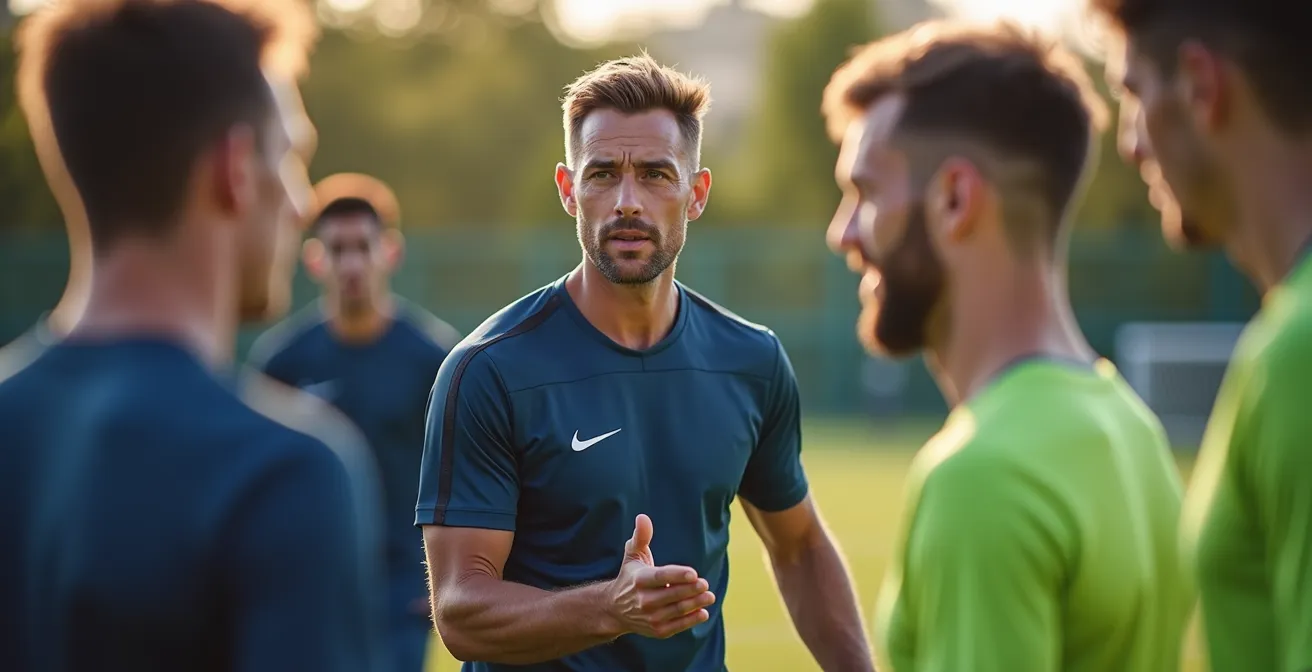
The program consists of three parts: running exercises at the start of training, followed by a core block of strength, plyometrics, and balance exercises, and concluding with further running exercises. For amateur teams, the key to success is gradual implementation, not trying to do the entire program perfectly from day one. Below is an illustration of a team engaged in these types of drills.
To avoid overwhelming players, introduce the program over several weeks. A progressive approach ensures better buy-in and technique. Here is a simple plan for Sunday league teams:
- Week 1: Start with the running exercises and the basic, Level 1 strength components only. Focus on familiarizing the team with the movements.
- Week 2: Continue with the running and Level 1 strength exercises, but now add the plyometric and balance components.
- Week 3: Integrate the full program with all three parts. Players who show competence can begin progressing to Level 2 difficulty on the strength exercises.
- Ongoing: After 3-4 weeks, the team should be comfortable with the full routine. Continue to progress exercise difficulty based on the team’s overall readiness and competence.
By replacing a generic jog and stretch with the FIFA 11+, coaches provide a powerful, science-backed tool that directly targets the mechanisms of common football injuries.
AG vs FG Boots: Which Sole Plate Prevents Knee Ligament Strain?
Choosing the right football boots goes far beyond brand loyalty or aesthetics; it’s a critical equipment decision that directly impacts injury risk, particularly to the knee. The most important factor is the interaction between the boot’s sole plate—specifically the stud configuration—and the playing surface. Using the wrong type of stud can create excessive rotational friction, or “torque,” where the foot gets caught in the turf while the body continues to rotate. This is a primary mechanism for ACL and other ligament injuries. For amateur players who often play on a variety of surfaces, from lush grass to hard-packed dry pitches and artificial grass (AG), understanding this relationship is vital.
Firm Ground (FG) boots, especially those with aggressive bladed studs, are designed to penetrate soft, natural grass for traction. On harder ground or AG, these blades can get stuck, acting like an anchor and increasing rotational strain on the knee. Conical (round) studs are generally safer as they allow the foot to pivot and disengage from the surface more easily. Research highlights this issue, noting that 82% of female players in Europe report discomfort and issues with their boots, often related to poor fit and inappropriate stud patterns for the surfaces they play on.
The table below, based on an analysis of stud configuration, provides a simple guide for amateur players to make a more informed and safer choice.
| Stud Type | Surface Best For | Knee Safety Rating | Key Benefit |
|---|---|---|---|
| Conical (Round) Studs | Mixed surfaces | High | Allow safer rotation and disengagement |
| Bladed Studs | Soft ground only | Medium-Low | Better traction but higher rotational torque risk |
| Hybrid FG/AG | 70% firm ground use | Medium-High | Versatile compromise for amateur players |
For most amateur players, a boot with conical studs or a modern hybrid FG/AG sole plate represents the safest all-around choice. It provides adequate traction on most surfaces without the high rotational torque risk associated with bladed studs on hard ground.
The Post-Match Mistake That Increases Stiffness for the Next Training Session
What you do in the 24 hours after a match is just as important as the warm-up before it. The most common post-match mistake amateur players make is either doing nothing (collapsing on the sofa) or performing intense static stretching on fatigued muscles. While stretching has its place, deep, prolonged static holds immediately after intense exertion can cause micro-trauma to already damaged muscle fibers, potentially increasing soreness and stiffness. The goal of post-match recovery is not to force flexibility but to kick-start the body’s repair processes. This involves refueling, rehydrating, and promoting blood flow to clear metabolic waste products.
The key is shifting the mindset from passive rest to active recovery. This involves light, low-impact movement that helps the body cool down gradually and stimulates circulation without adding further stress. A well-structured recovery protocol also prioritizes nutrition and hydration to replenish what was lost during the match. As experts in performance monitoring note, a proper diet is fundamental not just for energy but for muscle repair. The 30-60 minute window immediately after a match is the optimal time for the body to absorb nutrients and begin replenishing its glycogen stores.
For amateur teams, an effective post-match protocol doesn’t require ice baths or cryotherapy chambers. It’s about following a few simple, critical steps consistently. An analysis of professional recovery strategies by performance science experts at Catapult Sports can be adapted into a simple, actionable plan:
- Within 30-60 minutes: Consume a snack or drink containing both protein and carbohydrates to replenish glycogen stores and initiate muscle repair. A chocolate milk or a banana with a protein shake works well.
- Immediately post-match: Instead of deep static stretching, perform 5-10 minutes of light dynamic mobility. This includes walking, leg swings, and gentle hip circles.
- Day +1 (The day after the match): Engage in 20 minutes of active recovery. This could be a brisk walk, a light swim, or a gentle cycle. The goal is to get the blood flowing without causing fatigue.
- Throughout recovery: Focus on rehydration. It’s important to replace electrolytes lost through sweat, not just water. An electrolyte tablet or a sports drink can be beneficial.
By avoiding the mistake of static stretching on tired muscles and embracing an active recovery protocol, players can significantly reduce post-match stiffness and be better prepared for the next training session.
When to Resume Full Contact Training After a Grade 1 Hamstring Strain?
Returning from a hamstring strain is a delicate process, and the single biggest mistake is rushing back too soon. A Grade 1 strain involves minor tears to the muscle fibers. While it might feel “okay” to jog within a few days, the muscle tissue is not yet resilient enough to handle the explosive demands of football—sprinting, shooting, and tackling. Returning to full-contact training should be guided by criteria-based progression, not just the passage of time. This means a player must demonstrate they have regained full strength, flexibility, and function before they are cleared for full participation.
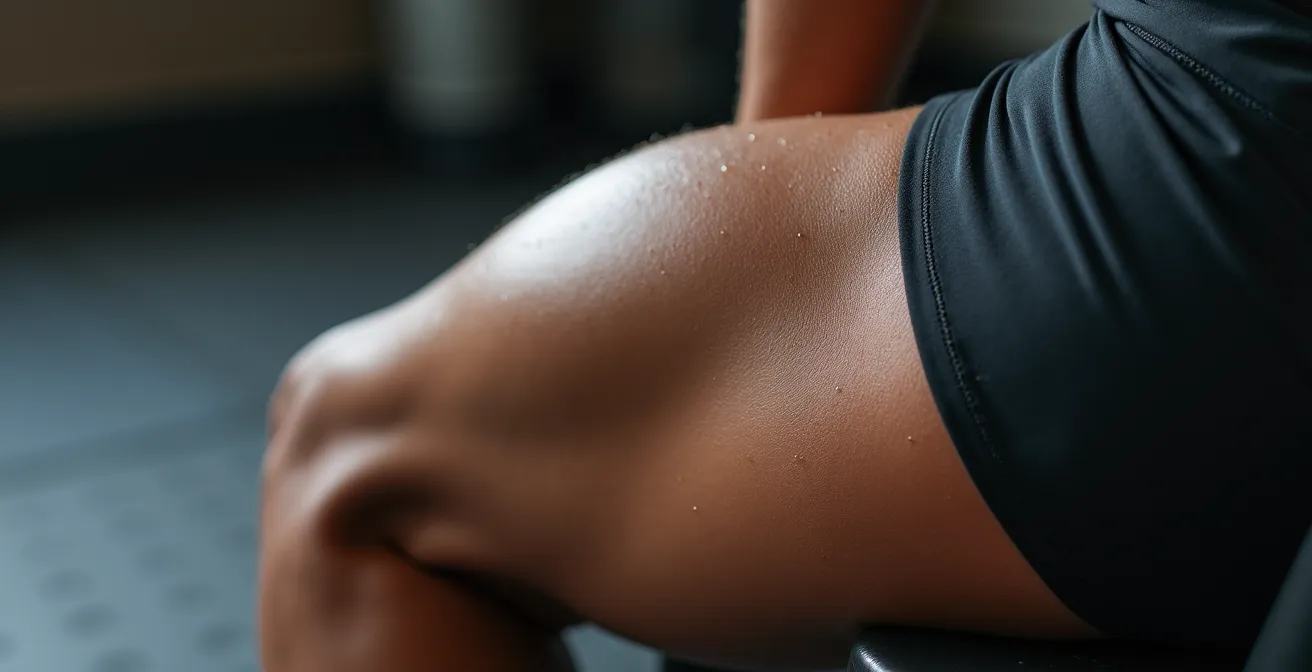
The cornerstone of hamstring rehabilitation and prevention is eccentric strengthening. This refers to exercises where the muscle lengthens under load, which is precisely what happens to the hamstrings during the deceleration phase of sprinting. The Nordic hamstring curl is the most well-researched and effective exercise for this. The visible muscle engagement during this exercise, as shown below, highlights the targeted stress placed on the muscle group.
Its effectiveness is backed by robust science; a comprehensive review published by the National Center for Biotechnology Information shows that just 27 sessions over 10 weeks decreased hamstring injury rates significantly by building eccentric strength. Before a player returns to full training, they should be able to complete a series of functional tests without pain, including:
- Full range of motion: Can the player straighten their leg fully without pain or tightness compared to the uninjured leg?
- Symmetrical strength: Can they perform single-leg bridges and Nordic curls with no significant strength difference between the injured and uninjured side?
- Pain-free acceleration and deceleration: Can the player perform running drills at increasing intensity (50%, 75%, 90%) and come to a sudden stop without pain or hesitation?
- Pain-free sport-specific movements: Can they strike a ball and perform cutting movements at high speed without any apprehension?
Only when a player can tick all these boxes should they be considered ready for full-contact training. Returning based on the calendar, rather than these functional milestones, is a direct path to re-injury.
Why Hamstring Injuries Spike During the December Fixture Congestion?
The festive period in many football leagues is notorious for its packed schedule, and with it, a sharp increase in soft tissue injuries, particularly hamstring strains. This is not a coincidence; it is a direct consequence of accumulated fatigue and insufficient recovery time. When players are asked to perform at high intensity with less than the optimal 72 hours of rest between matches, their bodies do not have enough time to repair and adapt. This state of constant fatigue leads to a breakdown in neuromuscular control, altered running mechanics, and a significantly higher risk of injury. The hamstring, being crucial for sprinting and deceleration, is often the first muscle group to fail under this excessive load.
The concept of workload management is central to understanding this phenomenon. It’s about balancing the stress of training and matches (workload) with adequate recovery. When the workload spikes dramatically—as it does during fixture congestion—without a corresponding increase in recovery, the risk of injury skyrockets. This principle applies just as much to amateur teams playing weekend tournaments as it does to professionals during a busy winter schedule.
This link between fixture congestion and injury is not just anecdotal; it is supported by extensive data from player unions and sports scientists.
Case Study: FIFPRO’s Analysis of Workload and Injury
A 2023 study by FIFPRO, the world players’ union, tracked 139 elite players over two seasons. The analysis revealed a clear and direct link between fixture congestion and injury rates. The data showed that players who had less than 5 days of rest between matches experienced significantly more injuries. Furthermore, the report found that in the 28 days leading up to an injury, affected players had consistently experienced more congested fixture schedules and less rest time than their uninjured counterparts. Crucially, hamstring injuries were one of the most common consequences, accounting for a staggering 23% of all injuries tracked in the study.
This study provides clear evidence that fixture congestion is a primary driver of hamstring injuries. For amateur coaches, the lesson is clear: be mindful of periods of increased game frequency (like tournaments or rescheduled matches) and prioritize recovery by adjusting training intensity to avoid overloading already fatigued players.
Early Specialization or Multi-Sport Background: Which Reduces Injury Risk?
There is a growing trend in youth sports to encourage children to specialize in a single sport, like football, from a very early age. The belief is that this focused practice will lead to elite performance. However, a growing body of evidence suggests this approach may be counterproductive for long-term athletic development and can significantly increase the risk of overuse injuries. Early specialization often leads to repetitive strain on the same muscle groups and joints, while neglecting the development of overall athleticism. A player might develop fantastic ball control but lack the fundamental movement skills—like landing mechanics, coordination, and core stability—that protect them from injury.
In contrast, a multi-sport background exposes a young athlete to a wide variety of movement patterns. Playing basketball teaches jumping and landing, gymnastics develops core strength and body awareness, and athletics builds efficient running mechanics. This variety creates a more robust and resilient athlete with a broader foundation of what sports scientists call “physical literacy.” These athletes tend to have better motor skills, more balanced muscular development, and a lower incidence of burnout and overuse injuries when they eventually choose to specialize in one sport later in their teens.
For amateur players who may have specialized early, it’s never too late to address potential gaps in their fundamental athleticism. A simple audit can identify areas of weakness that may predispose them to injury. Instead of more football-specific drills, integrating exercises that challenge balance, coordination, and whole-body strength can be incredibly beneficial.
Your Athleticism Audit Checklist: 5 Key Tests
- Single-Leg Stability: Can you jump off a 30cm box and land softly and in control on one leg, without your knee collapsing inwards?
- Coordination & Core Control: Can you crawl backwards for 10 meters, maintaining a flat back and coordinated movement between opposite arms and legs?
- Upper Body & Shoulder Stability: Can you hang from a pull-up bar for 30 seconds with your shoulders actively engaged (not passively hanging)?
- Lateral Movement: Can you perform lateral shuffles for 20 meters, staying low and balanced without your feet crossing over?
- Total Body Control: Can you complete a full Turkish get-up on each side with light weight (or just bodyweight), demonstrating smooth and controlled form through each phase?
If a player struggles with several of these tests, it’s a strong indicator that their training should incorporate more general athletic development to build a more resilient foundation and reduce their overall injury risk.
Key takeaways
- The most effective injury prevention programs, like the FIFA 11+, focus on improving neuromuscular control, not just generic stretching.
- Equipment choices, particularly boot stud patterns, must be matched to the playing surface to minimize harmful rotational forces on the knee.
- Monitoring player workload is crucial; simple, no-cost methods like Session RPE can be as effective as expensive technology for amateur teams.
Why GPS Vests Are Essential for Preventing Soft Tissue Injuries in Pre-Season?
In professional football, GPS vests are a non-negotiable tool for injury prevention. They allow sports scientists to precisely quantify a player’s workload by tracking metrics like total distance, sprint distance, and the number of accelerations and decelerations. This data is used to manage the Acute:Chronic Workload Ratio (ACWR)—a scientific measure that compares a player’s recent workload (acute) to their fitness base (chronic). A sudden spike in this ratio is a major red flag for an impending soft tissue injury. During pre-season, when training intensity is rapidly increasing, managing this ratio is essential for avoiding preventable hamstring, calf, and quad strains.
For amateur teams, however, GPS technology is financially out of reach. But the principle behind it—quantifying workload to avoid dangerous spikes—is not. A simple, free, and scientifically validated method known as Session Rate of Perceived Exertion (Session RPE) can be used to achieve the same goal. This method combines a player’s subjective rating of how hard a session was with its duration to create a workload score in “arbitrary units.” It empowers players to “listen to their body” in a structured, quantifiable way.
Implementing Session RPE is straightforward and requires nothing more than a pen and paper or a simple spreadsheet. Here’s how any amateur team can start tracking player load:
- Step 1: Collect RPE: Roughly 30 minutes after each training session or match, ask each player to privately rate the session’s difficulty on a scale of 1 (extremely easy) to 10 (maximal effort).
- Step 2: Calculate Session Load: Multiply the player’s RPE score by the session’s duration in minutes. For example, a 90-minute session rated as a 7/10 gives a session load of 630 units (7 x 90).
- Step 3: Track the Data: Record each player’s session load in a spreadsheet or team chat group to track their daily and weekly totals.
- Step 4: Monitor Weekly Spikes: Calculate the total weekly load for each player. A key rule of thumb is to avoid increasing total weekly load by more than 10-15% from the previous week. A sudden jump of 50% or more is a major red flag.
- Step 5: Adjust Training: If a player’s weekly load is spiking, or if their ACWR (Acute 1-week load divided by Chronic 4-week average load) exceeds a 1.5 ratio, consider reducing their training intensity or duration to allow for adaptation.
While GPS vests provide more detailed data, the principle is the same. By using Session RPE, amateur coaches can effectively monitor workload, prevent fatigue-related injuries, and ensure their players are building fitness safely and sustainably throughout pre-season and beyond.
Start today by implementing just one of these low-cost strategies, like the Session RPE method, to take the first, most important step towards building a healthier, more resilient squad.
Frequently Asked Questions About Player Load Management
What are the 5 key wellness questions to ask players before training?
To get a quick snapshot of a player’s readiness to train, ask them to rate the following on a scale of 1-10: Sleep quality, Overall fatigue, Muscle soreness, and Stress levels. Also, ask a simple Yes/No question about any new or ongoing Injury niggles, and if yes, their location.
How often should wellness questionnaires be administered?
Ideally, these quick questions should be asked before every training session to get the most accurate picture of player fatigue. For amateur teams with limited contact time, administering the questionnaire at least twice per week (e.g., before each training session) is the minimum needed to identify worrying fatigue patterns.
What wellness score indicates a player needs modified training?
There’s no single magic number, but a strong rule of thumb is to take a closer look at any player who reports a score below 6/10 for sleep quality or above 7/10 for fatigue or muscle soreness. For these players, reducing their planned training load for that session by 20-30% is a wise, proactive measure to prevent injury.