Your inability to influence the game stems not from a lack of technical skill, but from a critically slow cognitive processing speed.
- Elite midfielders operate at a scan frequency of over 0.6 scans/second; the average player is drastically slower, leading to reactive, predictable play.
- Increasing scan frequency is a trainable, neuro-cognitive skill focused on exploiting “dead time” and building predictive models of the game.
Recommendation: Stop practicing mindlessly and start implementing a structured neuro-training protocol. The goal is to reprogram your brain to scan subconsciously, transforming your perception and decision-making under pressure.
For too long, midfielders have been fed the empty mantra: “check your shoulder.” This advice is not only insufficient; it’s fundamentally flawed. It treats a complex perceptual-cognitive skill as a simple physical habit. The result? Players who turn their heads but see nothing, who scan without processing, and who are consistently one step behind the play. They remain trapped in a cycle of reacting to the game instead of dictating it. The truth is that the gap between an average midfielder and an elite playmaker isn’t just in their touch or passing range—it’s measured in milliseconds of cognitive processing time.
This is not a guide about “looking around more.” This is a coaching directive on the neuro-scientific reprogramming required to achieve elite spatial awareness. We will deconstruct the common platitudes and replace them with a demanding, evidence-based framework. Forget the vague idea of a “mental map.” We will focus on the mechanics of building a probabilistic model of the pitch, updating it multiple times per second. We will move beyond generic drills and into targeted protocols designed to shorten your brain’s perceptual-cognitive loop. The objective is precise and non-negotiable: to elevate your scanning frequency to the elite threshold of 0.5 scans per second or higher.
This transformation requires a systematic approach. We will first quantify the catastrophic cost of failing to scan and establish the benchmark set by the world’s best. Then, we will dissect the essential physical and mental mechanics, from body positioning to the art of anticipating opponent movements. Finally, we will provide concrete training protocols designed to forge these skills into subconscious, automatic reflexes that function under the most intense pressure. This is the blueprint for rewiring your game intelligence.
This article provides a complete, structured protocol for this cognitive enhancement. Below, the table of contents outlines the progressive stages of this neural reprogramming, from understanding the core problem to mastering its application in complex tactical scenarios.
Summary: The Midfielder’s Protocol for Elite Cognitive Scanning
- Why Failing to Check Your Shoulder Leads to Instant Dispossession?
- How to Position Your Body Body Before Receiving to Play Forward Instantly?
- Anticipation or Reaction: Which Mental Trait Defines World-Class Defenders?
- The Focus Mistake That Causes You to Lose Your Marker in the Box
- How to Reduce Decision Time by 200 Milliseconds Using Color Cued Drills?
- How to Improve Scanning Frequency to See Passes Before Receiving the Ball?
- The Visual Error That Turns a Good Dribble into a Turnover
- How to Find Pockets of Space Between the Lines Against a 4-4-2?
Why Failing to Check Your Shoulder Leads to Instant Dispossession?
Failing to scan isn’t a minor mistake; it’s a fundamental cognitive error that directly correlates with losing possession. When you receive the ball without an updated mental picture of your surroundings, you are operating in the past. Your decision will be based on outdated information, making you predictable and easily pressed. This is not a matter of opinion; it is a quantifiable disadvantage. You are effectively playing blind, relying on luck and reaction rather than intelligence and proactivity. Every moment spent fixated on the ball is a moment an opponent is repositioning, a passing lane is closing, and a pocket of space is vanishing.
The elite benchmark for this skill is brutally high. The standard is not one scan per possession, but multiple scans in the seconds leading up to it. World-class players like Frank Lampard (0.62 scans/second) and Cesc Fàbregas (0.76 scans/second) have demonstrated this relentless information gathering. The pinnacle of this ability was Xavi Hernández; groundbreaking research by Professor Geir Jordet shows that Xavi averaged 0.83 scans/second in the ten seconds before receiving the ball. This frequency is not a stylistic choice; it is a strategic necessity. It allowed him to know his next action before the ball ever arrived, rendering opposing pressure almost completely ineffective.
Your current scan rate is likely below 0.3 scans/second. This deficit is the primary reason you feel rushed, make poor decisions under pressure, and lose the ball in critical areas. The mission is to close this gap. Increasing your scanning frequency is the single most impactful way to elevate your game from amateur reactivity to professional proactivity. Without this foundation, all other technical skills are compromised.
How to Position Your Body Body Before Receiving to Play Forward Instantly?
Scanning is useless if your body cannot execute the action your brain decides upon. The critical link between perception and action is body orientation. Receiving the ball flat, with your back to the opponent’s goal, is a cardinal sin. It halves your field of view and eliminates all forward passing options, inviting immediate pressure. The correct posture is an “open” body shape, or the “half-turn,” where your shoulders are angled at roughly 45 degrees to the direction of the pass. This is non-negotiable.
This open position accomplishes three critical objectives simultaneously. First, it expands your field of view from 180 degrees to approximately 270 degrees, drastically increasing the amount of information you can gather per scan. Second, it pre-positions your body to play forward with your first touch, saving precious time. Third, it signals to your teammates that you are ready to receive and progress the ball, improving the team’s overall tempo. Mastering this stance transforms you from a dead-end to a dynamic hub of distribution.
The image below illustrates the precise mechanics of this open body stance. Note the angle of the hips and shoulders relative to the ball and the field.
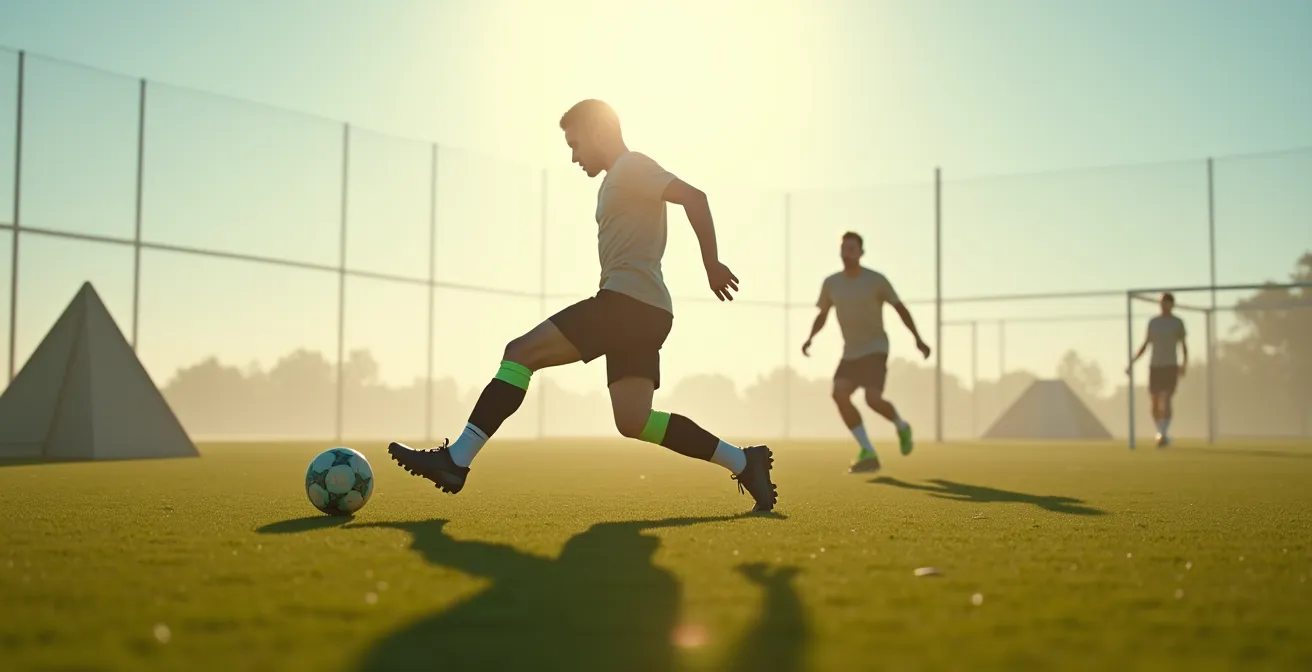
This posture must become your default state before receiving a pass. It requires conscious effort in training to overwrite the lazy habit of standing square to the ball. Your feet, hips, and shoulders must work in concert. This is not just a receiving technique; it is the physical foundation of high-frequency scanning, allowing you to see the field, protect the ball, and execute forward passes in one fluid motion.
Anticipation or Reaction: Which Mental Trait Defines World-Class Defenders?
The distinction between elite and average players, both in attack and defense, is the shift from reaction to anticipation. Reactive players see an event and then decide. Anticipatory players use a stream of data to build a probabilistic model of what is *about to* happen. They don’t just see the pass; they see the likelihood of the pass based on the passer’s body shape, the runner’s movement, and the defensive structure. This predictive processing is fueled by one thing: high-frequency scanning.
Elite defenders exemplify this principle. They don’t just watch the attacker with the ball; they scan the entire attacking structure to predict the next move. They understand the critical concept of “dead time.” When the ball is touched by a player, its pace and direction change, demanding visual focus. However, in the moments the ball is traveling *between* touches, its trajectory is predictable. This is the micro-window for a high-value scan. Elite players look away from the ball during this dead time to gather information on player positions and movements, updating their predictive model before returning their eyes to the ball just before it arrives.
This cognitive skill is fragile and degrades under specific conditions. For example, extensive UEFA youth championship analysis revealed that scan rates are lower under tight pressing. When cognitive load increases due to pressure, players revert to the primitive, “safe” behavior of ball-watching. This is a fatal error. The players who can maintain their scanning discipline under duress are the ones who thrive. They have so deeply ingrained the habit that it operates on a subconscious level, freeing up their conscious mind to make superior tactical decisions.
The Focus Mistake That Causes You to Lose Your Marker in the Box
The single most common cognitive error in football is ball-watching. It is a primitive attentional default that chains you to the present moment, making you completely blind to the developing threats and opportunities around you. In the penalty box, this mistake is catastrophic. A two-second fixation on the ball as it’s crossed is all an attacker needs to drift away from you and find a pocket of space for a clear shot. Your focus becomes a spotlight on the ball, plunging everything else—your marker, the covering defender, the goalkeeper’s position—into a cognitive blind spot.
The difference in visual behavior between a novice and an elite player is stark. The novice’s gaze is magnetically pulled to the ball, with over 90% of their visual fixation directed at it. In contrast, an elite player’s scanning is a structured, efficient sequence: a quick glance at the Ball, then the Man (their direct opponent), then the Space (dangerous areas or passing lanes). This sequence is executed in a fraction of a second and repeated relentlessly. Their gaze is a strobe light, not a spotlight, constantly refreshing their mental map.
This table quantifies the performance impact of different visual behaviors. Your goal is to transition from the default state to the elite scanning pattern.
| Behavior Type | Visual Focus Pattern | Scan Frequency | Performance Impact |
|---|---|---|---|
| Ball-Watching (Default) | 90%+ fixation on ball | <0.2 scans/second | Loses marker, reactive positioning |
| Structured Scanning | Ball-Man-Space sequence | 0.3-0.5 scans/second | Maintains marker awareness |
| Elite Scanning | Quick 0.7 sec glances, <3% fixations | 0.5-0.8 scans/second | Anticipates movements, proactive positioning |
This illustration conceptualizes the defender’s field of vision. Ball-watching creates deep shadows where threats emerge unseen. Structured scanning illuminates these areas, enabling proactive defending.
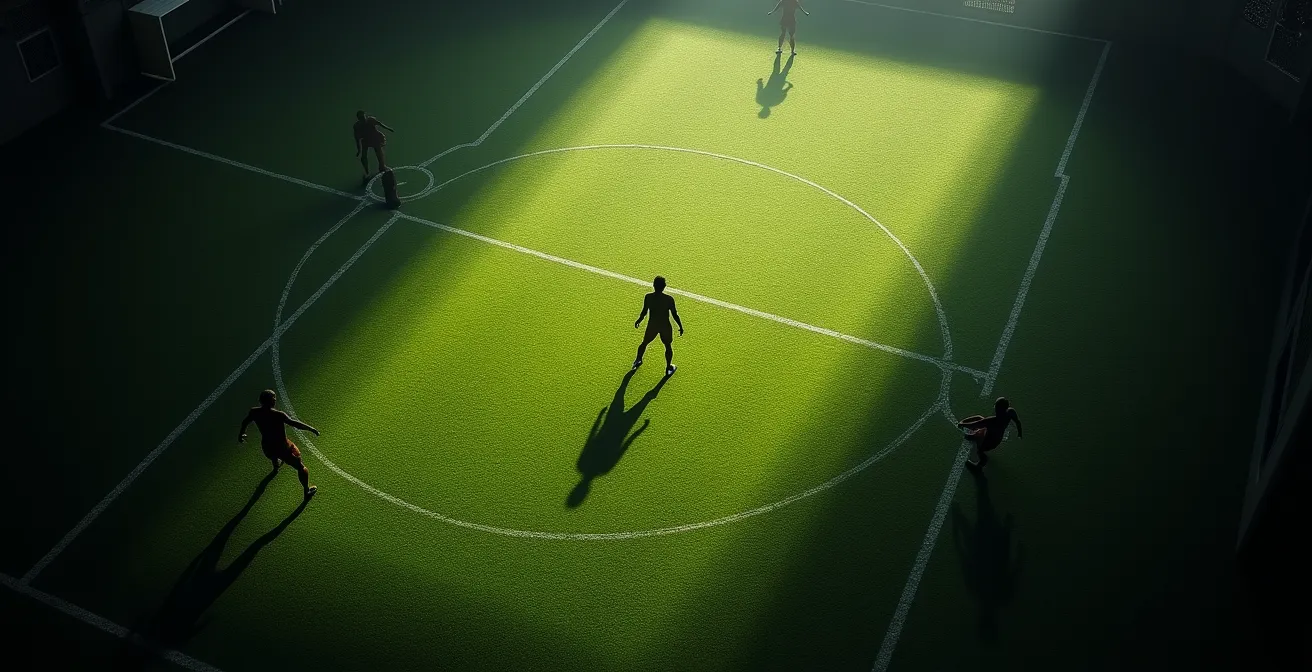
To eliminate this error, you must train your brain to resist the ball’s magnetic pull. Every training session must involve drills that force you to divide your attention and trust that the ball will be where you expect it to be. This is a battle against your own instincts.
How to Reduce Decision Time by 200 Milliseconds Using Color Cued Drills?
Improving scanning frequency is only half the battle. The information gathered must be processed and acted upon with extreme speed. The brain’s choice reaction time—the time it takes to select a response from multiple options—is a critical bottleneck. We can directly train this cognitive muscle using drills that introduce controlled “contextual interference.” Color-cued drills are a powerful and simple method for this neural programming.
The principle is to create a link between a visual cue (a color) and a motor action (a movement or pass). By progressively making this link more complex, you force the brain to process information faster and more flexibly. This is not just a physical drill; it is a workout for your prefrontal cortex, enhancing your executive functions. Research shows that consistent neurocognitive training integrated into regular practice achieves 200-250ms faster decisions. In a game where space and time are measured in fractions of a second, this improvement is monumental.
Implement the following progressive protocol to systematically reduce your decision-making time. This protocol must be executed with maximum intensity and focus. Track your performance to ensure you are meeting the targets.
- Week 1-2: Simple Color Association. Set up cones of two colors. Red means turn/pass right, Green means turn/pass left. Start from a stationary position and react to a coach’s call or a light system. Focus on explosive reaction.
- Week 3-4: Add Contextual Interference. The meaning of the color now changes based on an external factor (e.g., the coach’s position). If the coach is on your right, the color meanings are reversed. This challenges your cognitive flexibility.
- Week 5-6: Combine with Ball Control. Perform the drills while receiving a pass. You must scan for the color cue *as the ball is traveling*, make the decision, and execute with your first touch. This directly simulates game pressure.
- Week 7-8: Opposite Color Reactions. Introduce a rule where you must react to the *opposite* color shown (e.g., see Red, go Left). This places a high demand on your inhibitory control, a key executive function.
Use a reaction timer app to get a baseline measurement before you start and track your progress weekly. Your target is a verifiable reduction of at least 200 milliseconds in your choice reaction time by the end of the eight-week block. This is how you build a faster brain.
How to Improve Scanning Frequency to See Passes Before Receiving the Ball?
Achieving the target frequency of 0.5 scans/second requires moving beyond traditional drills and embracing methods that specifically overload the perceptual-cognitive system. The objective is to make scanning a subconscious, continuous loop, not a conscious, intermittent action. Your training must reflect this. The frequency of scanning directly correlates with a player’s level of quality and their ability to play progressive, line-breaking passes.
The performance gap between player levels is quantifiable and stark. While a youth player might manage 2-4 scans in the 10 seconds before receiving the ball, a top professional operates at 4-6 scans. The world-class elite, however, push this to another level entirely. This data makes the pathway to improvement explicit: to play at a higher level, you must process information at a higher frequency.
The following table, derived from analyses of professional players, shows a direct correlation between scan frequency and passing effectiveness. This is the data that should drive your training focus.
| Player Level | Scans/10 seconds | Scans/second | Pass Completion Impact |
|---|---|---|---|
| Youth Players | 2-4 scans | 0.2-0.4 | Baseline |
| Professional | 4-6 scans | 0.4-0.6 | +15% accuracy |
| Elite (Lampard) | 6.2 scans | 0.62 | +20% forward passes |
| World Class (Xavi) | 8.3 scans | 0.83 | +25% progressive passes |
Modern training methods now allow players to accelerate this cognitive development. Technology provides a way to simulate game scenarios and accumulate scanning practice at a rate impossible on a physical pitch.
Case Study: Aurélien Tchouaméni’s VR Scanning Training
Real Madrid’s Aurélien Tchouaméni utilizes the Be Your Best virtual reality platform for what he calls ‘pre-living games.’ This technology allows him to train specific game scenarios from his living room. For example, before a match where he was expected to play out of position as a centre-back, he used the VR system to specifically enhance his scanning patterns and positional awareness for that role. According to an analysis of his training methods, this allows him to arrive on match day with his brain already programmed for the specific perceptual challenges of the game, a clear competitive advantage.
To systematically improve, you must first measure. Use the following audit to deconstruct your current scanning habits and build a targeted improvement plan.
Your Action Plan: Auditing Your Scanning Protocol
- Identify Triggers: List all phases of play where scanning is critical: before receiving, during a dribble, when a teammate has wide possession, and during defensive transitions.
- Collect Data: Film a 15-minute segment of your gameplay. Manually tally every distinct head turn or shoulder check. Calculate your raw scans-per-second rate in the 5 seconds before you receive a pass.
- Analyze Timing: Confront your data with the “Dead Time” principle. Are your scans occurring as the ball travels, or are you wasting focus when the ball is static at a teammate’s foot? Score your timing efficiency out of 10.
- Assess Impact: Identify 3 moments where a scan provided critical information (a successful forward pass, avoiding a tackle) and 3 moments where a missed scan led to a negative outcome (dispossession, a missed opportunity).
- Implement a Micro-Goal: Based on your audit, define one, non-negotiable scanning trigger for your next training session (e.g., “Every time the ball moves from a center-back to a full-back, I will perform two full scans.”).
The Visual Error That Turns a Good Dribble into a Turnover
A common misconception is that dribbling is primarily a foot-skill. This is dangerously incomplete. Elite dribbling is a visual skill. The fatal error that leads to turnovers is a collapse of visual awareness, where the player’s gaze drops and fixates on the ball at their feet. This “head-down” dribbling instantly erases the player’s mental map of the field. They become blind to the positioning of the second defender, the run of a supporting teammate, and the space opening up behind the defense.
The solution is to train your peripheral vision to maintain awareness of the ball while your central, high-acuity vision is free to scan the field. The ball should be “felt” with the feet and tracked in the lower periphery of your vision, not stared at directly. This is a difficult skill that requires deliberate, structured practice to develop. It feels unnatural at first, as your brain craves the certainty of seeing the ball clearly. You must force your brain to trust your feet and your periphery.
This development sequence is designed to progressively decouple your gaze from the ball, forcing the use of peripheral vision. This is not optional for any player who wants to be a genuine threat on the ball.
- Foundation: During all training, write ‘SCAN’ on your wrist or tape. This serves as a constant, unavoidable visual reminder to get your head up.
- Drill 1 (Peripheral Dribbling): Dribble in an open space with the explicit goal of only seeing the ball in your lower peripheral vision. Your main gaze should be fixed on a point straight ahead.
- Drill 2 (Forced Head-Up): As you dribble, have a partner hold up different colored cones or fingers. You must call out what you see. This makes it impossible to stare at the ball.
- Drill 3 (Scanning Through Defenders): Practice dribbling towards a single defender, but intentionally focus your gaze *past* them to identify the position of a second defender or a teammate making a run.
- Advanced (Occlusion): Use vision-occlusion glasses (which block the lower field of view) for short periods during dribbling drills to aggressively force peripheral awareness.
This isn’t about fancy moves; it’s about processing information while executing a technical skill. The best dribblers are not the ones with the quickest feet, but the ones with the quietest heads, constantly updating their options while the ball seems attached to their foot by a string.
Key Takeaways
- Elite scanning is a trainable neuro-cognitive skill, not just a habit. The benchmark is over 0.6 scans per second.
- Effective scanning is impossible without an “open” body shape (half-turn), which is the physical prerequisite for forward play.
- The goal of scanning is anticipation, not reaction. This is achieved by building a probabilistic model of the game during “dead time” (when the ball is in transit).
How to Find Pockets of Space Between the Lines Against a 4-4-2?
Mastering the individual cognitive and physical components of scanning culminates in the ability to solve complex tactical puzzles in real-time. Finding and exploiting pockets of space between the midfield and defensive lines of a compact 4-4-2 formation is one of the most challenging tasks for a midfielder. This space is transient, opening and closing in fractions of a second based on the horizontal and vertical shifts of the defensive block. It cannot be found by reacting; it must be anticipated.
Exploiting this space requires a collective scanning intelligence. The key is not just your own scanning, but understanding that all your teammates must be adopting open body shapes and scanning constantly. Elite teams manipulate the 4-4-2 block by using a series of short, quick passes on one side of the pitch. This deliberately draws the opponent’s midfield and defensive lines over to that side, causing a momentary, stretched channel to open between the far-side center-back and full-back. The switch of play into this channel must be timed perfectly, as the defensive block will quickly shift horizontally to close it. The decision to switch is made based on scans that identify the over-commitment of the defensive block.
This hyper-detailed view represents the cognitive process: the eye itself reflecting the tactical problem to be solved. The player’s focus is on identifying the transient gaps in the opponent’s structure.

To operate effectively in these pockets, your scanning must become predictive. As the ball is traveling towards you, your scans should be answering a specific question: “Where will the space be in the next 0.5 seconds?” You are looking for the defender’s momentum, the direction of their hips, and the gap they are about to vacate. You receive the ball in that space, already turning to exploit it before the defense can recover. This is the pinnacle of game intelligence—using a high-frequency stream of visual data to out-think the opposition’s structure.
You now have the neuro-scientific framework and a series of demanding protocols. The gap between your current ability and elite performance is a function of deliberate, focused, and quantifiable training. Stop making excuses and begin the work of reprogramming your cognitive processes on the pitch.