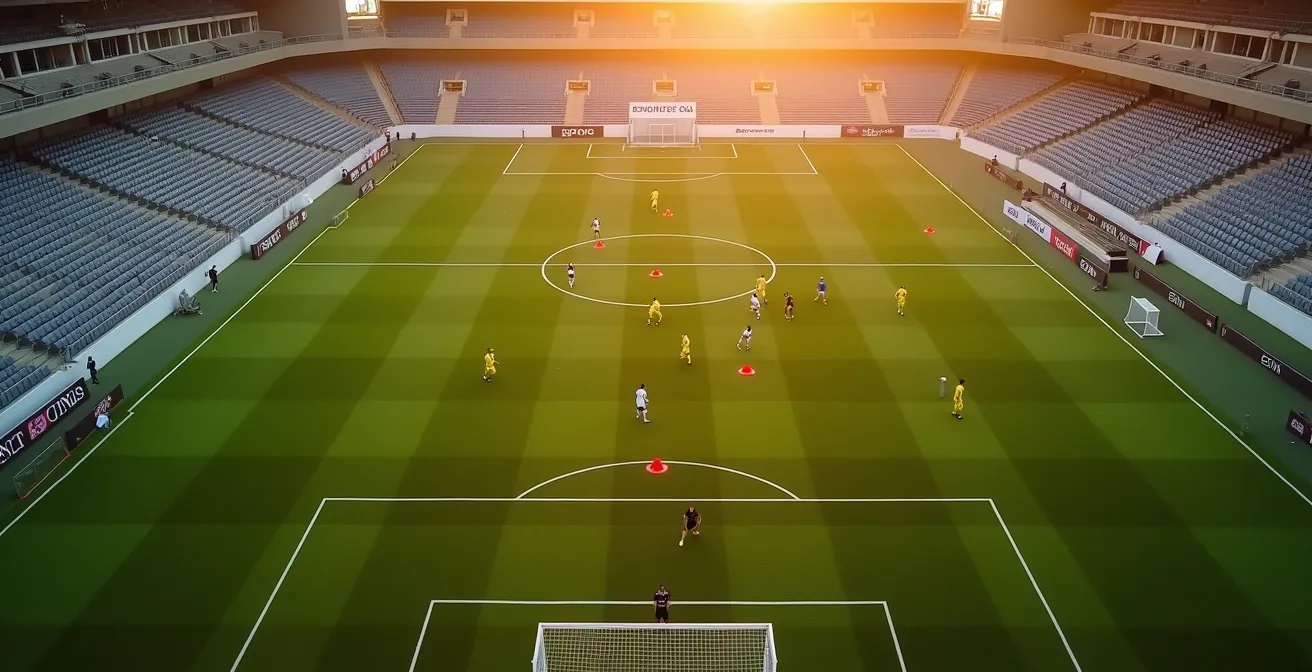
The success of modern mid-table teams is not built on isolated tactics, but on creating a coherent tactical ecosystem where every strategic choice is a calculated trade-off.
- Defensive structures like the low-block are not passive; they are active systems designed to dictate opposition play and create specific transition opportunities.
- Advanced roles like the inverted full-back and flexible formations demonstrate a shift from reactive defending to proactive, in-game problem-solving.
Recommendation: Analysts and coaches should focus less on adopting singular tactics and more on building a system where player roles, formation, and intensity management work in complete harmony.
In the high-stakes world of modern football, the narrative is often a familiar tale of financial Goliaths dominating the league tables. The prevailing wisdom suggests that for a mid-table team, success against a top-tier opponent is a matter of luck, defensive grit, and perhaps a moment of individual brilliance. Conventional advice revolves around generic principles: “park the bus,” counter-attack with pace, and fight for every ball. While discipline and spirit are essential, this view vastly underestimates the strategic revolution happening just below the summit of the sport.
The true story is far more nuanced and intellectually compelling. It’s a story of innovation born from necessity, where smaller budgets are compensated for by superior strategic thinking. The most successful mid-table disruptors no longer rely on simply frustrating their opponents; they aim to outsmart them. This involves moving beyond a single game plan and building a dynamic, adaptable tactical framework where every decision—from the starting formation to the trigger for a press—is a calculated choice with clear trade-offs.
But what if the key to competitiveness isn’t just about choosing between a high press or a deep block, but understanding how to integrate these concepts into a single, coherent system? This analysis will deconstruct the specific tactical mechanisms that empower mid-table teams. We will explore the science behind frustrating possession-heavy giants, the complex implementation of modern player roles, the critical decisions around in-game adaptability, and the coaching methodologies required to make it all work. It’s time to look beyond the clichés and analyze the tactical ecosystem that is leveling the playing field.
This in-depth analysis breaks down the core components of this tactical revolution. The following sections explore everything from foundational defensive strategies to advanced squad management and coaching principles, providing a complete picture of how tactical intelligence has become the great equalizer in modern football.
Summary: Deconstructing the Modern Mid-Table Tactical Playbook
- Why the Low-Block Defensive Strategy Frustrates Possession-Heavy Teams?
- How to Implement Inverted Full-Backs Without Exposing the Flanks?
- High Pressing or Deep Defending: Which Strategy Suits a Team with Low Stamina?
- The Common Tactical Mistake That Leaves the Central Channel Wide Open
- When to Switch Formations: 3 Signs Your Opponent Has Figured You Out
- Narrow Block or Wide Press: Which Shape Stops Wing-Heavy Teams Best?
- Specialist Role or Utility Player: Which Is More Valuable for a Squad?
- How to Structure Coaching Sessions to Maximize Intensity Without Risking Burnout?
Why the Low-Block Defensive Strategy Frustrates Possession-Heavy Teams?
The low-block is often misunderstood as a passive, “park the bus” tactic. In reality, a well-drilled low-block is an active defensive system designed to nullify space in the most dangerous areas of the pitch—the central channel and the penalty box. By compressing the defensive and midfield lines, the team creates a compact shape that denies passing lanes between the lines. This forces possession-heavy teams, who thrive on intricate central combinations, into predictable patterns of play. They are often forced to circulate the ball harmlessly in front of the block or resort to low-percentage crosses from wide areas.
The strategic genius of the low-block lies in its ability to control the opponent’s actions without having the ball. It sets a trap. As the opposition pushes forward, they inevitably commit players, leaving space behind their own midfield and defensive lines. This is the trigger moment. Upon winning possession, the low-block team is perfectly structured to launch rapid counter-attacks into this vacated space. The effectiveness of this approach is well-documented; for instance, an analysis of Antonio Conte’s Premier League-winning side showed that Chelsea conceded just 33 goals in 38 games using this disciplined structure as a foundation.
Case Study: Atlético Madrid’s Low-Block Implementation
Diego Simeone has built a dynasty at Atlético Madrid by perfecting the low-block, typically from a 4-4-2 formation. The system’s success is not just about the back four. It relies on incredibly versatile and hard-working midfielders like Koke and Marcos Llorente. They work in tandem with the forwards to form a narrow, combative, and horizontally-compact unit. This shape denies central progression and allows them to transition from a solid defensive wall to a potent attacking force in a matter of seconds, exemplifying how a low-block is a key part of a complete tactical ecosystem.
Therefore, the low-block frustrates top teams not by simply defending, but by dictating where the game is played and creating high-value attacking opportunities from a position of defensive security. It’s a calculated trade-off of territory for tactical control.
How to Implement Inverted Full-Backs Without Exposing the Flanks?
The inverted full-back is one of the most sophisticated innovations in modern tactics, famously pioneered by Pep Guardiola. Instead of overlapping on the wing, the full-back tucks into the central midfield during the build-up phase. The primary goal is to create a numerical superiority in the center of the pitch, allowing for better ball retention, control, and a more robust structure to defend against counter-attacks. This central overload can dismantle an opponent’s midfield press and open up new passing angles. Data supports this, as FIFA’s analysis shows inverted full-backs attempt more line-breaking passes than their traditional counterparts, making them a progressive tool.
However, this tactic comes with a significant calculated trade-off: it vacates the wide defensive areas, potentially exposing the team to attacks down the flanks. Successful implementation requires a coherent system, not just a talented player. The key is coordinated movement from other players. This typically involves:
- A wide winger holding their position high and wide to provide the team’s width in attack.
- A central midfielder or a center-back ready to shift across and cover the space abandoned by the inverting full-back.
- A holding midfielder who understands how to adjust their position to balance the new midfield structure.
The entire team must understand these rotations, which are drilled extensively in training. Without this systemic coherence, the tactic will fail and leave the team vulnerable. As first seen with Philipp Lahm at Bayern Munich, the inverted full-back is not a standalone role but the lynchpin of a fluid, possession-based system.

This visual representation shows how the full-backs (represented by knights) move from the flanks into the central zone, reinforcing the midfield. This repositioning is the heart of the tactic, but its success is entirely dependent on the rest of the team’s structure adjusting in unison to maintain defensive balance.
High Pressing or Deep Defending: Which Strategy Suits a Team with Low Stamina?
For any coach, especially at a mid-table club with finite resources, the choice between a high-pressing system and a deep-defending block is a fundamental strategic decision. A high press, or ‘gegenpressing’, aims to win the ball back immediately after it’s lost, high up the pitch. It is proactive and can lead to goal-scoring opportunities close to the opponent’s goal. However, it is incredibly demanding physically and requires elite levels of stamina, coordination, and speed across the entire team. For a squad with low or mixed stamina levels, attempting to maintain a high press for 90 minutes is a recipe for burnout and late-game defensive collapses.
Conversely, a deep-defending strategy, such as the low-block, is inherently more conservative in its energy expenditure. By retreating into a compact shape, players reduce the distances they need to cover. The focus shifts from aggressively chasing the ball to maintaining positional discipline and closing down space as the opponent enters the final third. This approach conserves energy, making it a far more sustainable strategy for teams that cannot match their opponents physically or need to protect a lead.
The key is energy efficiency. As one analysis of defensive strategies notes, by focusing on position rather than constant pursuit, players can conserve vital energy. This is crucial in matches where a team is outmatched in skill or physicality. The tactical ecosystem for a low-stamina team must be built on principles of intensity management: knowing when to conserve energy in a solid block and identifying specific, pre-determined triggers to expend energy in a coordinated press or a swift counter-attack. A hybrid model, where the team sits in a mid-block and only presses intensely upon certain cues (e.g., a poor touch, a pass to a specific player), often represents the most intelligent trade-off.
The Common Tactical Mistake That Leaves the Central Channel Wide Open
In the chess match of football tactics, control of the center is paramount. Yet, one of the most frequent and costly errors made by teams is leaving the central channel—the area directly in front of the center-backs—dangerously exposed. This vulnerability often stems from a poorly structured midfield. A flat two-man midfield in a 4-4-2, for example, is particularly susceptible. If both midfielders are drawn towards the ball or pulled out of position by opposing runners, a huge gap opens up for attacking midfielders or “false nines” to receive the ball in a prime scoring position, facing the goal with space to operate.
Another cause is the failure to maintain “vertical compactness,” which is the distance between the defensive line and the midfield line. If the defense drops too deep while the midfield pushes up to press, this fatal gap appears. Elite teams are masters at exploiting this. They use clever rotations and third-man runs to pull a midfielder out of the central zone and then quickly play the ball into the space that has been created. The recent decline in back-three formations, as only 19.2% of Premier League starting XIs used one in 2023/24, means many teams rely on a back-four, making the role of a screening midfielder even more critical.
Protecting this zone is non-negotiable for tactical stability. It requires a clear system and disciplined players who understand their roles within the team’s defensive structure. A dedicated holding midfielder, often called the ‘number 6’ or ‘firefighter’, is the most common solution, tasked with screening the backline and plugging these gaps.
Action Plan: Audit Your Central Channel Defense
- Compactness Check: During video analysis, pause play when the opponent is in possession in midfield. Are the distances between your defenders and midfielders minimal? Can you draw a tight grid around them?
- Screening Inventory: Identify who your designated holding midfielder is. Review their last three games: how many times were they pulled out of the central zone? Do you need to adjust their instructions or personnel?
- Midfield Structure Analysis: If you use a two-man midfield, is it too flat? Confront this with your team’s values. Do you prioritize a creative ‘number 8’ over a defensively solid partner? This is a critical trade-off.
- Vulnerability Mapping: Watch goal concession highlights. How many originated from a pass or run through the central channel? Identify patterns: is it a specific player’s movement or a systemic failure?
- Coaching Integration Plan: Based on the audit, dedicate a training session to “defending the center.” Use drills that force midfielders to maintain their shape and communicate with the backline, prioritizing the protection of this key area.
When to Switch Formations: 3 Signs Your Opponent Has Figured You Out
A well-defined tactical system is a mid-table team’s greatest asset, as famously demonstrated by Leicester City in 2016, whose incredible title win proved that a well-organized team can defeat opponents with vastly superior budgets. However, in the modern game, tactical rigidity can be a death sentence. An astute opposing coach will spend the first half analyzing your team’s patterns and implement changes to exploit them. The ability to recognize when your system has been “figured out” and to adapt accordingly is a hallmark of elite coaching and a crucial survival skill.
Recognizing the signs is the first step. Here are three clear indicators that your opponent has neutralized your primary game plan and a change is needed:
- Your Key Player is Neutralized: If your primary playmaker or goal threat is being consistently double-teamed or man-marked out of the game, and is receiving fewer touches in dangerous areas than usual, your system’s main outlet has been cut off.
- Passing Lanes to Your Forwards are Blocked: You may have comfortable possession among your defenders, but if every attempt to pass into the final third is being intercepted, the opposition has likely adjusted their defensive shape to block the specific channels you were using.
- You Are Consistently Being Overloaded in a Key Area: If the opponent is repeatedly creating a 2-vs-1 or 3-vs-2 situation on the flank or in central midfield, they have identified a structural weakness in your formation and are systematically exploiting it.
Switching formations is the most powerful way to respond. This could mean changing from a 4-4-2 to a 4-3-3 to regain control of the midfield, or from a back-four to a back-five to counter relentless wing play. This tactical flexibility is a weapon. It forces the opponent to solve a new problem mid-game, disrupting their rhythm and creating new opportunities.

Like a chess master, a coach must always be thinking several moves ahead. Having pre-planned formation switches and players with the tactical intelligence to execute them is essential. It’s about having not just a Plan A, but a coherent and well-drilled Plan B and C.
Narrow Block or Wide Press: Which Shape Stops Wing-Heavy Teams Best?
Facing a team whose primary threat comes from wide areas presents a specific tactical problem. The choice of defensive shape to counter this threat is a critical one, with two primary approaches: the narrow block and the wide press. Each has distinct advantages and risks, and the correct choice depends on the specific type of winger you are facing and the strengths of your own players. The decision is a calculated trade-off between conceding space in one area to protect another.
A narrow block involves keeping your midfield and defensive lines horizontally compact, prioritizing the protection of the central channel and the penalty area. This shape is highly effective against teams that use inverted wingers who like to cut inside and shoot or combine with a striker. By packing the center, you deny them this space and force them to play around the block. The trade-off is that you concede space on the flanks, inviting the opponent to cross the ball from deep. This can be a viable strategy if your team has dominant central defenders who are strong in the air.
Conversely, a wide press instructs your own wide players (wingers or full-backs) to aggressively engage the opponent’s wingers high up the pitch, trying to stop the threat at its source. This is best against traditional wingers who aim to get to the byline and deliver crosses. The advantage is that you can prevent dangerous balls from entering your box. The risk, however, is significant: this aggressive pressing can leave large gaps in central midfield if the opponent is able to switch play quickly.
A more balanced solution is often the “mid-block,” which offers a blend of both principles. As tactical analysts note, this is a more controlled approach.
The mid block will typically start just short of the halfway line and stretch 30 yards or so into the attacking third. Sides that adopt a mid block will typically allow the opposition’s defenders time and space when on the ball, while looking to press with intent once possession is transferred into the middle or attacking third.
– Tactical Analysis, Discount Football Kits – Tactics Explained
The following table, based on an analysis of defensive structures, breaks down the core trade-offs of each shape.
| Defensive Shape | Best Against | Key Advantage | Main Risk |
|---|---|---|---|
| Narrow Block | Inverted wingers cutting inside | Forces predictable crosses from deep | Vulnerable to overlapping full-backs |
| Wide Press | Traditional wingers crossing from byline | Stops crosses at source | Central spaces can open up |
| Pendulum Defense | Teams with slow ball circulation | Aggressive ball-side overload | Vulnerable to quick switches of play |
Specialist Role or Utility Player: Which Is More Valuable for a Squad?
Squad construction for a mid-table team is a masterclass in resource optimization. With a limited budget, every signing and contract extension is a critical decision. A central debate in this process is the relative value of the specialist versus the utility player. A specialist is a player who excels in one specific role—a towering center-back who only wins headers, a dead-ball expert, or a lightning-fast winger. A utility player, by contrast, is a jack-of-all-trades, capable of playing multiple positions to a competent, if not elite, level.
The conventional wisdom for building a starting eleven leans towards specialists. A team’s tactical identity is clearest when each player is an expert in their designated role within the system. For a mid-table team aiming for consistency, having a starting lineup where every position is filled by a player with at least a solid divisional standard is fundamental. The goal should be to have at least 18 players adequate to the levels of the division who can be called upon at any point in the season.
However, the value of the utility player becomes apparent when considering the demands of a long season and the need for tactical flexibility. They are the ultimate enablers of in-game adjustments. Having a player on the bench who can competently fill in at full-back, central midfield, or on the wing allows a coach to change formation and strategy without using up multiple substitutions. This positional fluidity is invaluable for reacting to injuries, red cards, or an opponent’s tactical switch. The ideal squad, therefore, is not a collection of one or the other, but a balanced ecosystem: a starting XI of specialists to define the team’s core identity, supported by a bench of utility players who provide the flexibility to adapt and overcome unforeseen challenges.
Key Takeaways
- Tactical success for mid-table teams stems from a coherent system, not isolated tricks.
- Defensive organization is an active strategy to dictate play, not passive containment.
- Adaptability, enabled by tactical flexibility and versatile players, is as crucial as the initial game plan.
How to Structure Coaching Sessions to Maximize Intensity Without Risking Burnout?
Implementing a sophisticated tactical system requires immense work on the training ground. The sessions must be intense enough to replicate match conditions and drill complex movements until they become second nature. However, for a mid-table squad with finite physical resources, relentless high-intensity training can lead to fatigue, injury, and burnout. The modern approach to coaching, therefore, is rooted in the science of tactical periodization and intensity management. The continuous progress in tactical analysis means that training must be as smart as it is hard.
The key principle is to vary the intensity both within a single session and across the training week. Not every drill needs to be performed at 100% physical output. A significant portion of tactical learning—understanding positioning, movement triggers, and team shape—can be achieved at a lower tempo. This allows players to absorb complex information without being physically overloaded. The high-intensity bursts are then reserved for drills that specifically aim to improve endurance and replicate the most demanding moments of a match.
Data from sports science provides a clear model for this. For instance, Catapult’s analysis of professional teams shows an optimal distribution where training is composed of roughly 80% controlled tempo and 20% maximum intensity bursts. This 80/20 rule ensures that players develop tactical understanding and physical resilience in a sustainable way. For a coach, this means structuring the week carefully: sessions closer to the previous match might focus on recovery and low-intensity tactical work, while peak intensity is reached mid-week, before tapering off in the 48 hours before the next game. This strategic management of a team’s energy is the final, crucial component of the tactical ecosystem, ensuring the team arrives on match day mentally sharp and physically ready.
By integrating these tactical, strategic, and coaching elements into a single, coherent philosophy, mid-table teams can build an ecosystem that consistently allows them to punch above their financial weight. The modern game is proving that while money can buy talent, it cannot buy the systemic coherence and tactical intelligence that are now the true hallmarks of a well-run football club. To apply this thinking, the next logical step is to perform a rigorous analysis of your own team’s capabilities and tactical identity.