
True team chemistry isn’t about forced fun or generic activities; it’s about consciously engineering a psychological safety net where players connect on a human level.
- Toxic social cliques can actively sabotage on-pitch coordination and are a leading cause of team failure.
- Structured vulnerability and shared purpose activities build trust far more effectively than unstructured free time.
- Proactive integration for new signings is a management responsibility, not just a hope, and prevents months of isolation.
Recommendation: Shift your focus from planning one-off events to building a continuous culture of connection, trust, and psychological safety throughout the season.
The pre-season tour: a time of fresh hopes, new faces, and the promise of a successful season ahead. For managers and captains, it’s the critical window to forge a disjointed group of talented individuals into a cohesive, single-minded unit. The conventional playbook is familiar: organize a few team dinners, maybe an escape room or a round of golf, and hope for the best. This approach sees team building as a box to be ticked, an activity on a schedule.
But what if this entire perspective is flawed? What if the key to unbreakable team chemistry isn’t just *what* you do, but the psychological principles behind *how* and *why* you do it? True team cohesion isn’t an accident; it’s a form of social architecture. It requires a deliberate strategy to dismantle the invisible barriers that create friction, manage the natural formation of cliques, and build a genuine sense of belonging and trust among every single member of the squad, from the star striker to the rookie defender.
This guide moves beyond the platitudes to give you a facilitator’s playbook. We will deconstruct the destructive power of social cliques, explore how to design activities players actually enjoy, weigh the benefits of structured versus unstructured time, and provide actionable strategies to integrate new signings and manage locker room conflict before it turns toxic. It’s time to stop hoping for chemistry and start building it with intent.
Summary: The Manager’s Guide to Building Elite Team Chemistry
- Why Social Cliques Can Destroy On-Pitch Performance?
- How to Organize Team Building Activities That Players Actually Enjoy?
- Structured Team Building or Free Time: Which Creates Better Bonds?
- The Integration Mistake That Isolates New Signings for Months
- When to Intervene in a Locker Room Dispute Before It Becomes Toxic?
- The Management Mistake That Allows Toxic Cliques to Divide an Elite Squad
- Why Rotating Key Players Before a Derby Can Backfire Psychologically?
- Why Elite Rosters Struggle with Harmony When Too Many Stars Want Playing Time?
Why Social Cliques Can Destroy On-Pitch Performance?
On the surface, social cliques seem like a natural, harmless part of any group. Players from the same country or with similar interests gravitate towards each other. However, in a high-performance environment, these unchecked social divisions act like a poison. They create an “us versus them” mentality that directly sabotages the trust and instant communication required for success on the pitch. When a player is more loyal to their clique than to the team, they might hesitate to make a difficult pass to someone outside their circle or fail to provide defensive cover, creating fractures in team strategy.
This isn’t just theory; it has a measurable impact. When on-pitch partnerships are not reinforced by off-pitch social connections, the team’s overall coordination suffers. The instinctive, almost telepathic understanding seen in top teams is a product of this holistic cohesion. When cliques dominate, this synergy is impossible. Instead, you get miscommunication, blame games, and a drop in collective effort. The energy that should be focused on the opponent is instead wasted on internal politics and navigating social minefields.
Case Study: The Decline of FC Barcelona’s Famed Chemistry
The 2014-2015 FC Barcelona squad is often cited as a benchmark for optimal team chemistry, leading to a dominant La Liga season. However, in the years that followed, despite spending over $600 million on new players, the team’s performance declined and debt soared. Analysts point to two critical failures in social architecture: an inability to effectively integrate new talent to replace an aging core and poor choices in superstar signings. These decisions disrupted the delicate chemical balance, proving that even for the most elite clubs, ignoring the human element and the dynamics of team cohesion can lead to catastrophic failure.
Ultimately, a team divided by cliques is a team that is easy to beat. The lack of unity creates predictable patterns of play that opponents can exploit and leads to a brittle team spirit that shatters under pressure. As a manager or captain, identifying and dismantling these social barriers isn’t “soft” management; it’s a fundamental requirement for building a resilient, winning squad.
How to Organize Team Building Activities That Players Actually Enjoy?
The collective eye-roll from players when “team building” is announced is a clear sign that the old methods are broken. Forcing professional athletes into cheesy trust falls or awkward icebreakers often builds resentment, not camaraderie. The key to success is shifting the ownership of these activities to the players themselves and focusing on authenticity and shared purpose rather than forced fun. An activity will only be effective if players are genuinely invested in it.
Instead of management-mandated fun, create a system where players have a voice. This fosters a sense of autonomy and ensures the chosen activities resonate with the group’s actual interests. The goal is to create experiences that break down hierarchies and allow players to see each other as multifaceted human beings, not just as teammates defined by their position on the field. Activities with a shared purpose, like community service projects, are especially powerful. They unite the team around a goal that is bigger than themselves, forging bonds through collaborative effort and shared accomplishment.

This image of players working together on a community project perfectly illustrates the concept. They are equals, working towards a common goal, building relationships in a context completely removed from the pressures of professional sport. It is in these moments of authentic interaction that the foundation of a psychological safety net is built, creating connections that will hold strong under the stress of a competitive match.
Your Action Plan: Player-Led Team Building
- Form a Committee: Create a rotating committee of players, mixing seniors, new signings, and younger talent, to propose and organize bonding activities.
- Implement Vulnerability Sessions: Organize structured, vulnerability-based sessions where senior players are encouraged to share stories of past failures and how they demonstrated resilience.
- Organize ‘Shared Purpose’ Activities: Plan activities outside of sport, such as community service projects or skills workshops in a different domain (like cooking or a language class).
- Use Structured Sharing Exercises: Incorporate simple exercises like the ‘Team Web’, where players sit in a circle and share what they value about each teammate, fostering mutual respect.
- Plan Informal Social Time: Arrange for pre- or post-game meals at teammates’ houses or local restaurants, allowing relationships to strengthen in a relaxed, informal setting.
Structured Team Building or Free Time: Which Creates Better Bonds?
A common debate on pre-season tours is how to balance the schedule. Should you fill the days with structured activities or give players ample free time to bond “naturally”? While downtime is essential for recovery, relying on it to build deep-seated chemistry is a strategic mistake. Unstructured time often leads to the reinforcement of existing cliques, as players will naturally gravitate to those they already know, leaving new or quieter players on the periphery.
Structured activities, when designed correctly, are far more effective at intentionally forging new connections. They are a tool for social engineering, creating scenarios that compel players from different social groups to interact, communicate, and solve problems together. This doesn’t have to be complex; it can be as simple as assigning mixed groups for a small-sided game or a dinner seating plan. The data supports this: a study by flair.hr found that well-executed team-building activities can lead to a 61% improvement in team morale and 63% better communication.
The key is that structure provides the container for connection to happen. It removes the social anxiety and guesswork, making it easier for relationships to form. As Lisa Bluder, a highly respected coach, explains, even simple, consistent structures can have a profound impact:
We eat a training table meal together every single day. Coaches can get to know their players a lot better during these team meals. Players and coaches getting to know each other on a more personal level will build a stronger bond between everyone.
– Lisa Bluder, University of Iowa Women’s Coach
This demonstrates that “structure” doesn’t mean “rigid” or “boring.” It means creating consistent, low-pressure opportunities for personal interaction. Free time allows for rest, but structured social architecture builds the championship-winning bonds that last an entire season.
The Integration Mistake That Isolates New Signings for Months
Perhaps the biggest oversight in building team chemistry is the passive approach to integrating new players. The prevailing attitude is often, “they’re a professional, they’ll figure it out.” This leads to what can be called integration friction—a period of weeks or even months where a new signing feels isolated, struggles to understand the team’s unwritten social rules, and fails to build the on-pitch trust necessary to perform at their best. This isolation is a silent performance killer.
Leaving integration to chance is a massive gamble. The responsibility lies with the management and senior players to create a deliberate and welcoming onboarding process. This goes far beyond a simple locker room introduction. It involves a proactive strategy to make the new player feel valued, understood, and connected from day one. A formal mentorship or “buddy system,” pairing a new signing with a respected veteran, is one of the most effective tools. This gives the newcomer a go-to person for questions, both tactical and social, immediately lowering their anxiety and accelerating their sense of belonging.
This process is a two-way street, as one professional player advises new signings to take initiative. However, the structure must be there to support their efforts.
If you’re a new player in the team try to break the ice with small conversations here and there and always shake your teammate’s hands or at least say hello. Start with the players that are sitting next to you and ask them different kinds of things… In this way, you can start creating a basic connection to them that can, later on, build up a strong relationship.
– Professional Player Perspective
To facilitate this, management can implement simple but powerful tools. Create a cheat sheet of local slang and key tactical terms, ensure their role is clearly defined to avoid uncertainty, and schedule regular, informal check-ins. These small acts of proactive integration transform a new signing from an outsider into a trusted teammate in a fraction of the time.
When to Intervene in a Locker Room Dispute Before It Becomes Toxic?
Conflict is inevitable in a competitive environment. The difference between a high-performing team and a dysfunctional one is not the absence of disputes, but how they are managed. A common mistake is to ignore minor disagreements, hoping they will resolve themselves. This passivity allows resentment to fester, turning a small personality clash into a toxic locker room issue that can derail an entire season. The key is early, calm, and structured intervention.
Recognizing the warning signs is the first step. Are certain players avoiding each other? Is there a new tension in training? Are post-game debriefs becoming personal? These are red flags that demand attention. Intervention shouldn’t be a public dressing-down but a private, facilitated conversation. The manager’s role is not to take sides, but to act as a mediator, helping both parties understand each other’s perspectives. Often, conflicts arise not from malice, but from simple differences in behavioral patterns and communication styles.
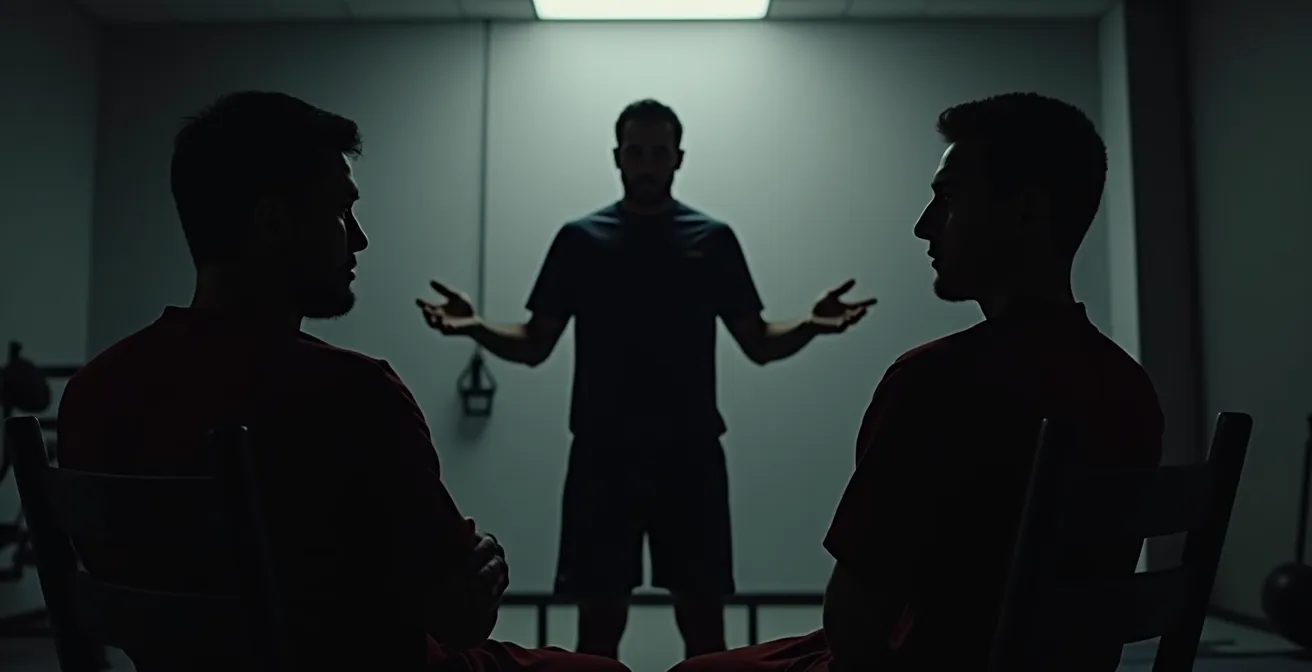
The scene above, with a manager mediating between two players, captures the essence of effective conflict resolution: it’s about de-escalation and understanding. By creating a safe space for dialogue, you prevent the dispute from becoming public and polarized. This proactive approach is central to maintaining the team’s psychological safety net, ensuring that disagreements strengthen understanding rather than destroying relationships.
The ’24-Hour Rule’ Protocol: A Proactive Approach
Many professional teams implement a ’24-Hour Rule’ to manage conflict. Players and coaches are discouraged from addressing contentious issues in the heat of the moment. Instead, they are given 24 hours to cool down before discussing the problem. This prevents emotional outbursts and allows for a more rational conversation. Furthermore, many teams work in the pre-season to identify potential behavioral clashes based on personality profiles. By making everyone aware of different communication styles upfront, the team can plan accordingly and manage personality differences before they ever escalate into a full-blown conflict.
The Management Mistake That Allows Toxic Cliques to Divide an Elite Squad
One of the most insidious management mistakes is the passive acceptance of toxic cliques. While some social grouping is normal, a toxic clique operates like a state within a state. It has its own agenda, protects its members above the team, and often undermines the coach’s authority. Allowing such a group to solidify is a failure of leadership, and it happens when managers either play favorites, ignore warning signs, or are too intimidated to confront influential players.
The mistake begins with a lack of clearly defined and consistently enforced team values. When the “team first” mentality is just a slogan on the wall and not the standard for every decision, it creates a vacuum where cliques can thrive. A manager who rewards a player from a dominant clique despite poor behavior or a lack of effort sends a clear message: the rules don’t apply to everyone. This instantly breeds resentment and fractures the locker room. This isn’t a minor issue; Northwestern University research shows a 2-7% increase in correctly predicted games based on chemistry metrics, highlighting the tangible cost of a divided squad.
Preventing this requires constant vigilance and unwavering fairness. The principles of your social architecture must be applied universally. This means calling out negative behavior, regardless of who the player is. It also involves strategically breaking up cliques during training drills, travel arrangements, and team activities. You are not trying to prevent friendships, but you are actively preventing the formation of exclusive, powerful subgroups that challenge the team’s unity. The harmony of the entire squad must always take precedence over the comfort of a few.
Ignoring a burgeoning toxic clique is like ignoring a crack in the foundation of a house. It may seem small at first, but it will inevitably grow, compromise the entire structure, and lead to an eventual collapse, often at the moment of greatest pressure.
Why Rotating Key Players Before a Derby Can Backfire Psychologically?
Rotating the squad is a modern necessity for managing player fatigue. However, the decision to rest a star player for a crucial derby match, often to keep them fresh for a “more important” game later, can have severe psychological repercussions that outweigh the physical benefits. From a player’s perspective, a derby is more than just another game; it’s a battle for pride, for the fans, and for bragging rights. Being benched for such a fixture can feel like a vote of no confidence.
The primary backfire is the message it sends to the entire squad. For the benched star, it can be interpreted as the manager not trusting them or prioritizing a different competition, which can lead to feelings of resentment or disconnection. For the players on the field, it can add immense pressure, making them feel like they are simply “filling in” and that a loss is more likely without their key teammate. This erodes the collective belief and “all for one” mentality that is so vital in high-stakes matches. The team’s psychological safety net is weakened when players feel their role and importance are conditional.
Furthermore, it disrupts the hard-earned on-pitch chemistry. The subtle understandings and movements between key players, built over hundreds of hours, are suddenly removed. The replacement player, no matter how talented, cannot replicate that specific dynamic instantly. This can lead to hesitation, missed opportunities, and defensive disorganization. As the Keep Playing Baseball Organization notes, team success hinges on every player, regardless of their role, feeling important and bought-in. Benching a healthy star for a derby can make their on-field contribution feel devalued, which can ripple through the entire squad.
While physical management is crucial, it cannot be done in a vacuum. A manager must weigh the physical rest against the potential for psychological damage. In a derby, the emotional and mental state of the team is often the deciding factor, and a decision that undermines squad belief can be the one that ultimately costs you the game.
Key Takeaways
- True team chemistry is engineered through a deliberate social architecture, not left to chance.
- Player-led activities focused on shared purpose and structured vulnerability are more effective than forced fun.
- Proactive integration of new players and early intervention in disputes are critical management responsibilities to maintain a psychological safety net.
–
Why Elite Rosters Struggle with Harmony When Too Many Stars Want Playing Time?
Assembling a roster of star players seems like a direct path to victory, but it often becomes a manager’s biggest headache. The core of the problem is a conflict between individual ambition and collective need. Every elite athlete has a powerful drive to be on the pitch, to be the difference-maker. When you have more stars than starting positions, you create a high-pressure environment where competition can turn from healthy to destructive. This is the ultimate test of a team’s social architecture.
The primary challenge is managing expectations and defining roles with absolute clarity. A star player who finds themselves on the bench can feel their status is threatened, leading to frustration, dissent, and a negative influence in the locker room. Their dissatisfaction is contagious and can quickly undermine the morale of the entire group. It creates a dynamic where players are constantly looking over their shoulders, more concerned with their individual playing time than with the team’s success. The support and encouragement that should exist between teammates are replaced by rivalry and tension.

This powerful image captures the silent story of an elite roster: the tension, the anticipation, and the frustration of immense talent waiting on the sidelines. Each grip tells a story of a player wanting to contribute but being unable to. Without a strong team culture, this energy turns inward and becomes corrosive. To counteract this, a manager must relentlessly communicate and reinforce the idea that every role, whether it’s starting, coming off the bench for 20 minutes, or mentoring in training, is vital to winning. Celebrating the assist from a substitute with as much enthusiasm as the starter’s goal is a small but powerful way to build this culture. It requires making every single player feel valued beyond their minutes on the pitch.
Ultimately, a team of stars can only succeed if they are convinced that the collective trophy is more valuable than their individual statistics. This requires a masterful job of man-management, focusing on building a culture where ego is secondary to the team’s shared purpose.
Now that you understand the psychological principles behind true team chemistry, the next step is to move from theory to practice. Begin today by evaluating your own team’s social architecture and identifying one small, deliberate change you can make to strengthen the connections within your squad.