Successfully modernizing a historic stadium is an engineering challenge of memory, not just a construction project; the soul of the ground can be transferred into a new design.
- Renovating an existing structure is often more financially and culturally sustainable than building a soulless new bowl from scratch.
- Designing for “acoustic heritage” and preserving fan “ritual pathways” are critical to maintaining the intangible value that drives loyalty.
Recommendation: Treat the stadium as a living archive, meticulously weaving historical narratives and sensory cues into every new element to ensure the past informs the future.
For any architect or club historian, the sight of a wrecking ball swinging towards a historic stand is a moment of profound conflict. It represents progress, increased revenue, and modern facilities. But it also signifies the erasure of collective memory, the silencing of decades of chants, and the potential alienation of a core fanbase whose identity is welded to the very concrete being turned to dust. The conventional debate endlessly pits nostalgia against revenue, framing heritage as an obstacle to financial growth. We are often told that to secure the future, we must demolish the past.
This binary choice, however, is a failure of imagination. The challenge isn’t about choosing between an outdated, beloved home and a sterile, profitable bowl. The true task of the modern stadium architect is far more nuanced and exciting. It’s a process of memory weaving: the deliberate, creative, and technical act of transferring a stadium’s soul—its stories, rituals, and sensory experiences—into a contemporary structure that can thrive for the next century. It’s about understanding that the echoes of the past are not a liability to be managed, but a powerful asset to be engineered into the design.
This guide moves beyond the simplistic “old vs. new” debate. We will explore the architectural and strategic mechanisms that allow clubs to modernize without cultural vandalism. From the financial calculus of renovation versus new construction to the subtle design choices that preserve atmosphere, we will outline a blueprint for building the future of football without forgetting its past. This is about creating venues that are not just places to watch a match, but cathedrals of the game that tell a continuous story.
This article breaks down the essential considerations for balancing heritage and modernity in stadium design. The following sections provide a detailed roadmap for architects, historians, and club decision-makers to navigate this complex challenge successfully.
Summary: A Blueprint for Preserving a Stadium’s Soul
- Why Demolishing a Historic Stand Can Alienate the Core Fanbase Forever?
- How to Design a Club Museum That Tells a Story, Not Just Displays Trophies?
- Renovate the Old Ground or Build New: Which Makes More Financial Sense?
- The Design Error That Makes New Stadiums Feel Like Soul-less Bowls
- How to Phased Construction Without Reducing Capacity for Big Matches?
- How to Convert 60,000-Seat Stadiums into Sustainable Community Hubs?
- The Design Error That Lets Atmosphere Escape into the Car Park
- Rebranding Risks: Why Modernizing a Club Crest Can Alienate the Core Fanbase?
Why Demolishing a Historic Stand Can Alienate the Core Fanbase Forever?
The decision to demolish a historic part of a stadium is never just about concrete and steel; it’s an emotional and financial calculation with long-term consequences. A stadium stand is more than a place to sit; it is a repository of memory, a physical anchor for generations of supporters. Removing it severs a tangible link to a club’s identity and can create a permanent rift with the most loyal fans. This isn’t just about sentimentality. Alienating this core demographic directly impacts the bottom line, as research shows that matchday revenue represents 14% of total Premier League turnover, an ecosystem built on the loyalty of returning fans.

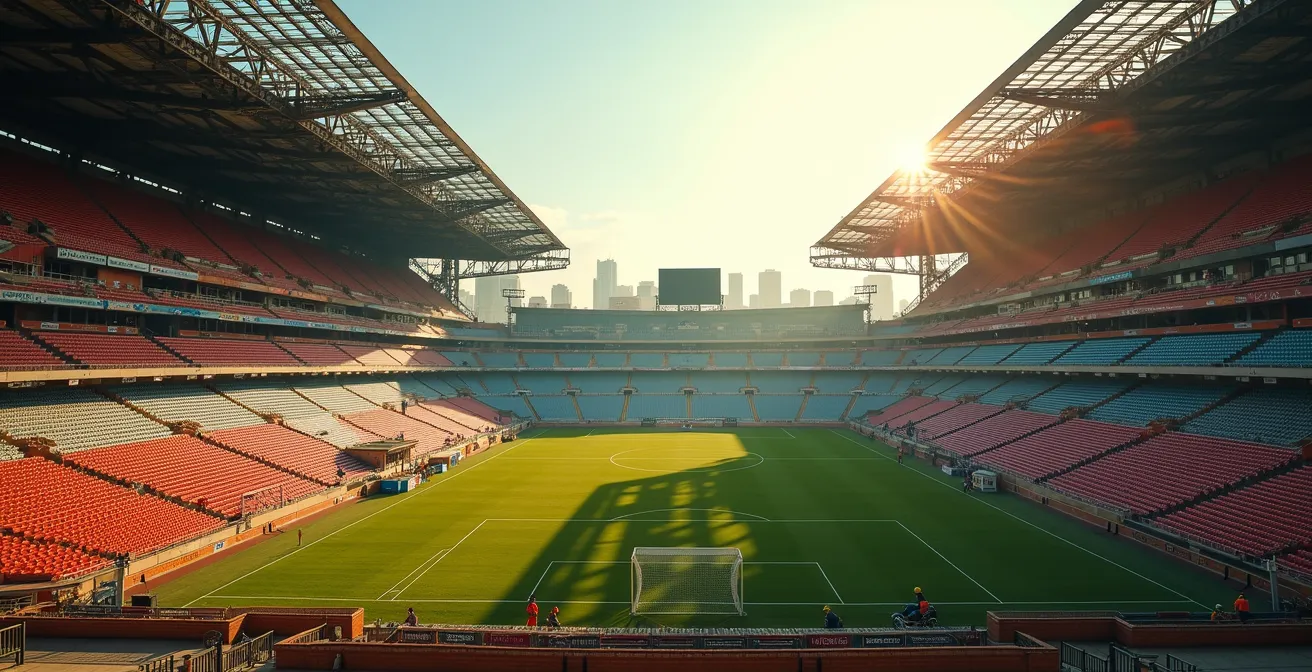
As the image above powerfully conveys, the connection fans have with these historic structures is deeply personal and often passed down through generations. The controversy surrounding the proposed demolition of Milan’s San Siro stadium serves as a stark warning. The plans were met with fierce resistance not just from fans, but from government and heritage groups. Supporters argued that the money from a new development could never outweigh the cultural loss, stating that their financial support helped build the club’s history in the first place. Italy’s Culture Minister ultimately intervened, signaling that the stadium would likely be preserved to protect Milan’s cultural identity. This case highlights a crucial truth: fans see themselves as custodians of the club’s heritage, not just consumers.
Ignoring this deep-seated sense of ownership is a perilous strategy. When a club unilaterally prioritizes profit over shared history, it sends a clear message that the fans’ emotional investment is devalued. This can lead to boycotts, reduced merchandise sales, and a toxic atmosphere that infects the entire club. The true cost of demolition isn’t in the rubble, but in the lost loyalty that may never be rebuilt.
How to Design a Club Museum That Tells a Story, Not Just Displays Trophies?
A club museum should be more than a sterile room filled with silver cups and old jerseys; it should be the narrative heart of the stadium, a place where the club’s identity is actively told and retold. The common mistake is to present history as a chronological list of achievements. A truly great museum, however, weaves a story, creating an emotional journey that connects fans to the human drama behind the victories and defeats. It transforms passive viewing into an active experience of “sensory history.”
As author Rafi Kohan argues, these venues are profound reflections of who we are as a society. In his book, The Arena, he makes a point that directly applies to museum design:
These places are reflections of who we are, the good and the bad, and I think we reveal ourselves in what happens to these venues. Do we want to be wasteful as a society, or do we want to be more sustainable?
To achieve this narrative depth, architects and curators must think thematically. Instead of a linear timeline, exhibits can be structured around powerful emotional arcs that resonate with every fan. This approach turns a collection of artifacts into a compelling story that reinforces club values and traditions. Here are some strategies for creating a narrative-driven museum:
- Structure exhibits around emotional themes like ‘Giant Killers’, ‘Local Heroes’, or ‘The Comeback Kings’ that resonate with shared fan experiences.
- Integrate sensory history by using acoustic engineering to replicate historic chants or haptic displays to let fans touch a piece of the original turf.
- Develop fan-sourced digital archives that allow supporters to upload personal photos and stories, creating a living, evolving map of memories connected to the club.
- Showcase ‘The Unseen Heritage’ with exhibits dedicated to the groundskeepers, ticket staff, and community volunteers who are the lifeblood of the institution.
By focusing on storytelling over simple display, a museum becomes a dynamic and essential part of the modern stadium, a place where heritage is not just preserved, but celebrated and passed on to the next generation of supporters.
Renovate the Old Ground or Build New: Which Makes More Financial Sense?
The decision to renovate an existing stadium or build a new one is one of the most significant financial choices a club will ever make. The allure of a state-of-the-art new build, often subsidized by public funds, is powerful. For instance, economic analysis reveals that new stadiums like Allegiant Stadium generate a $620 million annual economic output from a massive investment. However, this headline figure often masks a more complex reality involving public debt, gentrification, and the hidden costs of alienating a community.
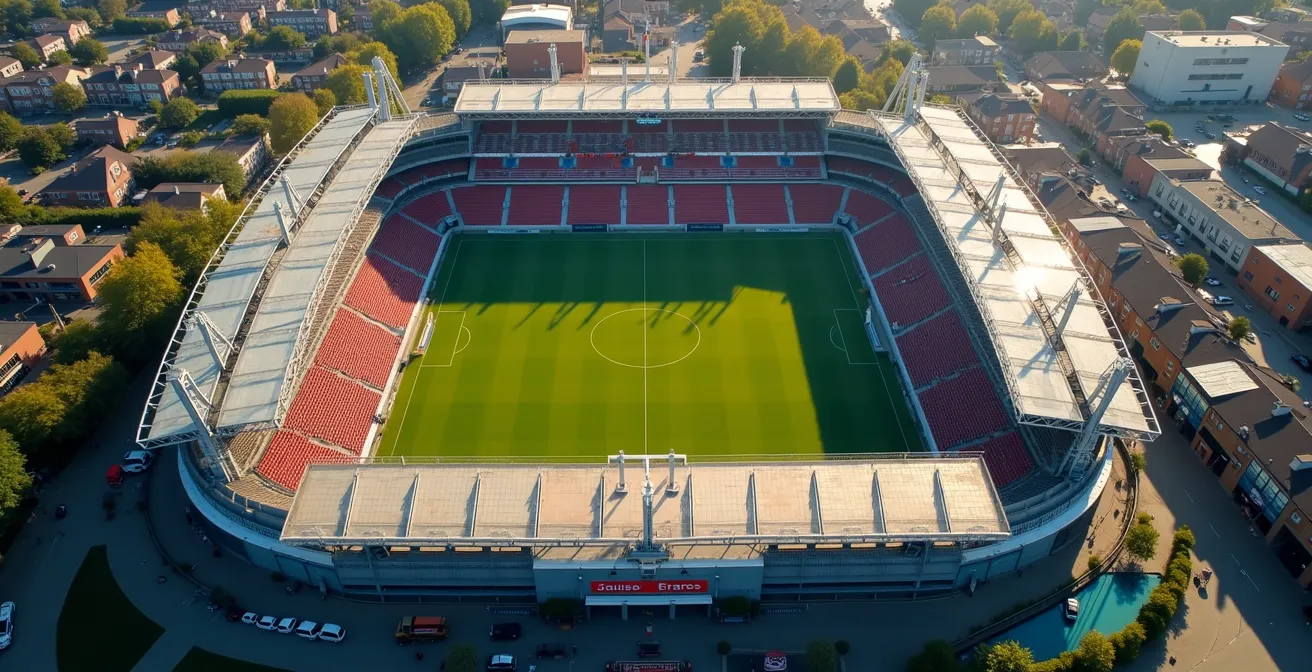
Renovation, while sometimes perceived as the less glamorous option, offers compelling financial and strategic advantages. It allows for a phased approach, maintaining crucial matchday revenue during construction and keeping the local business ecosystem intact. Furthermore, from a sustainability perspective, it preserves the vast amount of embodied carbon locked into the existing structure, avoiding the huge environmental cost of demolition and new construction. The choice is not merely financial; it’s a strategic decision about a club’s identity and its relationship with its community.
The following table, based on principles of urban and environmental impact, outlines the critical factors an architect or historian must weigh when comparing these two paths. It provides a clearer picture that extends beyond the initial construction budget.
| Factor | Renovation | New Build |
|---|---|---|
| Carbon Footprint | Preserves embodied carbon in existing structure | High carbon cost from demolition and new construction |
| Fan Loyalty Impact | Maintains emotional connection to historic venue | Risk of alienating core fanbase |
| Construction Timeline | Phased approach maintains revenue during work | Complete closure during construction period |
| Urban Economic Impact | Sustains existing local business ecosystem | May shift economy to new location |
| Ticket Pricing | Lower pressure for price increases | Higher prices needed to service construction debt |
This comparative analysis, drawn from a framework for assessing stadium heritage, shows that renovation is often the more holistically sensible route. It mitigates financial risk, strengthens community bonds, and aligns the club with modern sustainability goals, proving that preserving history can be the most forward-thinking financial strategy of all.
The Design Error That Makes New Stadiums Feel Like Soul-less Bowls
The most common complaint leveled against new stadiums is that they lack “soul.” This is not a mystical quality but the direct result of specific design choices that prioritize uniformity and broadcast optimization over the in-person fan experience. The “soulless bowl” is born from an architectural philosophy that smooths out all the quirks, oddities, and imperfections that gave older grounds their unique character. This sanitization process often erases the very elements that fostered community and intense atmosphere.
Case Study: The Loss of Heritage at Arsenal
Arsenal’s move from the tight, atmospheric Highbury to the modern Emirates Stadium is a textbook example of this phenomenon. While the new ground is a marvel of modern engineering, it came at a cultural cost. As analysts note, very little of old Highbury’s physical structure or social culture exists today. Sky-rocketing ticket prices excluded many traditional local supporters, fundamentally changing the demographic and atmosphere on matchdays. The move, while financially successful, illustrates how a club can lose a piece of its soul in the pursuit of modernization.
The core design error is the “tyranny of the perfect sightline,” where every seat is engineered to have a flawless, unobstructed view. While logical on paper, this leads to shallow, uniform seating rakes that dissipate noise and create a sense of detachment. The unique viewing angles and slightly “bad” seats of an old ground created distinct territories and identities within the stadium, fostering micro-communities. To avoid creating another generic bowl, architects must consciously design for character and intimacy. This means reintroducing elements of deliberate imperfection and focusing on the human scale.
Here are four design principles to inject soul back into modern stadium architecture:
- Incorporate ‘Prospect and Refuge’ design: Balance clear views of the pitch (prospect) with intimate, enclosed spaces like concourses or small standing sections that create a sense of personal territory (refuge).
- Avoid the tyranny of the perfect sightline: Embrace quirks and unique viewing angles that give character to different sections and create memorable spots.
- Prioritize in-person fan experience over broadcast optimization: Resist the urge to design primarily for television cameras, which often calls for flat lighting and wide, open spaces that kill atmosphere.
- Use varied and authentic materials: Mix brick, steel, and wood elements instead of relying on monotonous plastic and bare concrete, connecting the structure to its local environment and history.
How to Phased Construction Without Reducing Capacity for Big Matches?
Phased construction is the architect’s ultimate balancing act: renovating a stadium piece by piece while it remains operational, preserving revenue streams and minimizing disruption to the team and fans. It is a complex logistical puzzle, but when executed correctly, it is the key to modernizing a historic ground without the drastic step of a multi-year closure. The strategy hinges on meticulous planning, clear communication, and a deep understanding of the stadium’s operational rhythm.
Success stories demonstrate that it is entirely possible to maintain a significant fan presence during major works. For example, the Michie Stadium Preservation Project demonstrates how stadiums can maintain a 30,000 fan capacity during its East Stands reconstruction, with plans to return to full capacity upon completion. This approach keeps the heart of the stadium beating, ensuring that the “ritual pathway” of fans attending games is uninterrupted. It’s a powerful statement that the club values continuity over convenience.
FC Barcelona’s ambitious renovation of Camp Nou provides another world-class blueprint for phased development. Their strategy allows for a gradual increase in capacity as different stages of the project are completed, ensuring the club can return to its home ground with a substantial number of spectators long before the final nail is hammered. After completing the first phase, the club could host 45,000 fans, with plans to increase this to 62,000 as work progresses. This iterative model is a masterclass in financial and logistical management, turning a massive construction project into a series of manageable, value-adding steps.
Your Phased Renovation Audit: 5 Key Checkpoints
- Points of Contact: List all critical infrastructure that must be maintained throughout all phases, including utility lines, emergency access routes, and broadcast cabling paths.
- Structural Inventory: Create a detailed inventory of all existing elements, clearly marking which are to be preserved (e.g., historic facade), integrated, or demolished in each phase.
- Operational Coherence: Confront the phasing plan with matchday operations. Model fan flow, security perimeters, and concession access for each distinct construction phase to identify and mitigate bottlenecks.
- Emotional Touchpoints: Identify and map the ‘sacred’ zones for fans—a specific tunnel, a famous corner of the ground, a particular entrance—and develop a clear plan to protect, relocate, or ceremonially reintegrate them.
- Integration Plan: Develop a detailed timeline for connecting new structures to old ones, prioritizing key milestones that unlock increased capacity or improved amenities to maintain fan and stakeholder buy-in.
By breaking a monumental task into a logical sequence, phased construction becomes the most respectful and pragmatic way to breathe new life into a historic venue, ensuring its story continues without a single missed chapter.
How to Convert 60,000-Seat Stadiums into Sustainable Community Hubs?
The modern stadium can no longer afford to be a sleeping giant, used only a few dozen times a year. For a 60,000-seat arena to be truly sustainable—both financially and socially—it must transform into a vibrant, 365-day-a-year community hub. This concept of adaptive reuse is not about simply hosting more concerts; it’s a fundamental reimagining of the stadium’s role within the urban fabric. It means turning vast, empty concourses and exclusive suites into public-facing assets like health clinics, classrooms, co-working spaces, and local markets.
This approach is gaining traction as cities and clubs recognize the immense untapped potential of these structures. Historic ballparks in Major League Baseball are increasingly being preserved and updated not just as sports venues, but as “cathedrals of the game” that serve a broader community purpose. The engineering vision required is significant, as it involves making these historic places relevant and accessible while maintaining their essential character. It’s about making history last in an age of sleek, modern arenas by embedding the stadium into the daily life of its neighborhood.
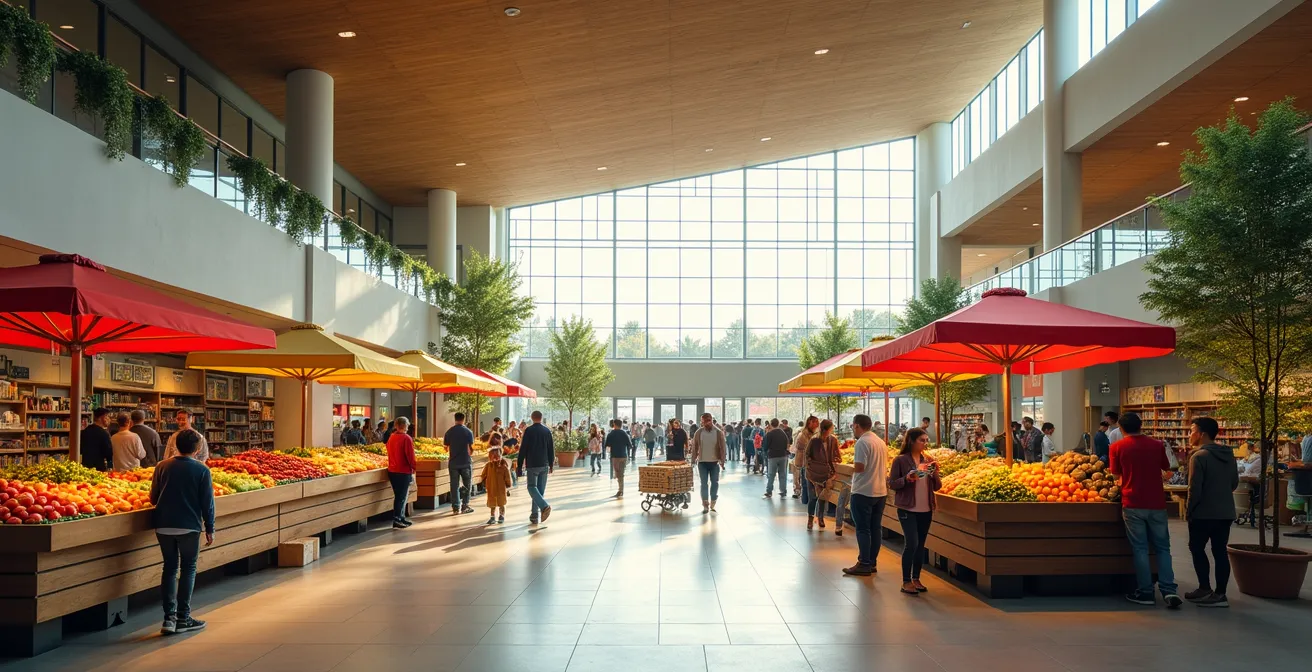
As the illustration suggests, this transformation turns a monolithic structure into a porous, multi-functional ecosystem. The key is to design for flexibility from the outset. This could mean modular partitions in concourses, dedicated entrances for non-matchday services, and integrating public green spaces around the stadium’s perimeter. This strategy creates diverse and stable revenue streams, reducing the club’s reliance on volatile ticket sales. More importantly, it re-establishes the stadium as a true civic landmark—a place of pride and utility for everyone, not just for ticket holders.
By becoming a genuine community asset, the stadium builds immense goodwill and political capital, making it easier to secure support for future developments. It answers the critical question of public benefit, proving that a stadium can give back to its city every single day. This is the future: a stadium that serves its team on Saturday and its community from Monday to Friday.
The Design Error That Lets Atmosphere Escape into the Car Park
Atmosphere is the lifeblood of a football stadium, an intangible but powerful force that can genuinely influence the outcome of a match. It’s a common experience for fans to move to a new, modern stadium only to find that the roar of the crowd has been replaced by a dull hum. This is not a matter of fans being less passionate; it is a direct consequence of architectural design that fails to contain and amplify sound. The biggest error is designing open, shallow bowls that allow the acoustic energy to dissipate into the sky and surrounding areas—literally letting the atmosphere escape into the car park.
The impact of a loud, unified crowd is not just psychological. It is a measurable performance enhancer. As one research group notes, the effect is tangible:
Research shows that loud, well-coordinated cheers can bump up a home team’s performance by about 5 to 10%. Picture it: every chant and shout sends a burst of energy to the players, almost like a magic boost.
– Sports Performance Research, Impact of Fan Culture on Sports Performance Study
Preserving this “12th man” effect is a critical design challenge. The solution lies in creating a “cauldron” of noise. This requires a conscious return to certain principles found in classic stadiums: steep seating rakes, enclosed corners, and roofs that hang low over the stands. These elements work together to trap sound waves, reflecting them back towards the pitch and the crowd, creating a virtuous cycle of noise. The concept of “Acoustic Heritage” involves studying the unique sound profile of a beloved old ground and using digital modeling to replicate its key characteristics in a new design.
To engineer an intense atmosphere, architects should focus on these key acoustic design solutions:
- Close open corners and design steep roof angles to trap sound waves within the stadium bowl and prevent them from escaping.
- Use sound-reflecting materials like corrugated metal on the roof and dense brickwork in the stands, rather than sound-absorbing modern composites.
- Design steeper, tighter seating arrangements to create “walls of people” that are closer to the pitch and act as massive surfaces to reflect sound.
- Implement ‘Acoustic Heritage’ modeling by digitally capturing the sound profiles of iconic, loud stadiums to inform and validate the acoustic properties of new designs.
By treating atmosphere as an engineering goal rather than a happy accident, architects can ensure that a new stadium sounds and feels like home from the very first whistle.
Key Takeaways
- Heritage is a tangible asset, not a liability; demolition carries a significant financial and cultural cost that can permanently damage fan loyalty.
- Successful modernization is about ‘memory weaving’—thoughtfully integrating fan rituals, sensory cues, and historical narratives into new architectural designs.
- A phased renovation strategy often presents a more financially and socially sustainable model than building new, preserving revenue and community bonds.
Rebranding Risks: Why Modernizing a Club Crest Can Alienate the Core Fanbase?
The stadium is the physical heart of a club, but the crest is its soul rendered in graphic form. It is the single most important symbol of a club’s identity, a visual shorthand for 100+ years of history, struggle, and glory. Consequently, the decision to “modernize” a crest is fraught with peril. While often undertaken with good intentions—to create a cleaner logo for digital media or appeal to a global market—a clumsy rebrand can feel like a corporate takeover of a sacred cultural symbol, triggering a visceral and hostile reaction from the core fanbase.
The reason for this intense reaction lies in the deep, early formation of fan identity. Research on fan psychology reveals that 41% of football fans are committed to their team by age 12, an identity intertwined with the symbols they grew up with. For these supporters, the crest is not a brand logo; it is a family heirloom. Changing it without profound and respectful consultation is seen as an act of erasure. The argument that a new design is “better” misses the point entirely, as the value of a crest lies in its history and authenticity, not its aesthetic alignment with modern design trends.
This alienation is not just an emotional issue; it has direct economic and social consequences. When clubs dismiss the deep meaning fans attach to their heritage, they harm the very stakeholders who form the bedrock of their support. As studies on the community impact of stadium changes show, these dedicated fans, who often have little political clout, suffer the most. A rebrand can be the final straw in a series of changes—like rising ticket prices and stadium relocations—that make supporters feel like their club no longer represents them or their community. This can lead to a tangible decline in engagement, from merchandise sales to matchday attendance.
Ultimately, a club’s identity is a shared entity, co-owned by the institution and its supporters. Any attempt to unilaterally redefine that identity through a top-down rebranding exercise is a fundamental misunderstanding of the unique social contract at the heart of football. The risk is not just a badly received logo; it’s the severing of a bond that, once broken, is incredibly difficult to repair.
To put these principles into practice, the next step is to re-evaluate every stadium project not as a simple construction job, but as an act of cultural preservation and forward-thinking design. Engage with historians, consult with fan groups, and challenge your team to find innovative ways to weave the story of the past into the fabric of the future.