The modern goalkeeper’s value is no longer defined by saves alone, but by their mastery of a new tactical “operational system” that dictates the team’s entire build-up and defensive structure.
- Distribution under pressure has become the primary differentiator, with passing now accounting for the majority of a keeper’s in-game actions.
- Proactive positioning and risk calculation outside the box are non-negotiable skills for supporting a high defensive line.
Recommendation: Coaches must shift training focus from isolated shot-stopping drills to integrated sessions that simulate game-speed decision-making, passing under pressure, and communication within the team’s tactical framework.
For decades, the goalkeeper’s job description was brutally simple: keep the ball out of the net. The metrics for success were clean sheets and highlight-reel saves. But the last decade has triggered a tactical earthquake, and the goalkeeper stands at its epicenter. Today, telling a keeper just to “be good with their hands” is like telling a quarterback to only practice hand-offs. The role has fundamentally transformed from a reactive specialist into a proactive, field-playing orchestrator.
Many discussions stop at the surface-level observation that “keepers need to be good with their feet,” often pointing to the back-pass rule as the sole catalyst. While true, this misses the profound evolution in tactical systems. The real shift isn’t just about technique; it’s about cognition. The modern keeper is expected to operate as the team’s deepest-lying playmaker, initiating attacks, breaking presses, and commanding a high defensive line. This requires a complete mental reboot, turning the penalty box into a command center for a new kind of operational system.
This guide moves beyond the platitudes. We will dissect the specific tactical triggers, decision-making frameworks, and technical skills that define the modern goalkeeper. We are not just observing the change; we are providing a technical manual for coaches and players to master it. We will explore the risks and rewards of the sweeper-keeper role, the mechanics of passing under pressure, the new hierarchy of attributes, and the communication protocols that prevent defensive breakdowns. This is the blueprint for evolving from a shot-stopper into a complete tactical asset.
To navigate this tactical evolution, this article breaks down the essential components that define the modern goalkeeper’s role. The following sections provide a detailed roadmap, from managing the risks of a high starting position to mastering the fine arts of distribution and communication.
Summary: The Goalkeeper’s Evolution into the 11th Outfield Player
- Why Playing as a Sweeper-Keeper Increases the Risk of Chip Goals?
- How to Improve Distribution Accuracy When Under High Pressing?
- Elite Reflexes or Perfect Passing: Which Attribute is More Valued in Top Teams?
- The Communication Mistake That Leads to Defensive Mix-ups on Set Pieces
- When to Commit to a 1v1 Challenge Outside the Penalty Box?
- The Positioning Error That Leaves Defenders Vulnerable to Balls Over the Top
- How to Weight a Pass Perfectly for a Striker Running at Full Speed?
- Why Futsal Techniques Improve Close Control in Tight Spaces on Grass?
Why Playing as a Sweeper-Keeper Increases the Risk of Chip Goals?
The sweeper-keeper’s high starting position is the foundation of a modern high-press, high-line system. It compresses the pitch, supports the defense, and allows the keeper to intercept through-balls. However, this aggressive positioning creates a fundamental vulnerability: the space behind the keeper. The primary tactical risk is the chip shot from distance. When a keeper is positioned 15-20 yards off their line, they are offering a constant invitation to technically gifted opponents who can spot the opportunity.
The data on elite keepers quantifies this risk. For instance, a world-class sweeper-keeper like Manuel Neuer performs defensive actions as far as 20.6 yards from his goal. This demonstrates an operational zone that is far removed from the goal line. Every yard gained in proactive positioning is a yard lost in goal-line security. The decision to play high is a constant trade-off in a complex risk-reward matrix. The keeper must read the game to know when their high position is a defensive asset and when it becomes a liability.
Mitigating this risk isn’t about abandoning the high line; it’s about mastering recovery mechanics. A keeper caught in a high position must have elite footwork to retreat effectively. Key recovery techniques include:
- Rapid backpedaling using crossover steps to maintain balance and speed.
- Maintaining a “live” stance on the balls of the feet for explosive backward movement.
- Training scrambling retreat drills to improve recovery speed over 10-20 yards.
- Using advanced blocking shapes (like the ‘K-shape’) when a full recovery to the goal line is impossible.
The sweeper-keeper’s role accepts the risk of the chip goal as a necessary cost for the immense tactical advantages it provides. The focus for the modern coach is not on eliminating this risk, but on equipping the keeper with the game intelligence and physical tools to manage it effectively.
How to Improve Distribution Accuracy When Under High Pressing?
In the modern game, the goalkeeper is the first attacker. Their ability to circulate the ball under pressure is no longer a bonus; it’s a core competency. In fact, analysis shows that distribution now accounts for 80% of goalkeeper actions in some top-tier games. When an opponent commits to a high press, the keeper’s composure and technical execution are tested to the limit. Poor distribution in these moments doesn’t just concede possession; it can lead directly to a goal-scoring opportunity for the opposition.
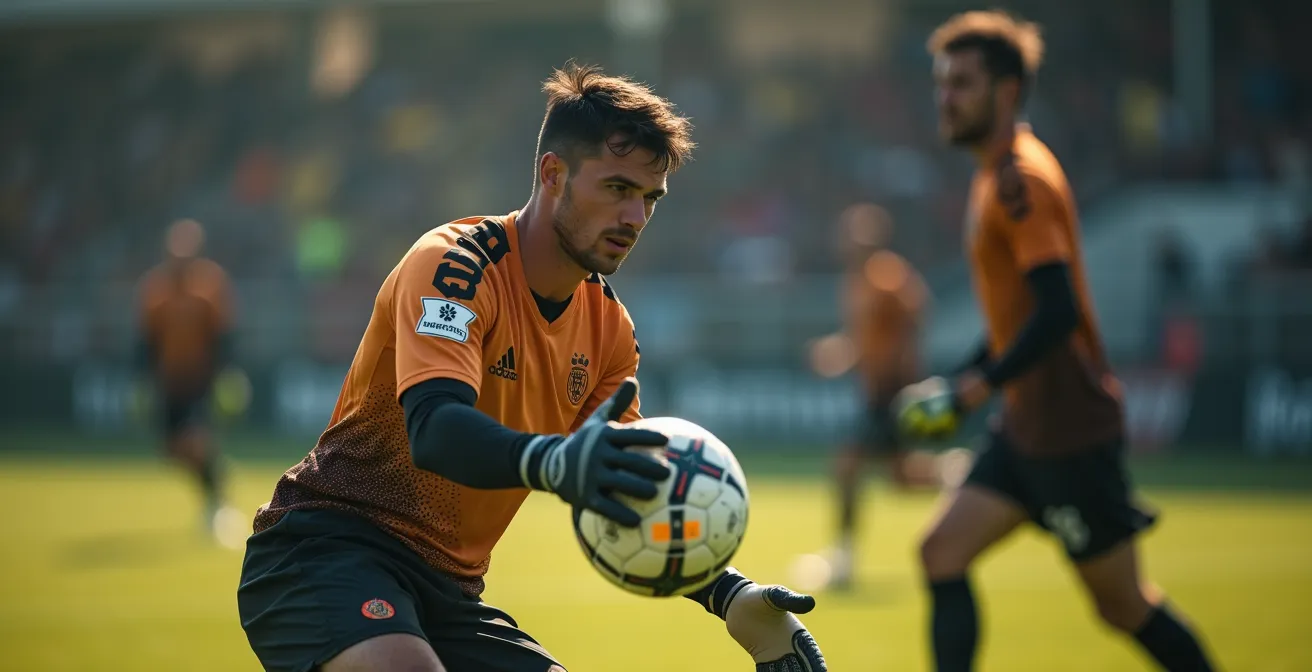
Improving accuracy under duress is about building an “operational system” for distribution. It starts with scanning *before* receiving the ball to create a mental snapshot of passing options. The keeper must then learn to use deception. A “no-look” pass or shaping the body to suggest a long kick before playing a short, disguised pass to a fullback can buy the crucial half-second needed to break the press. This level of composure is a hallmark of elite playmakers. As a case in point, Ederson at Manchester City has demonstrated how a goalkeeper can become a primary creator, using his exceptional passing range to launch attacks and bypass the opposition’s press entirely.
Training for this involves moving beyond static passing drills. Drills must simulate the chaos and pressure of a real game. This includes:
- Drills with active pressers: Using 1-2 attackers to close down the keeper forces quick decision-making.
- Small-sided games: Playing in tight spaces naturally improves a keeper’s ability to protect the ball and find short passing lanes.
- Variable passing targets: Drills should require a mix of short passes to feet, clipped passes over the first line of pressure, and driven long balls to switch the play.
Ultimately, accuracy under pressure is a product of technical repetition and cognitive training. The keeper must have the solutions programmed before the problem arises, turning a moment of high pressure into the starting point of a successful attack.
Elite Reflexes or Perfect Passing: Which Attribute is More Valued in Top Teams?
This is the central philosophical debate in modern goalkeeping. For generations, a keeper’s value was almost exclusively tied to their shot-stopping ability—their reflexes, agility, and bravery. While these attributes remain fundamentally important, the tactical evolution of the game has shifted the value proposition. Top teams that dominate possession and play with a high defensive line now place an enormous premium on a goalkeeper’s ability to contribute to the build-up play.
As goalkeeping coach George Berneanou notes, the paradigm has changed. In his analysis, he states:
At the elite level, ‘elite reflexes’ are the minimum entry requirement. The key differentiator that separates the good from the great then becomes what the keeper adds in possession.
– George Berneanou, The Football Week – Goalkeeping Coach Analysis
This insight is critical. Shot-stopping is no longer the defining skill; it’s the ticket to entry. The real value is added through distribution. This shift is reflected in the frequency of actions. A keeper might be called upon for a crucial reflex save a few times a game, but they will be involved in distribution plays dozens of times.
This table, based on an analysis of modern goalkeeper actions, starkly illustrates the new reality of the position.
| Action Type | Frequency Per Game | Impact on Team Play |
|---|---|---|
| Elite Reflex Saves | 3-5 actions | Defensive stability |
| Distribution Plays | 30-50 actions | Build-up and possession |
| Sweeper Actions | 2-3 actions | High line support |
The data is clear: while a reflex save prevents a goal, distribution and sweeper actions are what allow a team to implement its entire tactical philosophy. For a top team, a goalkeeper who is only an elite shot-stopper is a tactical liability. They need a keeper who is an active participant in possession, capable of acting as a release valve against a press and initiating attacks. The answer to the debate, therefore, is not “either/or” but a question of priority. Perfect passing has become the attribute that elevates a keeper from good to world-class.
The Communication Mistake That Leads to Defensive Mix-ups on Set Pieces
On a set piece, the goalkeeper is the only player on the field with a complete view of the play. They are the defensive coordinator, the general, the one person responsible for organizing the chaos in the penalty area. Yet, the most common source of defensive mix-ups is not a physical error but a communication failure. The critical mistake is using vague, indecisive, or passive language. Shouts of “Watch him!” or “Someone get the back post!” are useless noise. They create confusion, not clarity, because they assign responsibility to no one in particular.
Effective command of the penalty area relies on a protocol of clear, concise, and non-negotiable communication. Every word must have a purpose. When a keeper decides to claim a cross, the call must be “Keeper’s ball!” shouted with absolute conviction. There can be no room for a defender to second-guess the decision. Similarly, when organizing marking assignments, the keeper must use specific names and make eye contact to confirm the instruction has been received and understood. Pointing and calling out, “John, you have their number 5!” is infinitely more effective than a generic shout into the crowd.
This requires establishing a shared language with the defense, often developed through pre-match discussions and reinforced in training. The goal is to create an “operational system” of communication where every defender knows their role and trusts the keeper’s commands implicitly. Over-communication can be just as damaging as under-communication, as it can lead to defenders “tuning out” the keeper’s voice. The key is impactful, purposeful instruction.
Your Action Plan: Auditing Your Set-Piece Communication Protocol
- Points of Contact: List every moment you communicate during a set piece. (e.g., initial wall setup, confirming markers, call for the ball, organizing for the second ball). Are you silent at any key moment?
- Collecte: Inventory your current commands. Write down the exact words you use. Examples: “Keeper’s!”, “Away!”, player names, hand signals. Are they clear and universally understood by your defense?
- Coherence: Confront your commands with the principle of decisiveness. Are they non-negotiable instructions or passive suggestions? Does your body language match your verbal commands?
- Mémorabilité/émotion: Analyze the clarity versus the noise. Is your voice projecting confidence and control, or panic? Film a training session to assess how your commands are perceived by others.
- Plan d’intégration: Identify one weak command and one silent moment. Work with your defensive unit in training to introduce and practice a new, standardized, and decisive call until it becomes second nature.
By treating communication as a technical skill to be audited and refined, a goalkeeper can eliminate the ambiguity that so often leads to defensive breakdowns. It is this organizational mastery that transforms a penalty box from a chaotic zone into a controlled fortress.
When to Commit to a 1v1 Challenge Outside the Penalty Box?
For the sweeper-keeper, this is the highest-stakes decision they can make. Committing to a challenge outside the box is a moment of absolute risk and reward. A successful intervention snuffs out a dangerous attack and showcases tactical brilliance. A miscalculation, however, results in either a red card or an empty net for the attacker. This decision cannot be based on instinct alone; it must be governed by a rapid, almost subconscious, risk-reward calculation based on a set of clear tactical triggers.
The imperative for goalkeepers to master play outside their box was dramatically accelerated by the introduction of the back-pass rule, which forced them to become comfortable with the ball at their feet and, by extension, to operate in larger spaces. The modern game has taken this to an extreme. Data on elite keepers like Manuel Neuer, who performs 2.08 defensive actions outside his box every 90 minutes, shows this is a regular and vital part of the role. His ability to operate at extreme distances from his goal is not reckless; it’s a calculated strategy based on reading the game faster than the opponent.
So, when should a keeper commit? The decision hinges on three key factors:
- The Attacker’s Touch: The primary trigger is a heavy touch from the attacker. If the ball gets more than 2-3 yards away from the attacker’s feet, the keeper has a window to win the race. If the attacker has the ball under close control, the odds shift dramatically in their favor.
- The Race Dynamics: The keeper must instantly calculate their own speed versus the attacker’s, factoring in the angle of the run. Can they get to the ball *and* clear it before the attacker arrives? A 50/50 race is often too risky. The keeper should only commit if they are the clear favorite to reach the ball first.
- The Presence of Covering Defenders: Is there a defender who is in a better position to make the challenge? If so, the keeper’s role is to narrow the angle and delay the attacker, giving their defender time to recover, rather than rushing out and creating a 2v1 situation against the defender.
Training this decision-making process involves creating countless 1v1 scenarios in practice, forcing the keeper to make these split-second judgments under pressure. It’s about developing the cognitive skill to process these variables instantly and commit with 100% conviction or, just as importantly, make the correct decision to hold their position.
The Positioning Error That Leaves Defenders Vulnerable to Balls Over the Top
The relationship between a goalkeeper and their defensive line is like an elastic tether. The distance must contract and expand in perfect sync with the movement of the ball and the opposition. The single biggest positioning error a modern keeper can make is allowing this tether to become too long or too slack. A keeper who is rooted to their six-yard box while their defense pushes up to the halfway line creates a vast, undefended ocean of space behind the defense. This is a tactical invitation for any opponent with decent vision to play a simple ball over the top.
As noted by coaching experts, there is a fatal distance. In their analysis, they state:
A 25-yard gap between goalkeeper and defensive line is fatal. The ideal ‘tether’ distance must contract and expand with the defensive line’s movement.
– Prime Focus Goalkeeping, Mastering Modern Goalkeeping Analysis
This “fatal gap” makes defenders deeply uncomfortable. They cannot commit to pressing the ball in front of them for fear of the space they are leaving behind. A keeper who maintains the correct ‘tether’ distance—typically 10-15 yards from their center-backs—gives their defenders the confidence to play a high line aggressively. This proactive positioning is a preventative measure. It’s not about making a save; it’s about positioning oneself so the dangerous pass is never a viable option for the opponent in the first place.
Mastering this “tether” concept requires constant scanning and game-reading. The keeper must learn to read tactical triggers, such as a midfielder getting their head up with time on the ball or an attacker with an open body shape preparing to make a run. These are the cues to adjust their position. The ideal goalkeeper stance in these situations is a ‘live’ one, with a slight bounce on the balls of their feet, ready to explode forward to intercept or backward to recover. It’s a dynamic, constant state of adjustment, not a static position.
Ultimately, perfect positioning is invisible. It’s about being in the right place so often that the danger never materializes. It’s the quiet, cerebral work that underpins the entire defensive structure of a modern team.
How to Weight a Pass Perfectly for a Striker Running at Full Speed?
This is the pinnacle of goalkeeper distribution, the moment a keeper transcends the role of defender and becomes a genuine playmaker. Launching a quick counterattack with a long pass requires more than just kicking the ball far; it demands the vision and touch of a deep-lying midfielder or an NFL quarterback. The goal is to deliver the ball not *to* the striker, but *into the path* of the striker, allowing them to take it in stride without breaking their run. A pass that is under-hit forces the striker to stop, killing the momentum of the attack. A pass that is over-hit runs harmlessly through to the opposition keeper.
The technique involves a delicate balance of power and finesse. The keeper must strike the ball with the instep to generate backspin, which helps the ball “check up” or slow down upon landing, making it easier for the striker to control. The trajectory is also crucial: a low, driven pass is faster but harder to control, while a higher, lofted pass gives the defense time to recover. The perfect pass is often a clipped, medium-trajectory ball that drops into the space behind the last defender.
This skill is exemplified by keepers like Alisson Becker, who is renowned for his “quarterback mindset.” His ability to process the game situation in an instant—seeing his striker’s run, calculating the trajectory and speed required, and executing the pass—is a massive tactical weapon. For example, his 83 saves in a Premier League season were complemented by his role in launching Liverpool’s devastating counterattacks. This is the distribution architecture in action: not just passing, but designing the attack from its very first moment.
To develop this skill, a keeper must work on:
- Vision and scanning: Constantly looking for the counter-attacking opportunity the moment possession is won.
- Technical striking: Practicing different types of long passes (driven, clipped, curled) to various targets on the move.
- Understanding striker movement: Building a rapport with the team’s forwards to anticipate their runs and preferences.
Weighting a pass perfectly is the ultimate expression of the modern goalkeeper’s dual role. It is a defensive action (winning the ball) transformed instantly into a creative, attacking one.
Key Takeaways
- The modern goalkeeper’s primary value has shifted from reactive shot-stopping to proactive playmaking and tactical organization.
- Mastering distribution under pressure and proactive positioning to support a high line are the new core competencies.
- Effective goalkeeping is now defined by a cognitive “operational system” of risk calculation, game-reading, and decisive communication.
Why Futsal Techniques Improve Close Control in Tight Spaces on Grass?
The modern goalkeeper often finds themselves in possession within the tight confines of their own penalty area, facing an aggressive press. In these moments, the ability to control the ball instantly, shield it from an opponent, and make a quick, accurate pass is paramount. This is where the principles of futsal become an invaluable developmental tool. Futsal is played on a small court with a heavier, low-bounce ball, which naturally forces players to develop exceptional close control, quick decision-making, and spatial awareness.
The most important transferable skill is sole control. In futsal, players constantly use the sole of their foot to stop the ball dead, manipulate it in tight spaces, and shield it from opponents. For a goalkeeper on a grass pitch, mastering sole control allows them to kill a back-pass instantly, even if it’s hit with pace or on a difficult surface. This eliminates the risk of a heavy first touch that could present a simple tap-in for a pressing forward.
Furthermore, the compressed nature of a futsal court accelerates a player’s information processing. With less time and space, players must scan more frequently, think faster, and execute skills with fewer touches. This directly translates to the pressure a goalkeeper faces in their own box. Futsal training helps build the “360-degree awareness” and quick-touch combinations needed to evade a press and find a safe passing option. Futsal shielding techniques, using the body to protect the ball while assessing options, are also directly applicable when a keeper is closed down near their own goal line.
Integrating futsal skills into goalkeeper training provides the technical foundation needed for the modern game. It builds a comfort and confidence on the ball that cannot be developed through traditional goalkeeping drills alone. The essential skills that futsal develops include:
- Mastering sole control to kill passes dead under pressure.
- Practicing 360-degree awareness drills.
- Developing quick, one and two-touch combinations in confined spaces.
- Using the body to shield the ball effectively in the six-yard box.
By borrowing from futsal, we are not just training a goalkeeper; we are building a complete footballer who is as comfortable with the ball at their feet as they are with it in their hands.
Begin integrating these principles into your training sessions to build not just a goalkeeper, but a complete tactical asset for your team.