Technical failure in the final minutes is not a physical problem; it’s a cognitive one.
- Mental fatigue, not just muscle tiredness, causes a catastrophic drop in passing, dribbling, and decision-making accuracy.
- Sterile, unopposed drills are useless. Training must simulate the cognitive pressure of a real match to build resilience.
Recommendation: Shift your training focus from simply tiring players out to systematically overloading their perception-action coupling under pressure.
Every serious player knows the feeling. The first touch that was crisp and perfect for 70 minutes suddenly feels clumsy. The simple pass goes astray. The decision to dribble, so clear earlier, now leads to a costly turnover. The common coaching response is a simplistic cry for more fitness or better concentration. But this fundamentally misunderstands the problem. The breakdown of technical skill late in a match is rarely a failure of the body alone; it is a failure of the brain’s ability to command the body under duress.
Maintaining execution for the full 90 minutes isn’t about running harder; it’s about training smarter. It requires a paradigm shift away from viewing fatigue as a purely physical state and toward understanding it as a neuro-cognitive event. When the brain is tired, its ability to process information, make decisions, and send precise signals to the muscles—the very essence of technique—degrades catastrophically. The secret to becoming a true 90-minute player lies in building a technique that is resilient to this cognitive decay.
This guide deconstructs the science of technical performance under fatigue. We will move beyond platitudes and provide a systematic framework for players and coaches. We will analyze why the brain fails, how to forge a reliable first touch, the strategic choice between one-footed mastery and two-footed versatility, and the critical error of training in a vacuum. Finally, we’ll explore how to build a robust decision-making matrix and the surprising role of related disciplines like Futsal in developing fatigue-proof skills.
This article breaks down the essential components for building technical resilience. The following sections provide a detailed roadmap, from the underlying science to practical training methodologies that you can implement immediately.
Summary: Fatigue-Proofing Your Technical Game for 90-Minute Dominance
- Why Technique Breaks Down When the Brain Is Tired?
- How to Perfect the First Touch to Set Up the Next Action Instantly?
- Perfect One Foot or Good at Both: Which Is More Effective for Wingers?
- The Training Mistake of Practicing Skills Without Opponent Pressure
- When to Dribble and When to Pass: The Decision Matrix
- Why Hamstring Injuries Spike During the December Fixture Congestion?
- Why Early Physical Development Can Mask a Lack of Technical Ability in U17s?
- Why Futsal Techniques Improve Close Control in Tight Spaces on Grass?
Why Technique Breaks Down When the Brain Is Tired?
The catastrophic drop in technical execution after the 70th minute is not a myth; it’s a measurable neuro-cognitive event. The prevailing belief that physical exhaustion is the sole culprit is a dangerous oversimplification. The true failure occurs when cognitive fatigue decouples the brain’s perceptual systems from its motor-control pathways. In simple terms, the connection between what a player sees and what their body does becomes frayed and unreliable.
Research provides stark evidence for this phenomenon. A study on mental fatigue showed a staggering 97.7% increase in technical errors when players were cognitively drained, even if physically fresh. This highlights that the brain is the central processing unit for skill. When its processing power is diminished by 90 minutes of constant scanning, decision-making, and emotional regulation, its output—technical skill—suffers dramatically. This isn’t just a marginal decline; it’s a systemic collapse.
A separate analysis of professional soccer players under induced mental fatigue provides even more granular data. The study found that passing accuracy dropped from 88.2% to 81.5% and, more alarmingly, dribbling accuracy plummeted from 75.3% to 41.3%. This demonstrates a significant cognitive-motor impairment. The brain, struggling to manage its processing load, defaults to simpler, less precise motor patterns. The intricate muscle commands required for a delicate first touch or a sharp turn are replaced by gross, inefficient movements. Therefore, any effective training program must prioritize building cognitive endurance alongside physical conditioning.
How to Perfect the First Touch to Set Up the Next Action Instantly?
The first touch is the foundation of every subsequent action. Under fatigue, it’s the first skill to degrade, turning a promising attack into a turnover. A perfect first touch isn’t about softness; it’s about efficiency and purpose. It must instantly prepare the ball for the next action—a pass, a shot, or a dribble—with minimal cognitive and physical energy expenditure. To achieve this under late-game pressure, the touch must be an automatic, deeply ingrained motor program that bypasses the tired, decision-making part of the brain.
The key to developing this automaticity is not rote repetition, but structured variability, often referred to as differential learning. The brain must be forced to solve an infinite number of receiving “problems” so that no situation in a match feels truly novel. This builds a robust and adaptable motor schema that holds up when the conscious mind is overloaded. Visualizing the precise contact point is crucial for this process.
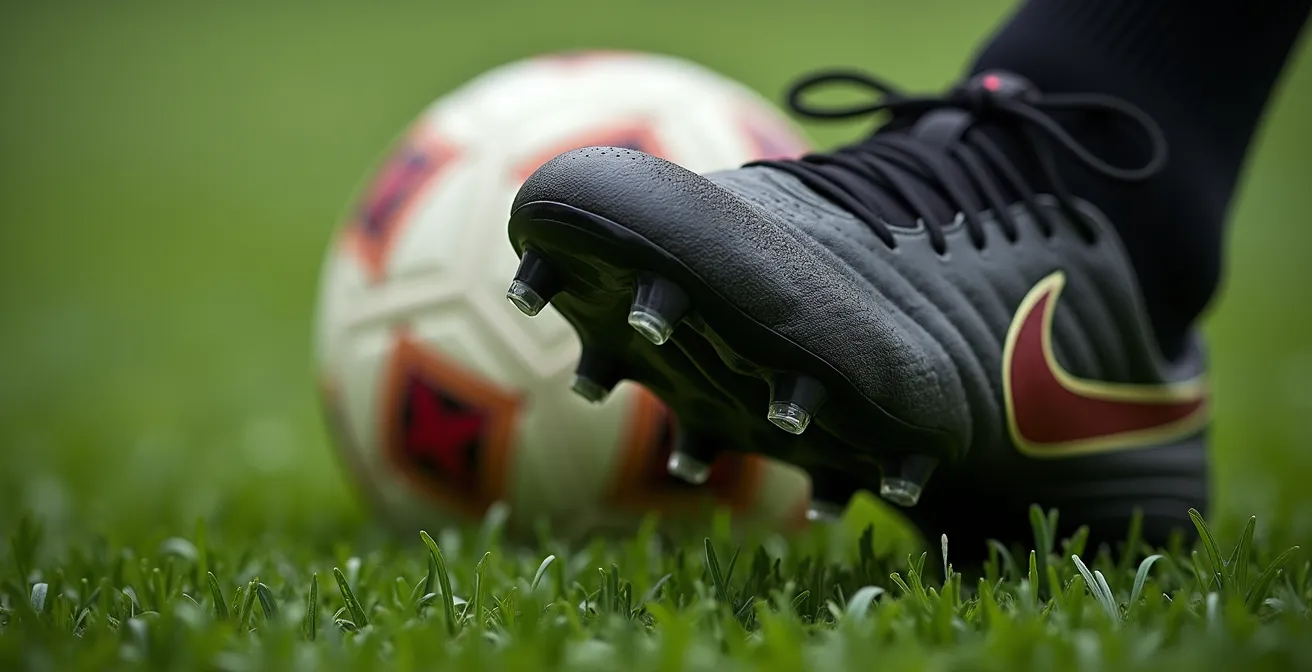
As the image above emphasizes, mastering the first touch is a game of millimeters. The surface of the boot, the angle of the foot, and the absorption of force are all micro-adjustments that become sloppy under fatigue. The goal of training is to make these adjustments reflexive. Instead of just passing a ball back and forth, training must introduce unpredictable elements that challenge the player’s perception-action coupling continuously.
Action Plan: Differential Learning Protocol for a Fatigue-Proof First Touch
- Vary Service Speed: Practice receiving balls at randomly sequenced speeds—slow rollers, firm passes, and driven balls—to force constant recalibration of body shape and foot position.
- Introduce Trajectory Chaos: Mix ground passes, bouncing balls, and aerial balls (driven, looped) without a predictable pattern. The player must learn to read the ball’s flight path and adjust instantly.
- Implement Spin Variations: Use services with topspin, backspin, and sidespin. This forces the player to develop a nuanced feel for how different spins affect the ball’s behavior on contact.
- Enforce the 2-Second Rule: After every first touch, the player must execute a second action (e.g., a pass to a target, a dribble through a gate) within two seconds. This ingrains the habit of touching with purpose.
- Create Overload Scenarios: In advanced drills, have multiple balls arrive from different angles in quick succession. This simulates the sensory chaos of a match and trains the brain to prioritize and execute under extreme cognitive load.
Perfect One Foot or Good at Both: Which Is More Effective for Wingers?
The debate between developing one world-class foot versus two proficient feet is central to player development, particularly for wingers who rely on deception and quick execution. Conventional wisdom often praises two-footedness as the pinnacle of technical ability. However, when viewed through the lens of cognitive fatigue, the argument becomes far more nuanced. The reality is that under extreme fatigue, the brain seeks to conserve energy by defaulting to its most efficient and ingrained neural pathways.
This neurological shortcut heavily favors the player with true mastery of a single foot. An action performed with a “master” foot is almost entirely subconscious, requiring minimal cognitive load. Conversely, choosing between two “good” feet introduces a split-second of decision-making, a luxury the tired brain cannot afford. This micro-delay is often the difference between a successful cross and a blocked attempt. As one expert notes, reliability is paramount in the final minutes.
Under fatigue, the brain defaults to the most ingrained, ‘low-cost’ neural pathway, making a truly masterful single foot more reliable than two ‘good’ feet
– Dr. Eduardo Mendez, Ertheo Sports Science Journal
While two-footedness offers tactical flexibility in the early stages of a match, its reliability can decrease significantly as cognitive resources are depleted. A single-foot master, while more predictable, can execute their core skills with a much higher success rate late in the game because the action is automatic. The following table breaks down this trade-off from a sports science perspective.
| Aspect | Single Foot Master | Two-Footed Player |
|---|---|---|
| Cognitive Load Under Fatigue | Lower – automatic execution | Higher – requires decision-making |
| Energy Conservation | Must reposition body frequently | Can execute from any position |
| Tactical Flexibility | Limited but highly predictable | Versatile but variable quality |
| Late-Game Reliability | High execution rate | Reduced execution rate |
The Training Mistake of Practicing Skills Without Opponent Pressure
One of the most pervasive and damaging errors in technical training is the reliance on sterile, unopposed drills. Practicing skills in a vacuum—passing against a wall or dribbling through cones without defenders—creates a false sense of mastery. This type of training improves motor execution in isolation but completely fails to develop the most critical element of on-field performance: perception-action coupling under pressure. A real game is a chaotic environment defined by constant spatial, temporal, and psychological pressure from opponents.
Scientific research validates this. When pressure is introduced, athletes experience a significant delay in their ability to process information and initiate a response. Studies show a 23.5% increase in response latency under pressure. This means a player who is technically proficient in unopposed drills may “freeze” or make a late decision when a defender closes them down. Training without pressure is like practicing a speech in an empty room; it doesn’t prepare you for the reality of a live audience.
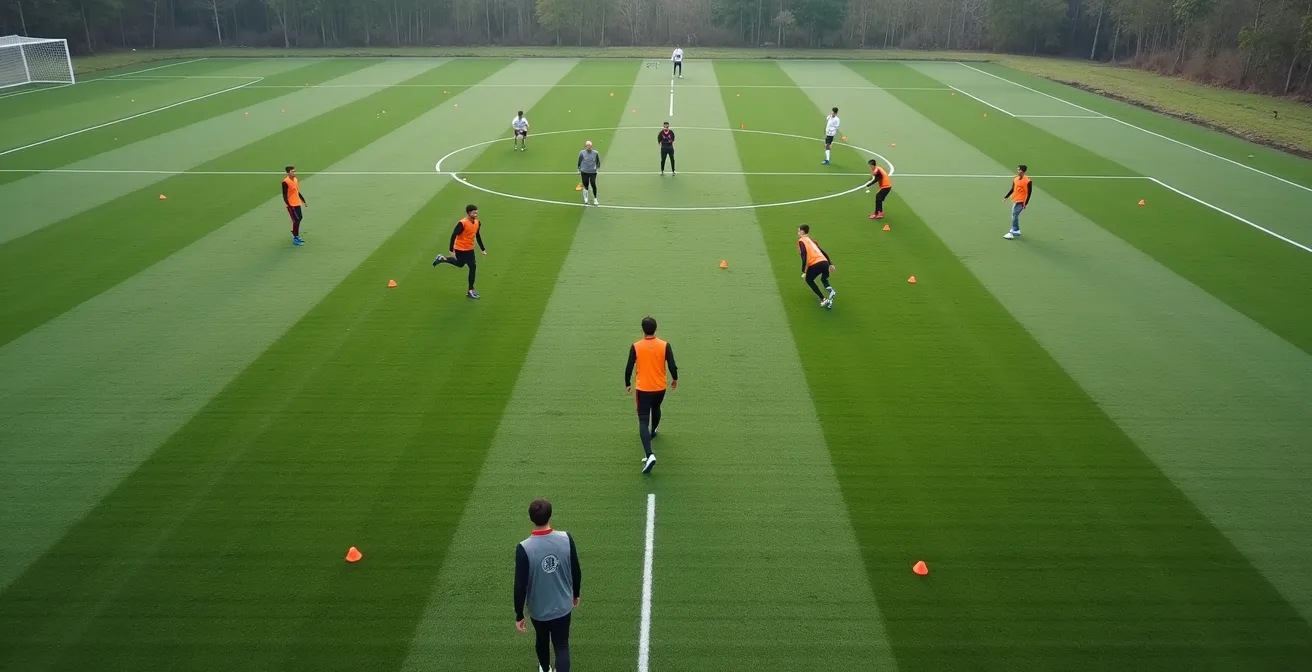
The solution is to adopt a Constraint-Led Approach (CLA) in training design. This methodology involves creating drills where constraints—such as limiting space, time, or the number of touches—naturally guide the player toward more effective solutions. Instead of telling a player what to do, the drill’s design forces them to discover it. A case study on elite teams that implemented CLA with four-dimensional pressure (spatial, temporal, physical, and consequential) showed significant improvements in decision-making and skill execution, particularly under fatigue. Training must replicate the problems of the game, not just the movements.
When to Dribble and When to Pass: The Decision Matrix
The decision to dribble or pass is one of the most frequent and critical choices a player makes. For 90 minutes, this choice is governed by a complex, dynamic risk-reward calculation. However, this calculation is heavily influenced by fatigue. As cognitive resources deplete, a player’s ability to accurately assess risk becomes impaired. A dribble that was a high-percentage play in the 10th minute might become a low-percentage gamble in the 80th.
Therefore, elite players must develop a “fatigue-adjusted” decision matrix. This is not a rigid set of rules, but an internal heuristic model that adapts based on the game state and the player’s own cognitive and physical condition. In the early stages of a match (0-30 minutes), with full physical and mental capacity, a player can take more risks. A 1v1 against a flat-footed defender is an opportunity to exploit. The probability of a successful dribble is high, and the potential reward (breaking a line, creating a chance) is significant.
As the match progresses (30-75 minutes), energy conservation becomes a key tactical weapon. The decision matrix should shift towards prioritizing possession and tempo control. Simple, high-percentage passes that move the opposition become more valuable than risky dribbles. A dribble should only be attempted if it offers a clear numerical advantage, such as a 2v1 overload. In the final, decisive phase of the match (75-90+ minutes), risk minimization is paramount. The cognitive cost of a complex dribble is extremely high, and the probability of failure increases dramatically. The default action must be to pass, unless a clear breakaway opportunity presents itself where the reward outweighs the significant risk of losing possession in a critical area.
Why Hamstring Injuries Spike During the December Fixture Congestion?
The link between fatigue and performance degradation is clear, but the connection to injury risk is even more alarming. The intense fixture congestion seen in many top leagues, particularly during periods like the traditional December schedule, creates a perfect storm for soft-tissue injuries, with hamstrings being the primary victim. This is not a coincidence; it is a direct consequence of accumulated, unrecovered fatigue.
The data from elite professional football is unequivocal. The most recent UEFA Elite Club Injury Study revealed that 24% of all injuries during the 2021/22 season were hamstring-related, making it the single most common injury type. These injuries are overwhelmingly non-contact, occurring during high-intensity actions like sprinting or shooting—movements that place the hamstring under maximal eccentric load. When a player is fatigued, their neuromuscular control is compromised. The brain’s ability to coordinate the precise firing patterns of the hamstring and quadriceps is diminished, leading to dysfunctional movement and, ultimately, tissue failure.
The problem is compounded by the high rate of re-injury. During congested periods, players are often rushed back into action without allowing for full tissue remodeling and neuromuscular retraining. A study focusing on fixture congestion found that 18% of all hamstring injuries are re-injuries, with the majority happening within two months of the player returning to play. This creates a vicious cycle where a player carries a latent weakness that is inevitably exposed when the cumulative load of multiple matches in a short period exceeds their body’s capacity to recover. Managing player load is not just about performance; it’s a critical injury prevention strategy.
Why Early Physical Development Can Mask a Lack of Technical Ability in U17s?
In youth football, particularly at the U17 level, there is a dangerous tendency to mistake physical precocity for superior talent. A player who is bigger, stronger, or faster than their peers can dominate matches through sheer physical advantage, masking underlying deficiencies in their technical skills. This creates a long-term problem known as “technical debt.” The player succeeds without having to develop efficient, refined motor patterns, and this debt comes due when they progress to higher levels where physical advantages are neutralized.
The science of biomechanics under fatigue exposes this issue clearly. When a physically dominant but technically inefficient player gets tired, their compensatory movements break down. IMU-based analysis of youth players shows an 18.7-22.3% decrease in biomechanical efficiency when fatigued. A technically sound player moves economically, conserving energy. The player reliant on strength uses gross, energy-intensive movements. Late in a game, when energy stores are low, their technical flaws become glaringly obvious.
To combat this, modern academies are implementing more sophisticated development strategies that de-emphasize physical dominance and prioritize technical proficiency. Key interventions include:
- Bio-Banding: Grouping players for certain drills based on their physical maturity (e.g., percentage of adult height) rather than their chronological age. This levels the playing field and forces players to solve problems with skill rather than size.
- Technique-Focused Constraints: Implementing rules in small-sided games, such as “no-contact” zones or a “two-touch maximum,” which neutralize physical advantages and reward players with superior awareness, movement, and first touch.
- Efficiency-Based Metrics: Shifting coaching focus from outcome-based results (scoring a goal) to process-based metrics (quality of first touch, efficiency of movement, decision-making speed).
This approach ensures that players develop a robust technical foundation that will serve them long after their temporary physical advantages have faded.
Key Takeaways
- Technical failure is cognitive: Your brain gives out before your muscles do. Training must build mental endurance.
- Context is everything: Unopposed drills create fragile skills. Pressure and variability are non-negotiable elements of effective practice.
- Efficiency is the ultimate weapon: Under fatigue, the most economical technique wins. Prioritize mastering reliable, low-cost motor patterns.
Why Futsal Techniques Improve Close Control in Tight Spaces on Grass?
For players looking to develop truly elite, fatigue-resistant close control, futsal is not just a variant of football; it’s a potent development accelerator. The unique constraints of the game—a smaller, heavier ball, a hard court surface, and severely restricted space—force players to develop a set of skills that transfer directly and effectively to the 11-a-side grass game, particularly in congested areas like the midfield or penalty box.
The core benefit of futsal lies in its ability to hyper-stimulate a player’s cognitive-motor processing. On a futsal court, players are forced to process information and make decisions at a much higher frequency. They receive the ball more often, are under more immediate pressure, and have less time and space to act. This intense environment forges a superior perception-action coupling that remains robust even when the player is fatigued. It trains the brain to see, decide, and act faster, an ability that provides a crucial advantage on the larger football pitch.
Furthermore, futsal places a heavy emphasis on using the sole of the foot for control and manipulation of the ball. This is a highly energy-efficient technique that is often underutilized in traditional football coaching. For a tired player, being able to control the ball instantly with the sole, rather than taking a larger, less precise touch with the inside of the foot, is a vital energy conservation tool. The data on skill transfer from futsal to football is compelling, highlighting its role in building more resilient and effective players.
As the following comparison shows, the developmental benefits of futsal are both significant and directly applicable to improving performance under the fatiguing conditions of a 90-minute match. It is an essential tool for any player serious about mastering control in tight spaces.
| Skill Component | Futsal Development | Transfer to Grass | Fatigue Resistance |
|---|---|---|---|
| Touch Frequency | 6x more touches/minute | Superior first touch | Maintains high quality at min 80 |
| Decision Speed | Sub-2-second windows | Faster processing | 30% better under pressure |
| Sole Control | Primary technique | Energy conservation tool | Low metabolic cost |
| 1v1 Success Rate | Higher repetition | Expanded skill repertoire | Less reliance on physicality |
To truly elevate your game, stop training technique in isolation. Begin implementing drills that systematically overload your cognitive processes under conditions of physical stress. Prioritize decision-making speed and technical efficiency over raw physical output. This is the path to becoming not just a fit player, but a truly effective 90-minute performer.