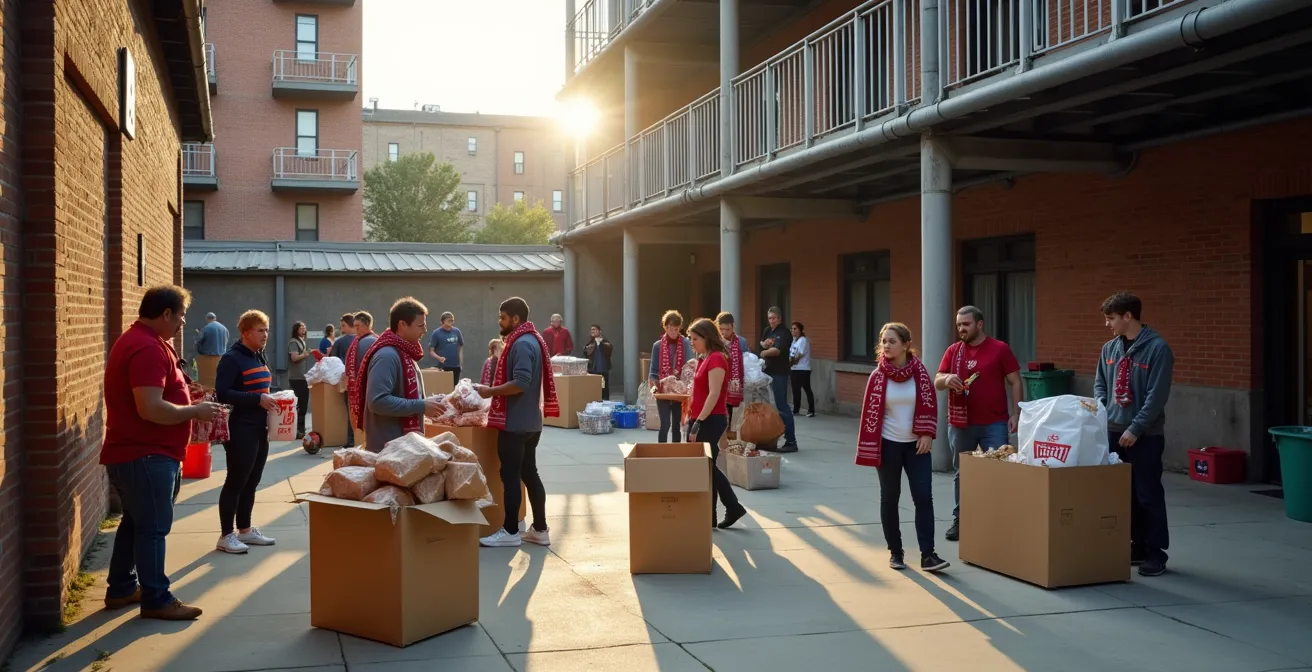
Contrary to popular belief, the true power of an ultras group lies not in aggression, but in its sophisticated organizational structure, which functions as a highly effective engine for social and community action.
- Their capacity for rapid mobilization, honed for stadium choreography, makes them effective first responders in local crises.
- Through strategic initiatives like food drives and supporter trusts, they build social capital that translates into tangible influence over club and community affairs.
Recommendation: To understand modern football fandom, look past the flares and focus on the logistics; you’ll find a blueprint for powerful grassroots organizing.
The term ‘ultra’ often conjures a singular, media-fueled image: smoke bombs, aggressive chants, and the shadow of hooliganism. This portrayal, while not entirely without basis, is a dramatic oversimplification. It misses the core of what these groups are and, more importantly, what they do when the final whistle blows. For many, the passion forged in the stadium’s “curva” doesn’t just dissipate; it’s channeled back into the streets, neighbourhoods, and communities they call home. These are often the same individuals organizing blood drives, coordinating aid during natural disasters, or collecting food for the less fortunate.
The common discourse focuses on their disruptive potential, often overlooking their constructive capacity. While discussions of fan behaviour rightly touch on issues of public order and safety, they seldom investigate the internal mechanics that make these groups so effective. The very organizational prowess required to orchestrate a stadium-wide tifo—a massive, choreographed visual display—involves logistics, communication, and a hierarchical structure that can be pivoted to serve social causes with remarkable speed and efficiency. This article moves beyond the hooligan stereotype to provide a more nuanced, sociological perspective.
Our central argument is this: the organizational genius of ultras groups is a powerful, and often underestimated, engine for grassroots community resilience. We will not just list their good deeds but analyze the strategic methods behind them. By examining how their structure enables rapid mobilization, how they differentiate from other fan subcultures, and how they leverage their social capital to influence club governance, we can build a more complete and accurate picture of their role in modern society. This is the story of how stadium passion becomes a structured force for community good.
text
This article will deconstruct the stereotype by exploring the methods, motivations, and impact of ultras’ community involvement. The following sections provide a comprehensive analysis of their social role, from crisis response to boardroom influence.
Summary: Deconstructing the Ultra: From Stadium Passion to Community Action
- Why Ultras Are Often the First Responders During Local Floods or Crises?
- How to Organize a Matchday Food Bank Collection at the Turnstiles?
- Organized Support or Designer Clothes: Differentiating Subcultures in the Stand
- The Risk of Political Extremism Infiltrating the Curva
- When to Start the Corteo to Create Maximum Impact in the City Center?
- How to Start an Official Supporters Club in Your City for a Foreign Team?
- Boycott or Boardroom: Which Strategy Changes Owner Behavior Faster?
- How Supporter Trusts Can Influence Club Board Decisions Effectively?
Why Ultras Are Often the First Responders During Local Floods or Crises?
When a local crisis hits—be it a flood, an earthquake, or a public health emergency—the first responders are not always in uniform. In many cities, they wear club colours. The reason lies in the inherent nature of the ultra group: it is a pre-existing, highly organized, and geographically concentrated network of people with a deep-seated loyalty to their community. This “organizational engine” is built for rapid, large-scale mobilization. The same skills used to coordinate thousands of fans for a march or tifo display are directly transferable to disaster relief. They have established communication channels, a clear hierarchy for decision-making, and a volunteer base that can be activated in hours, not days.
This phenomenon is particularly visible in places with a strong ultra tradition. A case study of Italian ultras reveals how their involvement extends far beyond match days. Their well-defined structures enable them to organize fundraising, deliver essential supplies, and provide manpower for clean-up operations much faster than formal NGOs or government agencies, which are often burdened by bureaucracy. Their actions are not just charity; they are an expression of community custodianship, a belief that they are the guardians of their city’s well-being just as they are of their club’s traditions.
Italian Ultras’ Community Involvement Beyond Football
Despite media portrayals focusing on violence, research shows many Italian ultras groups maintain significant community involvement through charity work and local governance participation. Their inherent organizational structures, built on loyalty that extends beyond match days, enable rapid mobilization for social causes and crisis response, demonstrating a powerful and often overlooked civic function.
This capacity turns the group into a vital social safety net. They operate on a foundation of trust and shared identity, which compels members to act collectively for the common good. As one analysis notes, their social activities are a core part of their identity. The group’s loyalty isn’t just to the team, but to the community the team represents. This transforms the ultra group from a simple fan club into a dynamic force for civic action in times of need.
How to Organize a Matchday Food Bank Collection at the Turnstiles?
Translating passion into practical aid requires more than just good intentions; it demands strategic planning. A matchday food bank collection is a classic example of how ultras leverage their unique position to facilitate community support. The stadium on matchday is a logistical chokepoint, a place where thousands of like-minded individuals gather predictably. By transforming the turnstiles into collection points, ultras tap into a captive and often generous audience. This is not a spontaneous act but a calculated operation designed for maximum efficiency and impact.
The success of such an initiative hinges on coordination and visibility. Partnering with the club is crucial for securing permissions and access, while collaborating with established local food banks ensures that the collected goods are distributed effectively to those in need. The ultra group itself provides the most valuable resource: a dedicated and motivated team of volunteers. They staff the collection points, spread the word through their networks, and create an atmosphere of collective effort. This turns a simple act of donation into a shared community event, reinforcing the group’s positive identity.
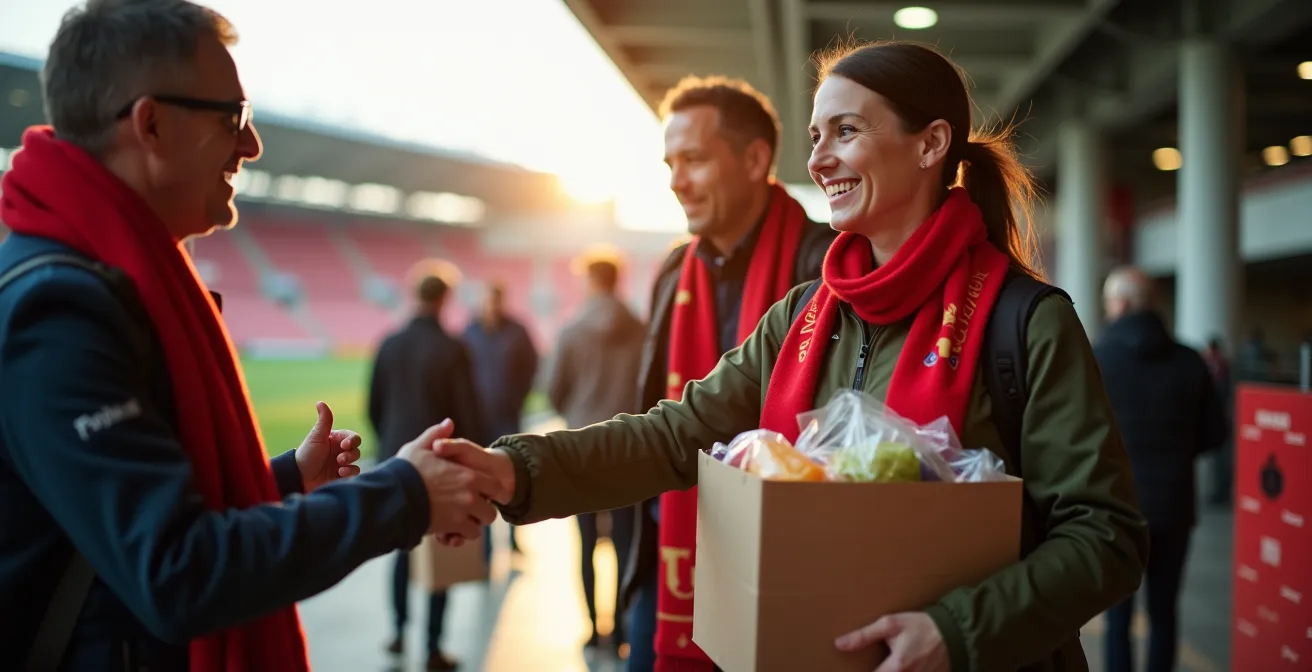
The most effective collections go beyond passive appeals. By using social media to announce goals, document the process, and transparently report on the results, groups build trust and momentum for future events. Introducing competitive elements, such as a friendly rivalry between different stands to see who can donate the most, can further gamify the process and boost participation. It’s a perfect example of strategic mobilization in a social context.
Your Action Plan: Organizing a Stadium Collection
- Coordinate with club security for necessary turnstile access permissions.
- Partner with established local food banks to handle distribution logistics efficiently.
- Create highly visible collection points at strategic chokepoints before matches.
- Mobilize ultra group members as enthusiastic and recognizable collection volunteers.
- Use social media to document impact and maintain transparency, building trust and momentum.
Ultimately, a successful food drive does more than feed people. It strengthens the bond between the club, its supporters, and the wider community, demonstrating in a very tangible way that the fans’ commitment doesn’t end at the final whistle.
Organized Support or Designer Clothes: Differentiating Subcultures in the Stand
To understand the social role of ultras, it’s crucial to distinguish them from other fan subcultures, particularly the ‘casuals’ with whom they are often confused. While both groups can be associated with intense football rivalries, their philosophies, motivations, and visual identities are fundamentally different. The stereotype of the violent football fan often conflates these distinct groups, blurring the lines and obscuring the community-oriented nature of many ultra organizations. Failure to differentiate them makes any meaningful analysis of fan culture impossible.
Ultras are defined by collective, organized support. Their primary purpose is to create an overwhelming and visually spectacular atmosphere to aid their team. As one analysis states, ultras “pride themselves on their organised approach,” coordinating massive tifos and pyrotechnic shows. Their identity is group-centric, expressed through team colours and group-specific merchandise. Their structure is hierarchical, enabling the complex choreography that defines their presence. In contrast, the casual subculture is rooted in individualism and confrontation. Its visual identity is based on expensive designer clothing, intended to display status and avoid police attention. Their organization is a loose network rather than a structured hierarchy, and their stadium presence is often more about intimidation than coordinated support.
This distinction is critical when evaluating their community role. The collective, structured nature of ultras is what enables their charity work and social initiatives. The individualistic and confrontational focus of casual culture, however, typically involves limited community engagement. The following table breaks down these core differences:
| Aspect | Ultras | Casuals |
|---|---|---|
| Primary Motivation | Collective support through choreographed displays | Individual status and confrontation |
| Visual Identity | Group-specific merchandise, team colors prominent | Designer clothing, subtle team affiliation |
| Organization | Highly structured with leadership hierarchy | Loose networks, less formal structure |
| Stadium Presence | Vocal support, tifos, pyrotechnics | Lower profile, focus on intimidation |
| Community Role | Active in charity and social causes | Limited community engagement |
Recognizing this difference is the first step toward a more accurate understanding. Lumping all passionate—or aggressive—fans together under the “hooligan” banner ignores the sociological nuances and prevents a fair assessment of the positive social functions that groups like ultras can perform. It’s a difference between a disciplined army and a scattered band of raiders.
The Risk of Political Extremism Infiltrating the Curva
The Curva is a microcosm of society, and as such, it is not immune to political currents. The highly organized and passionate nature of ultras groups can make them attractive targets for political movements seeking a dedicated and visible platform. The risk of infiltration by extremist ideologies, particularly from the far-right, is a well-documented and serious concern in many parts of the world. These movements exploit the group’s loyalty and sense of identity, attempting to co-opt its energy for their own political agenda. This can tarnish the group’s reputation and divert its focus from supporting the team to advancing a partisan cause.
However, it is a sociological error to paint all ultras with the same political brush. The reality is far more complex. In fact, ultras groups exist across the political spectrum, from nationalist or far-right factions to explicitly left-wing and anti-fascist groups, such as those associated with clubs like St. Pauli in Germany or Rayo Vallecano in Spain. The Curva is often a battleground of ideas, not a monolithic political bloc. The group’s political leaning typically reflects the history, social fabric, and dominant ideologies of its city or region.
Crucially, many ultra groups are aware of this risk and have developed their own internal countermeasures. Rather than being passive vessels for political hijacking, they actively engage in self-policing to protect their identity. These strategies are a testament to their organizational maturity.
Counter-Strategies Against Extremist Infiltration
Many ultra groups have developed self-policing mechanisms and community initiatives to counter extremist infiltration. These include promoting inclusivity, organizing educational programs, and making public declarations of anti-extremist values. By actively emphasizing responsible fandom and celebrating diversity within their ranks, these groups work to create an “immune system” against political hijacking, preserving their core identity as supporters of the club above all else.
The struggle against political extremism is therefore an internal one as much as an external threat. It highlights the group’s capacity for self-governance and its desire to define its own narrative, separate from those who would seek to exploit its passion for their own ends.
When to Start the Corteo to Create Maximum Impact in the City Center?
The “corteo,” or supporter march, is one of the most visible expressions of an ultra group’s power. It is a moving spectacle of sound, colour, and passion that temporarily reclaims urban space for the fans. But like any other ultra activity, it is rarely spontaneous. The timing of a corteo is a strategic decision calculated to achieve a specific objective, whether it’s building pre-match excitement, protesting against the club’s management, or making a wider political statement. The choice of when to start the march is fundamental to its success and demonstrates the group’s understanding of urban rhythms and media cycles.
The timing directly influences the march’s narrative and impact. A few key strategies are commonly employed:
- Evening Rush Hour (5-7 PM): This timing maximizes disruption and, consequently, visibility. It guarantees that the march will be witnessed by thousands of commuters and will almost certainly attract media coverage. It’s a high-impact choice, best used for protests where disruption is part of the message.
- 2-3 Hours Before Kickoff: This is the classic choice for a celebratory or supportive march. It allows for a slow, powerful build-up of energy that culminates with arrival at the stadium, firing up both the participants and other fans.
- Weekend Afternoons: A march at this time creates a more inclusive, festival-like atmosphere. It’s less confrontational and can attract families and casual fans, broadening the base of support.
- Night Marches: These are chosen for pure visual drama. The darkness provides the perfect canvas for the use of flares and pyrotechnics, creating iconic and intimidating imagery that defines the ultra aesthetic.
As one analysis puts it, the corteo is a spectacle designed to encapsulate “raw, unfiltered passion.” The sight of thousands of flares in the night, accompanied by deafening chants, is a powerful sensory experience. The choice of timing is about creating the right stage for this spectacle. A successful corteo is a masterclass in strategic mobilization, using the city itself as a theater and its daily rhythms as a script to ensure the fans’ message is seen and heard.
This careful planning underscores that the corteo is not simply a walk to the stadium; it is a performance, a statement, and a tactical maneuver rolled into one.
How to Start an Official Supporters Club in Your City for a Foreign Team?
The passion for a football club is no longer bound by geography. Thanks to globalization and digital media, supporter cultures have spread across the world, with fans in one continent passionately following a team from another. Creating an official supporters club for a foreign team is the ultimate expression of this long-distance loyalty. It’s a process that moves beyond a few friends watching a game in a pub to establishing a formal, recognized entity that builds a local community around a shared, distant passion. This process involves creating a unique hybrid identity that is both loyal to the foreign club and authentically rooted in the local city.
The journey to official recognition is a structured one. It begins with building a tangible, physical presence—often by designating a local pub as a “home base” for match viewings. The next step is to build a community that exists beyond the 90 minutes of a match, organizing non-matchday social events. Most parent clubs have minimum requirements for official status, typically a certain number of registered members (often 50 or more) and a formal legal constitution. This requires a level of organization and commitment that demonstrates the group’s seriousness.
The most successful foreign supporter clubs create a “glocalized” identity. They don’t just mimic the culture of the home fans; they adapt it. Research shows how supporter groups worldwide blend international traditions with their own local characteristics, creating something new and unique. This could involve writing new chants that reference their own city while cheering for the foreign team or designing unique merchandise that fuses the club’s iconography with local symbols. Establishing partnerships with local charities can also demonstrate community value, reinforcing the group’s legitimacy both to the parent club and the local authorities. Ultimately, it is about proving that the group is not just consuming a brand, but building a genuine, localized community asset.
The Globalization and Adaptation of Ultras Culture
Research from the University of Brighton highlights the globalization of fan culture, where groups create “glocalized” identities. For instance, Japanese ultras incorporated South American and European supporter styles learned via social media but blended them with distinctive local characteristics. This process shows how foreign influences are not merely copied but are adapted to create a hybrid culture that is both globally connected and locally authentic.
Boycott or Boardroom: Which Strategy Changes Owner Behavior Faster?
When fans feel that the club’s owners are betraying its heritage, making poor decisions, or treating supporters with contempt, they face a critical strategic choice: fight from the outside or influence from the inside. The two primary strategies, the boycott and the boardroom approach, offer a classic trade-off between speed and sustainability. The decision of which path to take depends on the specific goal, the level of fan unity, and the desired nature of the change. There is no single correct answer; both are tools that can be effective in the right circumstances.
The boycott approach is a strategy of direct, external pressure. By refusing to attend matches or buy merchandise, fans hit the owners where it hurts: their revenue. This approach can be very fast and effective, especially if it gains media support and is focused on a single, clear demand (e.g., reversing a ticket price increase). It creates immediate leverage for negotiation. However, its main risk is that it can lose momentum. Sustaining a boycott requires immense unity and sacrifice from the fan base, and if it fizzles out, it can leave the supporters in a weaker position than before.
The boardroom approach is a long-term strategy of internal influence. This involves fans organizing into a formal supporter trust, acquiring shares in the club, and seeking a legitimate seat at the decision-making table. This method is slow and requires significant expertise in governance, finance, and law. Its goal is not to reverse a single bad decision but to achieve lasting structural reforms that embed fan interests into the club’s DNA. The main risk here is co-optation, where the fan representative is given a token presence without any real power. The following table contrasts the two approaches:
| Strategy Aspect | Boycott Approach | Boardroom Approach |
|---|---|---|
| Speed of Impact | Fast – immediate financial pressure | Slow – requires long-term engagement |
| Type of Change | Short-term reversals of decisions | Lasting structural reforms |
| Success Factors | Media support, clear single demand | Legitimacy, data, governance expertise |
| Main Risk | Can fizzle out without sustained support | Co-optation, token presence without power |
Often, the most effective campaigns use a hybrid model: the threat of a boycott is used to create the leverage needed to gain a seat in the boardroom. It’s a strategic dance between external pressure and internal diplomacy.
Key Takeaways
- Ultra groups are complex social organizations whose logistical skills, honed for stadium support, are highly effective for community action and crisis response.
- Distinguishing ultras from other fan subcultures like ‘casuals’ is essential; ultras are defined by collective organization, whereas casuals are focused on individual status.
- Fan influence is a strategic choice between short-term pressure (boycotts) and long-term structural change (boardroom engagement through supporter trusts).
How Supporter Trusts Can Influence Club Board Decisions Effectively?
The ultimate evolution of fan power is the supporter trust. This is the mechanism by which disorganized passion is transformed into formal, institutionalized influence. A supporter trust is a democratic, not-for-profit organization of fans committed to strengthening the influence of the community over the running of the club. Effective influence, however, is not simply about having a voice; it’s about being a voice that the board has to listen to. This is achieved by building legitimacy and demonstrating value beyond just being a “customer.” This is where the power of social capital comes into play.

An effective trust builds its influence long before it ever enters the boardroom. It does this by becoming an undeniable asset to the community. As case studies show, by spearheading charity events, food drives, and other social causes, ultras and supporter groups bolster their image as vital community members. This community work is not just altruism; it is a strategic accumulation of social capital. When the trust then approaches the board, it does so not merely as a group of disgruntled fans, but as a respected community stakeholder whose support is valuable and whose opposition carries weight.
Inside the boardroom, influence is maintained through professionalism and expertise. An effective trust doesn’t just bring passion; it brings data, well-researched proposals, and a clear understanding of governance and finance. It presents itself as a competent partner, not an adversary. Its representatives see themselves, as one supporter put it, as “the custodians of their club’s heritage,” there to ensure the long-term health of the institution, not just to complain about short-term results. Their role is to provide a counterbalance to purely commercial interests and ensure the club remains connected to its community roots.
At the core of Ultra culture is an unrelenting passion for their club. This passion is not limited to watching games; it’s a lifestyle. Ultras see themselves as the custodians of their club’s heritage, maintaining traditions and ensuring the spirit of the team is never lost.
– Original Football, Football Ultra’s: The Fans Igniting the Atmosphere
By combining community legitimacy with professional competence, a supporter trust can transform the fan-club relationship from a one-way transaction into a collaborative partnership, ensuring the soul of the club is protected for future generations.
By understanding these dynamics, we can move beyond the caricature and appreciate the ultras movement as a complex and influential social phenomenon, capable of both creating spectacle and fostering real community solidarity. The next step is to recognize and engage with these groups not as problems to be managed, but as potential partners in building stronger communities.