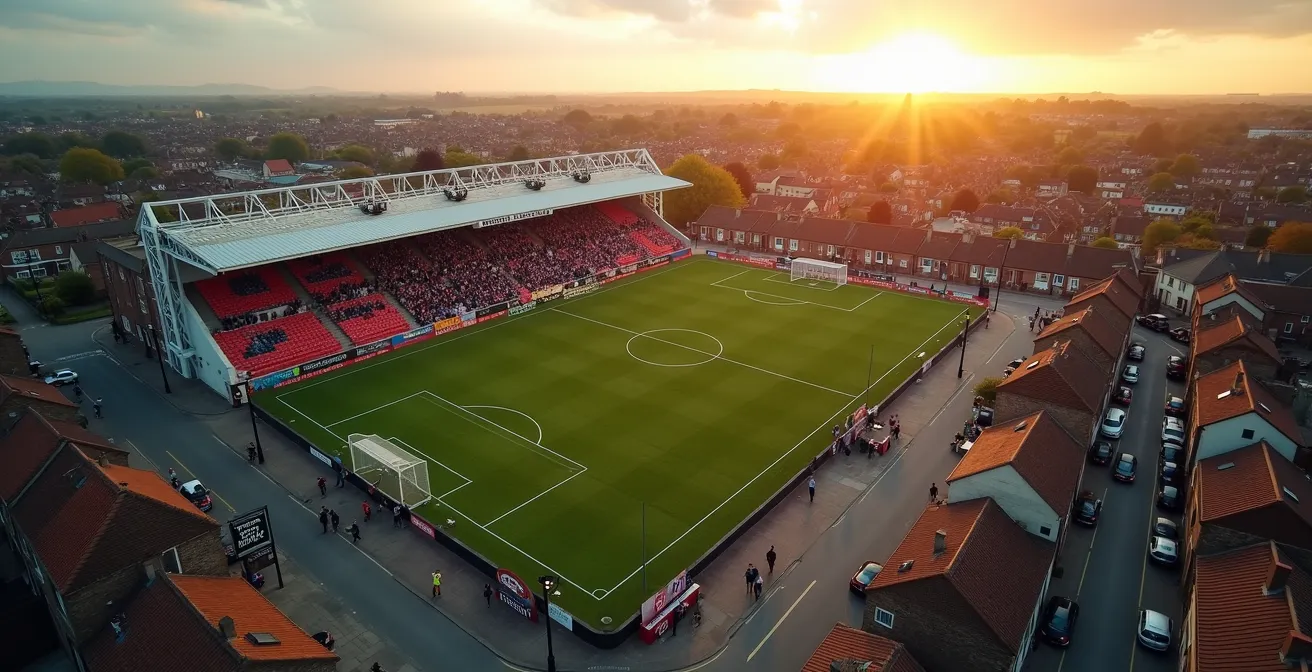
The conventional wisdom that parachute payments save relegated clubs is a dangerous myth; they often create a cycle of dependency that threatens a club’s very existence.
- True survival hinges on replacing volatile broadcast income with sustainable, community-driven revenue streams.
- Empowering supporter trusts and protecting core assets (like the stadium and brand) are non-negotiable for long-term resilience.
Recommendation: View relegation not as a financial crisis to be managed, but as a strategic opportunity to rebuild a stronger, more authentic club identity from the ground up.
The final whistle blows on a devastating season. Relegation isn’t just a sporting failure; for a historic club, it’s an existential shock that sends tremors through its finances, its squad, and its multi-generational fanbase. The immediate conversation often turns to a supposed lifeline: parachute payments. This injection of cash from the wealthier top flight is framed as a tool to soften the landing and fuel a quick return. But this perspective is dangerously shortsighted and misses the deeper truth of survival.
Relying on these payments is akin to treating a structural wound with a temporary painkiller. It encourages a desperate gamble on immediate promotion, often leading to unsustainable wage bills and a deeper crisis when that gamble fails. The real challenge—and the greatest opportunity—of relegation is not to manage the fall, but to use the crisis as a mandate for a fundamental reset. It’s a moment for financial sobriety, forcing a club to rediscover its core purpose beyond television money.
This guide reframes the narrative. We will move past the platitudes of “cutting costs” and “selling players” to explore a resilient, community-first model for survival. The true path forward lies in severing the dependency on external bailouts and rebuilding the club as a sustainable institution, where the community is not just a consumer but the foundational asset. This is about transforming a financial catastrophe into a cultural rebirth, ensuring the club doesn’t just survive but emerges with a stronger, more authentic identity.
This article provides a strategic framework for navigating the treacherous waters of relegation. We’ll dissect the financial traps, outline methods for retaining the loyalty of your core fanbase, and explore the governance models that can protect a club’s soul for generations to come.
Summary: Beyond the Bailout: How Historic Clubs Can Survive Relegation and Reclaim Their Identity
- Why Relying on Parachute Payments Can Doom a Club if Promotion Fails?
- How to Keep Season Ticket Holders Loyal When the Team Drops a Division?
- Fan Ownership or Billionaire Bailout: Which Saves the Soul of the Club?
- The Asset-Stripping Danger That Threatens the Existence of Historic Clubs
- How to Overhaul a Squad for a Physical League in Less Than 6 Weeks?
- Franchise Model or Promotion/Relegation: Which Generates More Viewer Excitement?
- Why Clubs Target Tourists Instead of Multi-Generational Local Fans?
- How Supporter Trusts Can Influence Club Board Decisions Effectively?
Why Relying on Parachute Payments Can Doom a Club if Promotion Fails?
Parachute payments are designed to prevent a relegated club from financial implosion. In theory, they buffer the catastrophic loss of Premier League broadcast revenue. However, in practice, they create a distorted and addictive economic reality. These payments—starting at 55% of a top-flight share in year one and tapering to 20% by year three—create a “boom or bust” incentive. Clubs are pressured to maintain a Premier League-level wage bill in a desperate bid for immediate promotion, a gamble that often fails and leads to a far more severe financial cliff edge when the payments stop.
This financial doping widens the gap within the Championship itself, creating a two-tiered system. The financial power given to recently relegated clubs makes it disproportionately harder for established Championship teams to compete. As a result, the league’s competitive balance is broken, fostering an environment where a handful of clubs are caught in a “yo-yo” cycle between divisions. This system benefits the few at the expense of the many, undermining the health of the entire football pyramid.
The core problem is that these payments encourage clubs to delay the necessary and painful process of achieving financial sobriety. Instead of immediately adjusting their operating model to the new reality of lower-league football, they are tempted to chase a dream funded by dwindling cash reserves. A recent financial analysis reveals that over 92% of distributable revenues went to just 20 Premier League teams and 5 clubs receiving parachute payments in the 2022/23 season, highlighting the immense concentration of wealth that destabilizes the ecosystem.
How to Keep Season Ticket Holders Loyal When the Team Drops a Division?
When a club is relegated, its most resilient asset isn’t a star player or a parachute payment; it’s the unwavering loyalty of its multi-generational fanbase. Losing a division can test this bond, but it also presents a unique opportunity to deepen it. The key is to shift the club’s mindset from treating fans as customers to honoring them as the institution’s true custodians. This requires more than just discounted tickets; it demands genuine, transparent, and personalized engagement.
In the face of on-pitch failure, the club must over-deliver on off-pitch connection. This is the moment for radical transparency. Club leadership should communicate directly with supporters, explaining the recovery plan, acknowledging the pain of relegation, and framing the fanbase as a core partner in the rebuild. Symbolic gestures, such as players and managers attending supporter events or sending personalized messages to long-standing season ticket holders, can reinforce this sense of shared purpose and mutual respect. The goal is to make fans feel seen, heard, and essential to the club’s survival and future identity.

As the image poignantly shows, the connection to a club is often an emotional inheritance passed down through generations. To protect this, clubs must offer value beyond 90 minutes of football. This includes creating tiered loyalty programs that reward longevity, offering exclusive access to “meet the rebuild” events, and even giving supporters a voice in minor club decisions, such as kit designs or stadium anthems. The focus must be on creating a sense of belonging and shared ownership, transforming the crisis of relegation into a powerful reaffirmation of community.
Action Plan: A Checklist for Fan Retention in a Crisis
- Personalize Communication: Use CRM data to send messages from players or the manager acknowledging individual fan loyalty and history.
- Tier Your Loyalty: Create programs where the longest-standing supporters receive the most significant benefits, like priority access or exclusive content.
- Offer Non-Monetary Value: Implement voting rights on minor club decisions (e.g., third kit choice) or hold exclusive town halls about the rebuild.
- Adapt Content Dynamically: Ensure club messaging and offers adapt based on a fan’s history, attendance patterns, and preferences.
- Identify At-Risk Supporters: Use attendance data to trigger real-time engagement for season ticket holders who may be drifting away, offering them unique incentives to reconnect.
Fan Ownership or Billionaire Bailout: Which Saves the Soul of the Club?
In the wake of relegation, a club often finds itself at a crossroads of identity, facing two starkly different paths to financial stability: the fan ownership model or the billionaire bailout. A wealthy benefactor can inject huge sums of cash, promising a rapid return to glory and signing star players. However, this model places the club’s soul—its name, colors, location, and very existence—in the hands of a single individual whose motivations can be unpredictable. The club becomes a private asset, and its connection to the community can become secondary to the owner’s personal or commercial ambitions.
Conversely, fan ownership models, where a supporters’ trust holds a majority or significant stake, embed the club directly within its community. Democratic control ensures that key identity-related decisions are protected by those who care most. While this model typically has more limited financial capacity, it builds deep, authentic roots and guarantees that the club’s primary purpose remains serving its supporters and preserving its legacy. As the Arsenal Supporters’ Trust argued in its written evidence to the UK’s Fan-led Review:
The best ownership model for Arsenal, and all clubs, will always include supporters being represented and involved in the ownership structure as shareholders.
– Arsenal Supporters’ Trust, Written evidence to Fan-led Review
The most resilient structures often lie in hybrid models. A “golden share” held by a supporters’ trust can give fans veto power over fundamental identity changes, even if a private investor holds a majority stake. This approach seeks to balance the need for professional investment with the non-negotiable protection of the club’s heritage, creating a framework for structural resilience against future threats.
| Ownership Model | Identity Protection | Financial Capacity | Community Connection |
|---|---|---|---|
| Fan Trust Majority | Democratic control over name, colors, location | Limited to fundraising and local support | Deep roots, one member one vote |
| Hybrid Model (Golden Share) | Veto power on identity changes | Private investment with safeguards | Balance of business and tradition |
| Billionaire Ownership | Dependent on owner’s commitment | Significant investment potential | Risk of disconnect from community |
The Asset-Stripping Danger That Threatens the Existence of Historic Clubs
The most immediate consequence of relegation is a catastrophic revenue shock. This is not a minor dip; an analysis of relegation’s financial impact shows a minimum loss of £100 million in broadcasting revenue. This sudden financial vacuum makes a club intensely vulnerable, not just to sporting decline, but to predatory ownership and asset-stripping. Unscrupulous owners can see the crisis as an opportunity to sell off the club’s most valuable assets for personal gain, leaving behind a hollowed-out institution with no foundation for a rebuild.
The primary targets for asset-stripping are the stadium and the training ground. If the club does not own its ground, or if the ownership structure is complex, a predatory owner can sell the land to property developers, severing the club’s physical tie to its community and its history. Other assets at risk include future transfer fee clauses, intellectual property like the club badge, and even its league membership. This is the ultimate danger of relegation: not just dropping a division, but complete obliteration through financial mismanagement.
The story of Portsmouth FC serves as a stark warning. After winning the FA Cup in 2008 and playing in the Premier League, a series of disastrous ownerships led to financial collapse. By 2013, just four years after relegation, the club was in League Two and on the brink of extinction. It was only saved when the Pompey Supporters’ Trust took control, demonstrating the critical role an organized fanbase can play as the last line of defense. They stabilized the club and eventually secured promotion before selling to a more stable ownership group in 2017. This journey highlights both the extreme peril of financial crisis and the immense potential of community as an asset in safeguarding a club’s future.
How to Overhaul a Squad for a Physical League in Less Than 6 Weeks?
The financial reset of relegation is matched by an urgent sporting one. A squad built for the technical, possession-based style of the top flight is often ill-equipped for the grueling, physical reality of a 46-game Championship season. The transfer window becomes a frantic, six-week race against time to rebuild a team with a completely different profile. High-wage, under-motivated stars must be moved on, and in their place, the club must recruit players with the right mentality: hungry, resilient, and physically robust.
This process is as much about character as it is about talent. The recruitment department must prioritize players who understand the division and possess the mental fortitude for a promotion battle. This means looking for leaders, athletes with high work rates, and individuals who are motivated by the collective challenge rather than personal glory. The manager and director of football must work in lockstep, identifying targets who fit a clear, pragmatic system of play suited to the league. Speed, decisiveness, and a unified vision are non-negotiable.

The pre-season period is brutal and transformative. It’s where the physical and psychological foundations for the campaign are laid. The intensity must be dialed up to prepare the squad for the relentless Saturday-Tuesday rhythm of the lower leagues. However, this sporting challenge is again skewed by parachute payments. A study on Championship competitive balance shows a promotion success rate of 18.7% for clubs receiving parachute payments, compared to just 10.0% for those without. This advantage allows relegated clubs to retain more expensive talent, further distorting the competitive landscape and making a sustainable, organic rebuild even more challenging for other clubs.
Franchise Model or Promotion/Relegation: Which Generates More Viewer Excitement?
The increasing financial stratification in football forces a debate about its very structure. Some argue for a closed, franchise-based model, similar to major American sports. Proponents claim this provides financial stability, eliminates the “disaster” of relegation, and allows owners to invest with long-term security. In this system, every game has stakes, but the ultimate jeopardy—loss of status—is removed. The excitement is contained within a single season’s championship race, with no broader narrative of ascent or decline.
However, the promotion and relegation system is the lifeblood of English football’s drama. It is the engine of hope and despair that connects the entire pyramid, giving every fan from the Premier League down to non-league the dream that their club can rise and the fear that it can fall. This jeopardy is what makes a late-season relegation battle as compelling as a title fight. It creates narratives that span generations and ties a club’s identity to a journey, not a static position. The excitement isn’t just about winning; it’s about surviving, striving, and the ever-present possibility of transformation.
Yet, the system is under threat. The “yo-yo club” phenomenon, fueled by the disparity in revenue and parachute payments, is eroding the pyramid’s integrity. The fact that all three promoted clubs were immediately relegated in both the 2023/24 and 2024/25 seasons shows the widening chasm between divisions. This trend damages the credibility of promotion and turns the top flight into an increasingly closed shop. While the franchise model offers stability, it sacrifices the very soul and unpredictable drama that makes the pyramid structure so captivating. The challenge is not to abolish the system, but to reform its finances to restore genuine competition and hope.
Why Clubs Target Tourists Instead of Multi-Generational Local Fans?
In the globalized world of modern football, top clubs often fall into the trap of prioritizing transient, high-spending “football tourists” over their loyal, local fanbase. The logic seems simple: a tourist might spend hundreds on a single matchday experience, buying a full-price ticket, a new shirt, and stadium hospitality. In contrast, a long-standing local season ticket holder represents a smaller, albeit more consistent, revenue stream. This short-term, high-margin thinking leads clubs to allocate tickets to international agencies and build “experiences” tailored to visitors, often at the expense of the authentic atmosphere generated by the core support.
This strategy is a profound mistake, especially for a club facing adversity. The tourist disappears the moment the team is no longer successful or fashionable. They have no emotional investment in the club’s identity or long-term survival. The local, multi-generational fan, however, is the club’s bedrock. Their loyalty is not conditional on league position. They are the ones who will show up on a wet Tuesday night in a lower division, and their predictable, recurring revenue is the foundation of any sustainable financial model. Chasing tourist money is like building a house on sand.
The case of Reading FC provides a powerful lesson in this regard. Following their relegation from the Premier League, rather than alienating their base, the club doubled down on community engagement. They focused on making football accessible and reinforcing their local identity. The result was counter-intuitive but profound: the number of season ticket holders actually increased in the seasons following their drop. This proves that in a crisis, the most valuable strategy is not to chase new, fleeting customers, but to reinvest in the loyalty of the people who have always been there. This is the essence of making the community a balance sheet asset, not an expense.
Key Takeaways
- Parachute payments are not a solution but a dependency trap that distorts competition and delays necessary financial restructuring.
- A club’s most valuable asset in a crisis is its loyal fanbase; survival depends on deepening this relationship, not chasing transient revenue.
- Sustainable survival requires building structural resilience through community-centric ownership models and protecting core assets from being stripped.
How Supporter Trusts Can Influence Club Board Decisions Effectively?
For fans who want to move from passive support to active guardianship, the supporters’ trust is the most powerful vehicle. It is a democratic, not-for-profit organization committed to strengthening the influence of supporters over the running of their club. In the UK, the movement is well-established, with over 110 trusts currently holding equity in their clubs. But influence is not solely dependent on owning a majority stake. Even a minority shareholding can provide a crucial foothold for accountability and a platform for change.
The example of the Manchester United Supporters Trust (MUST) is instructive. Despite the club being under billionaire ownership, MUST has grown to over 200,000 members, making it the largest supporters’ trust in the world. Through organized activism, public campaigning, and strategic use of its platform, it exerts significant influence on club policy and holds the ownership to account on behalf of the fans. This demonstrates that a large, unified, and articulate supporter base can become a powerful stakeholder that no board can afford to ignore completely.
Effective influence comes from a combination of formal and informal mechanisms. Formal power can be secured through direct board representation, which is often negotiated as part of an investment or a “golden share” agreement. This gives supporters a literal seat at the table. However, even without this, trusts can utilize structured dialogue—regular, formalized meetings with club executives—to ensure their voice is heard on key issues like ticket pricing, stadium development, and community initiatives. By building coalitions with local politicians and businesses, trusts can further amplify their voice, ensuring the club remains anchored to its community.
| Influence Method | Requirements | Impact Level |
|---|---|---|
| Board Representation | Negotiated agreement or shareholding threshold | Direct involvement in decisions |
| Minority Shareholder Activism | Even 1% stake allows AGM resolutions | Public accountability platform |
| Structured Dialogue | Formal agreement with club | Regular consultation on key issues |
| Coalition Building | Alliances with local stakeholders | Amplified community voice |
Ultimately, navigating relegation is the truest test of a club’s identity. By embracing financial sobriety, empowering the community as a core asset, and building a resilient governance structure, a club can transform the darkest of moments into a catalyst for a brighter, more sustainable future.